
Join Our JEE Preparation Group
Prep with like-minded aspirants; Get access to free daily tests and study material.
Sign in
Please select an account to continue using cracku.in
↓ →
Join Our JEE Preparation Group
Prep with like-minded aspirants; Get access to free daily tests and study material.
A thermodynamic system is taken from an original state D to an intermediate state E by the linear process shown in the figure. Its volume is then reduced to the original volume from E to F by an isobaric process. The total work done by the gas from D to E to F will be
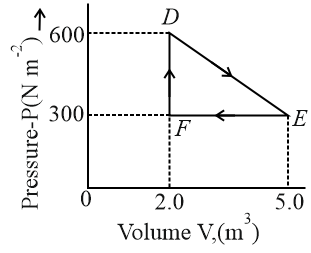
We need to find the total work done by the gas during the thermodynamic process from $$D \rightarrow E \rightarrow F$$.
The total work done ($$W_{\text{total}}$$) is the sum of the work done in each individual stage of the path:
$$W_{\text{total}} = W_{DE} + W_{EF}$$
The work done during any process on a Pressure-Volume ($$P-V$$) diagram is equal to the area under the $$P-V$$ curve projected onto the Volume axis.
Calculating $$W_{DE}$$:
$$W_{DE} = \frac{1}{2} \times (600 + 300) \times (5.0 - 2.0)$$
$$W_{DE} = \frac{1}{2} \times 900 \times 3.0 = 450 \times 3.0 = +1350\text{ J}$$
Note: The work is positive because the gas is expanding from $$2.0\text{ m}^3$$ to $$5.0\text{ m}^3$$.
The process from $$E \rightarrow F$$ is an isobaric compression path carried out at a constant pressure.
Calculating $$W_{EF}$$:
$$W_{EF} = P \times \Delta V = P \times (V_F - V_E)$$
$$W_{EF} = 300 \times (2.0 - 5.0) = 300 \times (-3.0) = -900\text{ J}$$
Note: The work is negative because the gas is undergoing compression.
Combining the work computed from both segments gives:
$$W_{\text{total}} = W_{DE} + W_{EF}$$
$$W_{\text{total}} = 1350\text{ J} + (-900\text{ J}) = 450\text{ J}$$
Therefore, the total work done by the gas from D to E to F is 450 J, which corresponds to Option B.
Was this solution helpful?
Click on the Email ☝️ to Watch the Video Solution
Create a FREE account and get:
_1.webp)

Educational materials for JEE preparation

Ask our AI anything

AI can make mistakes. Please verify important information.
AI can make mistakes. Please verify important information.
