
Join Our JEE Preparation Group
Prep with like-minded aspirants; Get access to free daily tests and study material.
Sign in
Please select an account to continue using cracku.in
↓ →
Join Our JEE Preparation Group
Prep with like-minded aspirants; Get access to free daily tests and study material.
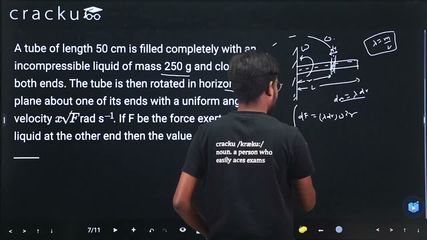
A tube of length 50 cm is filled completely with an incompressible liquid of mass 250 g and closed at both ends. The tube is then rotated in horizontal plane about one of its ends with a uniform angular velocity $$x\sqrt{F}$$ rad s$$^{-1}$$. If F be the force exerted by the liquid at the other end then the value of x will be _____
Correct Answer: 4
We have a tube of length $$L = 50$$ cm $$= 0.5$$ m filled with an incompressible liquid of mass $$m = 250$$ g $$= 0.25$$ kg, rotating in a horizontal plane about one end with angular velocity $$\omega$$. We need to find the force exerted by the liquid at the far end.
Consider a small element of the liquid at distance $$r$$ from the axis of rotation, of length $$dr$$. The linear mass density is $$\lambda = \frac{m}{L} = \frac{0.25}{0.5} = 0.5$$ kg/m. The mass of this element is $$dm = \lambda \, dr$$. This element needs a centripetal force $$dF = dm \cdot \omega^2 r = \lambda \omega^2 r \, dr$$.
The force at the far end (at $$r = L$$) is the net force required to keep all the liquid beyond... but actually, the force at the closed end (the far end at distance $$L$$) must provide the centripetal force for the entire liquid column. We integrate the centripetal force contribution from $$r = 0$$ to $$r = L$$: $$F = \int_0^L \lambda \omega^2 r \, dr = \lambda \omega^2 \frac{L^2}{2} = \frac{m}{L} \cdot \omega^2 \cdot \frac{L^2}{2} = \frac{m \omega^2 L}{2}$$
Now we substitute $$\omega = x\sqrt{F}$$: $$F = \frac{m (x\sqrt{F})^2 L}{2} = \frac{m x^2 F L}{2}$$
Dividing both sides by $$F$$ (assuming $$F \neq 0$$): $$1 = \frac{m x^2 L}{2}$$
Solving for $$x^2$$: $$x^2 = \frac{2}{mL} = \frac{2}{0.25 \times 0.5} = \frac{2}{0.125} = 16$$
Hence $$x = 4$$.
Hence, the correct answer is 4.
Was this solution helpful?
Click on the Email ☝️ to Watch the Video Solution
Create a FREE account and get:
_1.webp)

Educational materials for JEE preparation

Ask our AI anything

AI can make mistakes. Please verify important information.
AI can make mistakes. Please verify important information.
