
Join Our JEE Preparation Group
Prep with like-minded aspirants; Get access to free daily tests and study material.
Sign in
Please select an account to continue using cracku.in
↓ →
Join Our JEE Preparation Group
Prep with like-minded aspirants; Get access to free daily tests and study material.
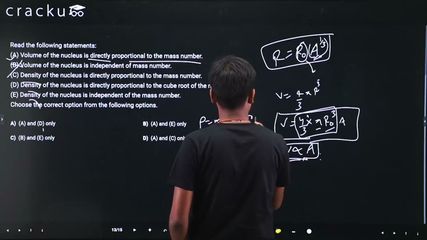
Read the following statements:
(A) Volume of the nucleus is directly proportional to the mass number.
(B) Volume of the nucleus is independent of mass number.
(C) Density of the nucleus is directly proportional to the mass number.
(D) Density of the nucleus is directly proportional to the cube root of the mass number.
(E) Density of the nucleus is independent of the mass number.
Choose the correct option from the following options.
We know that the radius of a nucleus is given by $$R = R_0 A^{1/3}$$, where $$R_0 \approx 1.2 \times 10^{-15}$$ m is a constant and $$A$$ is the mass number. The volume of the nucleus is then $$V = \frac{4}{3}\pi R^3 = \frac{4}{3}\pi R_0^3 A$$. Since $$\frac{4}{3}\pi R_0^3$$ is a constant, we see that the volume is directly proportional to the mass number $$A$$. Hence, statement (A) is correct and statement (B) is incorrect.
Now, the mass of the nucleus is approximately $$M = A \cdot m_u$$, where $$m_u$$ is the atomic mass unit. The density of the nucleus is $$\rho = \frac{M}{V} = \frac{A \cdot m_u}{\frac{4}{3}\pi R_0^3 A} = \frac{m_u}{\frac{4}{3}\pi R_0^3}$$. We see that the mass number $$A$$ cancels out completely, so the nuclear density is a constant, independent of the mass number. Hence, statement (E) is correct, while statements (C) and (D) are incorrect.
Hence, the correct answer is Option B.
Was this solution helpful?
Click on the Email ☝️ to Watch the Video Solution
Create a FREE account and get:
_1.webp)

Educational materials for JEE preparation

Ask our AI anything

AI can make mistakes. Please verify important information.
AI can make mistakes. Please verify important information.
