
Join Our JEE Preparation Group
Prep with like-minded aspirants; Get access to free daily tests and study material.
Sign in
Please select an account to continue using cracku.in
↓ →
Join Our JEE Preparation Group
Prep with like-minded aspirants; Get access to free daily tests and study material.
Given,
$$S=\sum_{r=1}^{20}(r^2+1)r!$$
Now,
$$r^2+1=(r+1)^2-2r$$
Hence,
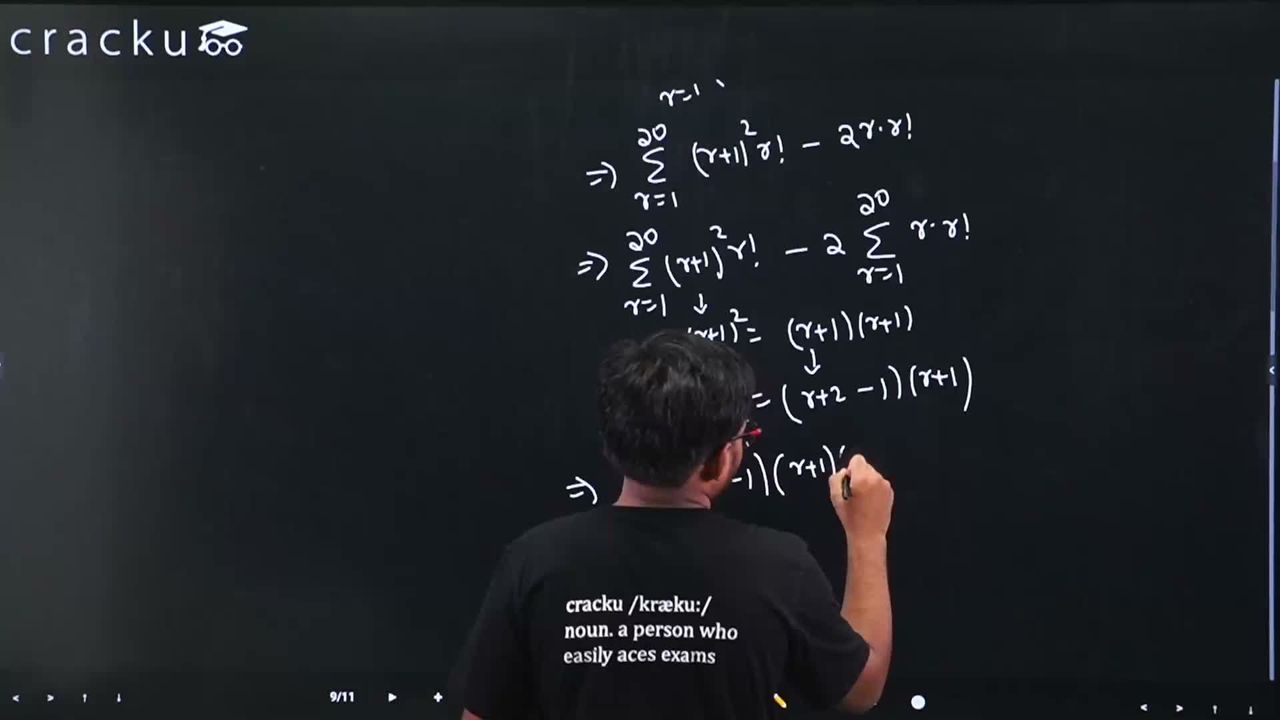
$$S=\sum_{r=1}^{20}\left((r+1)^2-2r\right)r!$$
$$=\sum_{r=1}^{20}(r+1)^2r!-2\sum_{r=1}^{20}rr!$$
Using
$$ (r+1)^2r!=(r+1)(r+1)! $$
and
$$ rr!=(r+1)!-r! $$
we get
$$S=\sum_{r=1}^{20}(r+1)(r+1)!-2\sum_{r=1}^{20}\left((r+1)!-r!\right)$$
Now,
$$ (r+1)(r+1)!=(r+2-1)(r+1)! $$
$$=(r+2)!-(r+1)!$$
Therefore,
$$S=\sum_{r=1}^{20}\left((r+2)!-(r+1)!\right)-2\sum_{r=1}^{20}\left((r+1)!-r!\right)$$
Both sums are telescopic.
Hence,
$$S=(22!-2!)-2(21!-1!)$$
$$=22!-2-2\cdot21!+2$$
$$=22!-2\cdot21!$$
$$=21!(22-2)$$
$$=22!\ -\ 2.21!$$
Hence,
$$\boxed{22!\ -\ 2.21!}$$.
Was this solution helpful?
Click on the Email ☝️ to Watch the Video Solution
Create a FREE account and get:
_1.webp)

Educational materials for JEE preparation

Ask our AI anything

AI can make mistakes. Please verify important information.
AI can make mistakes. Please verify important information.
