
Join Our JEE Preparation Group
Prep with like-minded aspirants; Get access to free daily tests and study material.
Sign in
Please select an account to continue using cracku.in
↓ →
Join Our JEE Preparation Group
Prep with like-minded aspirants; Get access to free daily tests and study material.
The number of elements in the set $$S = \left\{x \in \mathbb{R} : 2\cos\left(\frac{x^2+x}{6}\right) = 4^x + 4^{-x}\right\}$$ is
We need to find the number of elements in $$S = \left\{x \in \mathbb{R} : 2\cos\left(\dfrac{x^2+x}{6}\right) = 4^x + 4^{-x}\right\}$$.
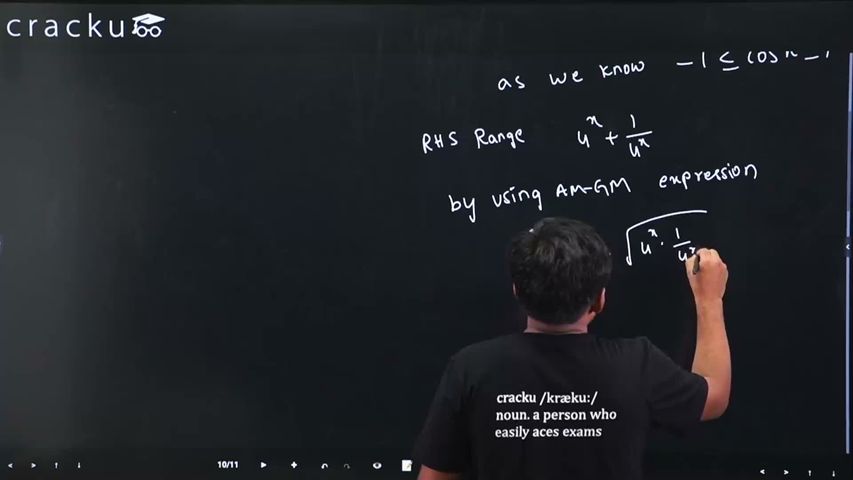
We observe that the right-hand side can be written as $$4^x + 4^{-x} = 2^{2x} + 2^{-2x}$$. By the AM-GM inequality, $$2^{2x} + 2^{-2x} \geq 2\sqrt{2^{2x} \cdot 2^{-2x}} = 2$$. Equality holds if and only if $$2^{2x} = 2^{-2x}$$, i.e., $$x = 0$$.
Now for the left-hand side, we know that $$\cos\theta \leq 1$$ for all real $$\theta$$, so $$2\cos\left(\dfrac{x^2+x}{6}\right) \leq 2$$.
Since the LHS $$\leq 2$$ and the RHS $$\geq 2$$, equality is possible only when both sides equal 2 simultaneously. The RHS equals 2 only when $$x = 0$$. At $$x = 0$$, the LHS becomes $$2\cos\left(\dfrac{0+0}{6}\right) = 2\cos(0) = 2$$.
Since both sides equal 2 at $$x = 0$$ and no other value of $$x$$ can satisfy the equation, there is exactly 1 element in the set $$S$$.
Hence, the correct answer is Option A: $$1$$.
Was this solution helpful?
Click on the Email ☝️ to Watch the Video Solution
Create a FREE account and get:
_1.webp)

Educational materials for JEE preparation

Ask our AI anything

AI can make mistakes. Please verify important information.
AI can make mistakes. Please verify important information.
