
Join Our JEE Preparation Group
Prep with like-minded aspirants; Get access to free daily tests and study material.
Sign in
Please select an account to continue using cracku.in
↓ →
Join Our JEE Preparation Group
Prep with like-minded aspirants; Get access to free daily tests and study material.
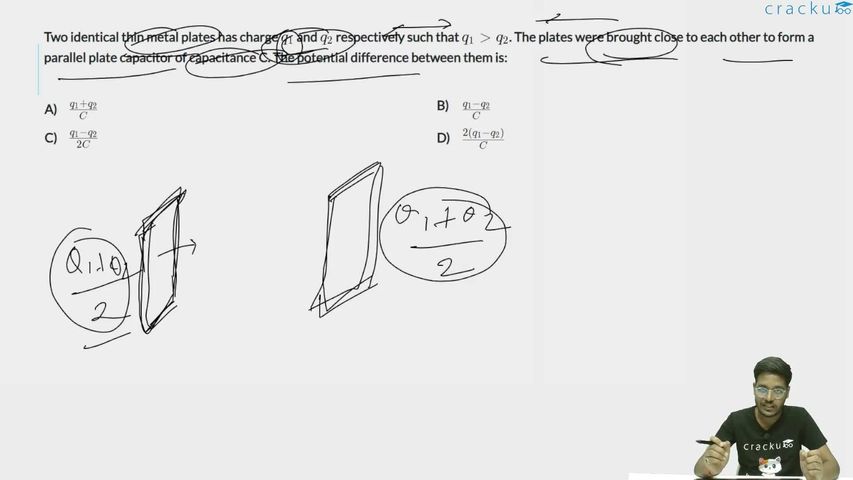
Two identical thin metal plates has charge $$q_1$$ and $$q_2$$ respectively such that $$q_1 > q_2$$. The plates were brought close to each other to form a parallel plate capacitor of capacitance C. The potential difference between them is:
We need to find the potential difference $$V$$ between two parallel metal plates that carry charges $$q_1$$ and $$q_2$$ and form a capacitor of capacitance $$C$$.
When two large conducting plates carrying charges $$q_1$$ and $$q_2$$ are brought close together, the total charge is distributed across their outer and inner surfaces due to electrostatic induction.
The charge on the outermost surfaces of both plates must be equal and is given by the average of the total charge: $$q_{outer} = \frac{q_1 + q_2}{2}$$.
The charge on the inner surface of the first plate ($$q_{inner1}$$) is found by subtracting the outer surface charge from its total charge: $$q_{inner1} = q_1 - \frac{q_1 + q_2}{2} = \frac{q_1 - q_2}{2}$$.
By conservation of charge and induction, the inner surface of the second plate carries an equal and opposite charge: $$q_{inner2} = -\left(\frac{q_1 - q_2}{2}\right)$$.
The potential difference between the plates of a capacitor depends solely on the magnitude of the charge residing on their inner facing surfaces, which is $$q = \frac{q_1 - q_2}{2}$$.
Using the standard definition of capacitance $$C = \frac{q}{V}$$, we can rearrange the equation to find the potential difference: $$V = \frac{q}{C}$$.
Substituting the inner surface charge expression into the potential formula yields: $$V = \frac{q_1 - q_2}{2C}$$.
Therefore, the correct answer is Option C: (q_1 - q_2) / 2C.
Was this solution helpful?
Click on the Email ☝️ to Watch the Video Solution
Create a FREE account and get:
_1.webp)

Educational materials for JEE preparation

Ask our AI anything

AI can make mistakes. Please verify important information.
AI can make mistakes. Please verify important information.
