
Join Our JEE Preparation Group
Prep with like-minded aspirants; Get access to free daily tests and study material.
Sign in
Please select an account to continue using cracku.in
↓ →
Join Our JEE Preparation Group
Prep with like-minded aspirants; Get access to free daily tests and study material.
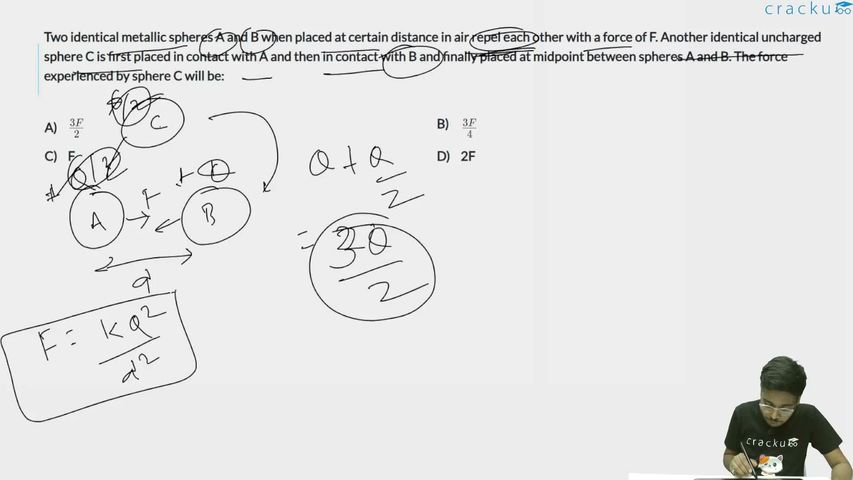
Two identical metallic spheres A and B when placed at certain distance in air repel each other with a force of F. Another identical uncharged sphere C is first placed in contact with A and then in contact with B and finally placed at midpoint between spheres A and B. The force experienced by sphere C will be:
We have two identical metallic spheres A and B, each carrying the same charge $$q$$ (since they repel with force $$F$$, both have like charges). The initial force between them at distance $$d$$ is $$F = \frac{kq^2}{d^2}$$.
An uncharged sphere C is first placed in contact with A. Since C is identical to A, the charge is shared equally, so after contact A has $$\frac{q}{2}$$ and C has $$\frac{q}{2}$$.
Now C (with charge $$\frac{q}{2}$$) is placed in contact with B (which still has charge $$q$$). The total charge is $$\frac{q}{2} + q = \frac{3q}{2}$$, which is shared equally, giving B a charge of $$\frac{3q}{4}$$ and C a charge of $$\frac{3q}{4}$$.
Sphere C is now placed at the midpoint between A and B, at a distance $$\frac{d}{2}$$ from each.
The force on C due to A is $$F_{CA} = \frac{k \cdot \frac{q}{2} \cdot \frac{3q}{4}}{(d/2)^2} = \frac{k \cdot \frac{3q^2}{8}}{d^2/4} = \frac{3kq^2}{2d^2} = \frac{3F}{2}$$, directed away from A (repulsive, towards B).
The force on C due to B is $$F_{CB} = \frac{k \cdot \frac{3q}{4} \cdot \frac{3q}{4}}{(d/2)^2} = \frac{k \cdot \frac{9q^2}{16}}{d^2/4} = \frac{9kq^2}{4d^2} = \frac{9F}{4}$$, directed away from B (repulsive, towards A).
These two forces act in opposite directions along the line joining A and B. The net force on C is $$F_{CB} - F_{CA} = \frac{9F}{4} - \frac{3F}{2} = \frac{9F - 6F}{4} = \frac{3F}{4}$$, directed from B towards A.
Hence, the correct answer is Option 2.
Was this solution helpful?
Click on the Email ☝️ to Watch the Video Solution
Create a FREE account and get:
_1.webp)

Educational materials for JEE preparation

Ask our AI anything

AI can make mistakes. Please verify important information.
AI can make mistakes. Please verify important information.
