
Join Our JEE Preparation Group
Prep with like-minded aspirants; Get access to free daily tests and study material.
Sign in
Please select an account to continue using cracku.in
↓ →
Join Our JEE Preparation Group
Prep with like-minded aspirants; Get access to free daily tests and study material.
The metallic bob of simple pendulum has the relative density 5. The time period of this pendulum is 10 s. If the metallic bob is immersed in water, then the new time period becomes $$5\sqrt{x}$$ s. The value of x will be _____
Correct Answer: 5
We have a simple pendulum with a metallic bob of relative density (specific gravity) $$\rho_r = 5$$, meaning the density of the bob is 5 times that of water. The time period in air is $$T = 10$$ s.
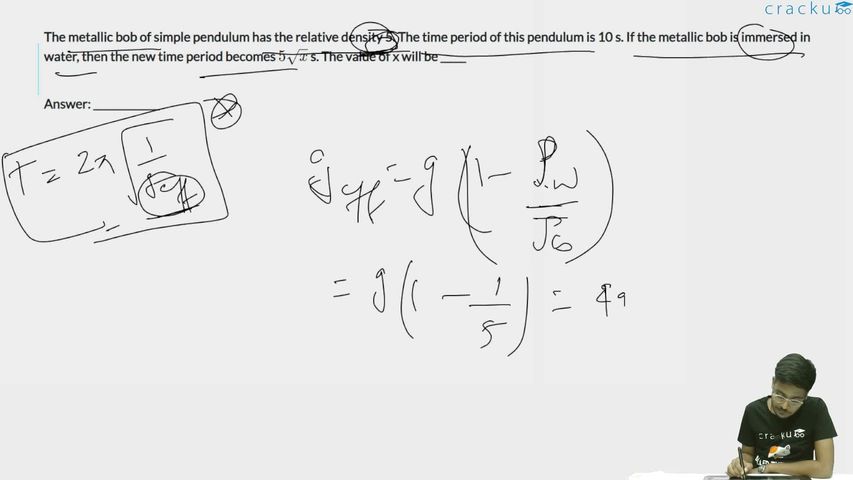
When the bob is immersed in water, it experiences an upthrust (buoyant force). The effective gravitational acceleration acting on the bob in water becomes $$g_{\text{eff}} = g\left(1 - \frac{\rho_w}{\rho_b}\right) = g\left(1 - \frac{1}{5}\right) = \frac{4g}{5}$$, where $$\rho_w$$ is the density of water and $$\rho_b$$ is the density of the bob.
The time period of a simple pendulum is $$T = 2\pi\sqrt{\frac{l}{g_{\text{eff}}}}$$. The ratio of the new time period to the original is: $$\frac{T'}{T} = \sqrt{\frac{g}{g_{\text{eff}}}} = \sqrt{\frac{g}{\frac{4g}{5}}} = \sqrt{\frac{5}{4}}$$
Now, $$T' = T \times \sqrt{\frac{5}{4}} = 10 \times \frac{\sqrt{5}}{2} = 5\sqrt{5}$$ s.
We are told $$T' = 5\sqrt{x}$$ s. Comparing, we get $$5\sqrt{x} = 5\sqrt{5}$$, which gives $$x = 5$$.
Hence, the correct answer is 5.
Was this solution helpful?
Click on the Email ☝️ to Watch the Video Solution
Create a FREE account and get:
_1.webp)

Educational materials for JEE preparation

Ask our AI anything

AI can make mistakes. Please verify important information.
AI can make mistakes. Please verify important information.
