
Join Our JEE Preparation Group
Prep with like-minded aspirants; Get access to free daily tests and study material.
Sign in
Please select an account to continue using cracku.in
↓ →
Join Our JEE Preparation Group
Prep with like-minded aspirants; Get access to free daily tests and study material.
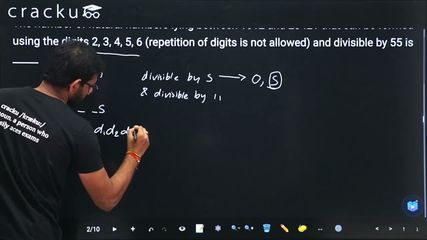
The number of natural numbers lying between 1012 and 23421 that can be formed using the digits 2, 3, 4, 5, 6 (repetition of digits is not allowed) and divisible by 55 is _____
Correct Answer: 6
We need to count natural numbers between 1012 and 23421, formed using the digits $$\{2, 3, 4, 5, 6\}$$ without repetition, that are divisible by 55. Since $$55 = 5 \times 11$$, the number must be divisible by both 5 and 11. The only available digit that is a multiple of 5 is 5 itself (and 0 is not available), so the last digit must be 5.
The range 1012 to 23421 includes 4-digit numbers and 5-digit numbers. Since we use distinct digits from $$\{2,3,4,5,6\}$$, a 4-digit number uses exactly four of these five digits, and a 5-digit number uses all five.
Case 1: 4-digit numbers $$\overline{abc5}$$ where $$a, b, c$$ are three distinct digits from $$\{2, 3, 4, 6\}$$. For divisibility by 11, the alternating sum of a 4-digit number $$\overline{d_1 d_2 d_3 d_4}$$ must satisfy $$(d_1 - d_2 + d_3 - d_4) \equiv 0 \pmod{11}$$. Here this gives $$(a - b + c - 5) \equiv 0 \pmod{11}$$, i.e., $$(a + c) - b = 5 + 11k$$ for integer $$k$$.
Since $$a, b, c \in \{2,3,4,6\}$$ are distinct, $$(a+c) - b$$ ranges from $$(2+3) - 6 = -1$$ to $$(6+4) - 2 = 8$$. The only multiple-of-11 shift that fits is $$k = 0$$, so $$(a+c) - b = 5$$.
Writing $$a + b + c = S$$ and using $$a + c = b + 5$$, we get $$S = 2b + 5$$, so $$b = \frac{S-5}{2}$$.
For the triplet $$\{2,3,4\}$$ with $$S = 9$$: $$b = 2$$, and $$a, c \in \{3,4\}$$. This gives numbers 3245 (since $$3245 = 55 \times 59$$) and 4235 (since $$4235 = 55 \times 77$$). Both are in range.
For $$\{2,3,6\}$$ with $$S = 11$$: $$b = 3$$, and $$a, c \in \{2,6\}$$. This gives numbers 2365 (since $$2365 = 55 \times 43$$) and 6325 (since $$6325 = 55 \times 115$$). Both are in range.
For $$\{2,4,6\}$$ with $$S = 12$$: $$b = 3.5$$, which is not a valid digit. No solutions here.
For $$\{3,4,6\}$$ with $$S = 13$$: $$b = 4$$, and $$a, c \in \{3,6\}$$. This gives numbers 3465 (since $$3465 = 55 \times 63$$) and 6435 (since $$6435 = 55 \times 117$$). Both are in range.
This yields $$2 + 2 + 0 + 2 = 6$$ valid 4-digit numbers.
Case 2: 5-digit numbers using all five digits $$\{2,3,4,5,6\}$$ with last digit 5, lying between 10000 and 23421. The first digit must be 2 (since digits 3, 4, or 6 as the leading digit would produce numbers exceeding 30000). With first digit 2, the number is $$\overline{2\,b\,c\,d\,5}$$ where $$b, c, d$$ is a permutation of $$\{3,4,6\}$$.
The alternating sum is $$2 - b + c - d + 5 = (7 + c) - (b + d)$$. Since $$b + c + d = 13$$, we have $$b + d = 13 - c$$, so the alternating sum equals $$7 + c - 13 + c = 2c - 6$$. For divisibility by 11, we need $$2c - 6 \equiv 0 \pmod{11}$$, giving $$c = 3$$. With $$c = 3$$, $$\{b,d\} = \{4,6\}$$, producing numbers 24365 and 26345. Since both exceed 23421, neither is valid.
The total count is $$6 + 0 = 6$$.
Hence, the correct answer is $$\boxed{6}$$.
Was this solution helpful?
Click on the Email ☝️ to Watch the Video Solution
Create a FREE account and get:
_1.webp)

Educational materials for JEE preparation

Ask our AI anything

AI can make mistakes. Please verify important information.
AI can make mistakes. Please verify important information.
