
Join Our JEE Preparation Group
Prep with like-minded aspirants; Get access to free daily tests and study material.
Sign in
Please select an account to continue using cracku.in
↓ →
Join Our JEE Preparation Group
Prep with like-minded aspirants; Get access to free daily tests and study material.
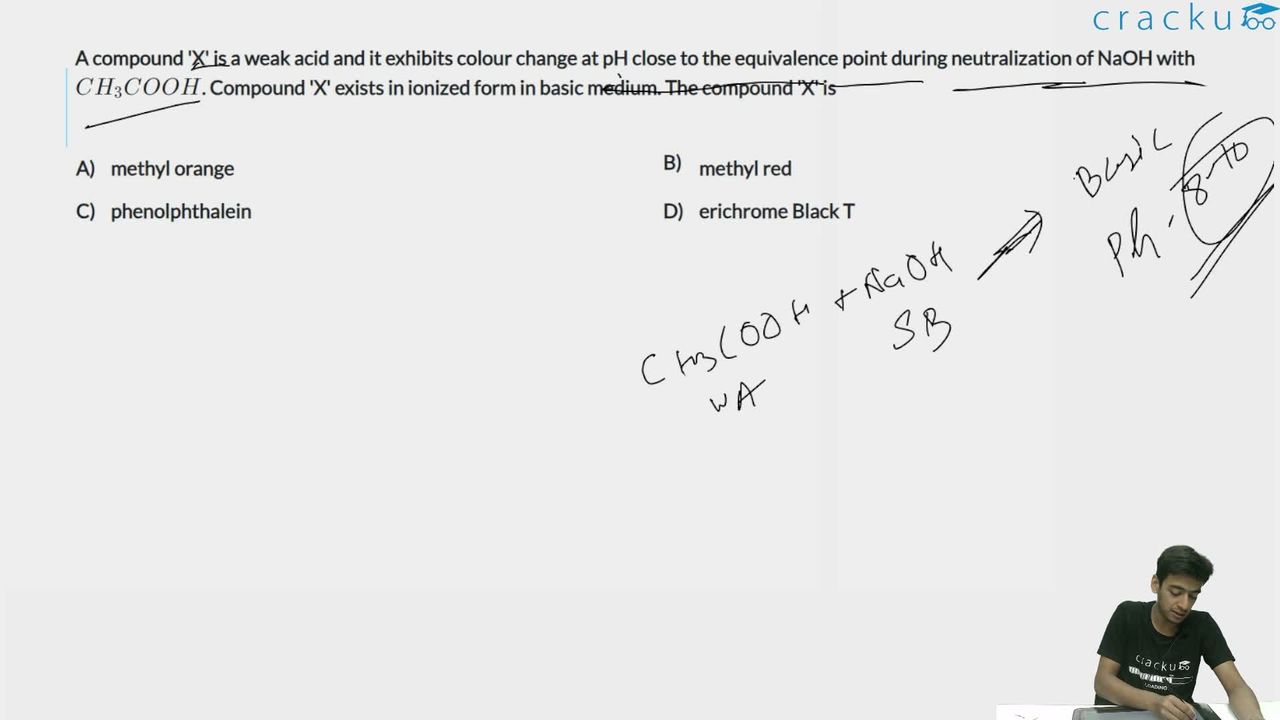
A compound 'X' is a weak acid and it exhibits colour change at pH close to the equivalence point during neutralization of NaOH with $$CH_3COOH$$. Compound 'X' exists in ionized form in basic medium. The compound 'X' is
We are told that compound X is a weak acid that exhibits a colour change at a pH close to the equivalence point during the neutralisation of NaOH (a strong base) with $$CH_3COOH$$ (a weak acid). It also exists in ionised form in a basic medium.
The equivalence point of a weak acid-strong base titration lies in the basic pH range (typically pH 8-10), because the salt formed (sodium acetate) undergoes hydrolysis to give a basic solution.
Among the given indicators, phenolphthalein has a pH range of approximately 8.2 to 10.0, which matches the equivalence point of this titration. Phenolphthalein is itself a weak acid — in acidic solution it is colourless (unionised form), while in basic solution it ionises and turns pink. This is consistent with the statement that compound X exists in ionised form in basic medium.
Methyl orange (pH range 3.1-4.4) and methyl red (pH range 4.4-6.2) change colour in acidic pH ranges, which do not match the equivalence point of a weak acid-strong base titration. Eriochrome Black T is used in complexometric titrations, not acid-base titrations.
Hence, the correct answer is Option C.
Was this solution helpful?
Click on the Email ☝️ to Watch the Video Solution
Create a FREE account and get:
_1.webp)

Educational materials for JEE preparation

Ask our AI anything

AI can make mistakes. Please verify important information.
AI can make mistakes. Please verify important information.
