
Join Our JEE Preparation Group
Prep with like-minded aspirants; Get access to free daily tests and study material.
Sign in
Please select an account to continue using cracku.in
↓ →
Join Our JEE Preparation Group
Prep with like-minded aspirants; Get access to free daily tests and study material.
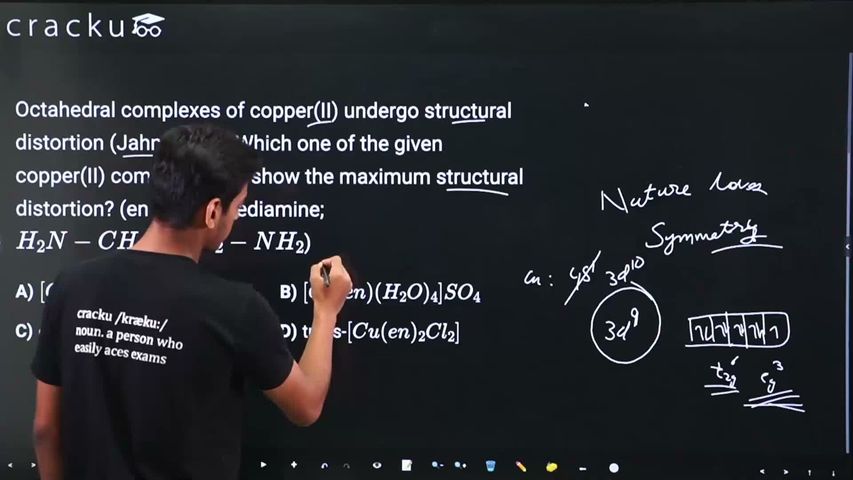
Octahedral complexes of copper(II) undergo structural distortion (Jahn-Teller). Which one of the given copper(II) complexes will show the maximum structural distortion? (en = ethylenediamine; $$H_2N-CH_2-CH_2-NH_2$$)
We need to determine which copper(II) complex shows the maximum Jahn-Teller distortion.
Copper(II) has the electronic configuration $$[Ar]3d^9$$. In an octahedral crystal field, the five d-orbitals split into a lower $$t_{2g}$$ set ($$d_{xy}$$, $$d_{xz}$$, $$d_{yz}$$) and an upper $$e_g$$ set ($$d_{z^2}$$, $$d_{x^2-y^2}$$). For $$Cu^{2+}$$ with 9 d-electrons, the filling is $$t_{2g}^6 e_g^3$$. Now, the two $$e_g$$ orbitals must share 3 electrons, so one orbital gets 2 electrons and the other gets 1. For example, $$d_{z^2}$$ may hold 2 electrons while $$d_{x^2-y^2}$$ holds 1, or vice versa. This unequal filling of degenerate orbitals creates an electronically unstable situation.
The Jahn-Teller theorem states that any non-linear molecule in an orbitally degenerate electronic state will distort to remove the degeneracy and lower the total energy. For $$Cu^{2+}$$, the distortion typically elongates the octahedron along the z-axis: the two axial ligands move farther away, weakening their interaction with the metal. This lowers the energy of $$d_{z^2}$$ (which points along z) relative to $$d_{x^2-y^2}$$, so the 2 electrons preferentially occupy $$d_{z^2}$$ and the single electron occupies $$d_{x^2-y^2}$$. The net energy is reduced, stabilising the complex.
The key factor determining the magnitude of this distortion is the symmetry of the ligand environment. When all six ligands are identical, the $$e_g$$ orbitals are perfectly degenerate before distortion, so the driving force for distortion is maximum. However, when different types of ligands are present, the lower symmetry of the ligand field already lifts the degeneracy of the $$e_g$$ set to some extent even without any structural distortion. This pre-existing splitting reduces the additional energy gain from Jahn-Teller distortion, and so the distortion is smaller.
Now let us compare the four complexes:
Case 1: $$[Cu(H_2O)_6]SO_4$$ — Here all six coordination positions are occupied by identical $$H_2O$$ ligands. The complex has perfect $$O_h$$ (octahedral) symmetry, so the $$e_g$$ orbitals are fully degenerate. The driving force for Jahn-Teller distortion is the highest. The experimentally observed Cu-O bond lengths in this complex show two long axial bonds (~2.4 Å) and four short equatorial bonds (~1.97 Å), confirming a pronounced tetragonal elongation.
Case 2: $$[Cu(en)(H_2O)_4]SO_4$$ — This has one bidentate ethylenediamine (en) and four water molecules. The presence of two different types of ligands (N-donors from en and O-donors from water) lowers the symmetry, partially lifting the $$e_g$$ degeneracy. The Jahn-Teller distortion is therefore reduced compared to Case 1.
Case 3: cis-$$[Cu(en)_2Cl_2]$$ — Two en ligands and two chloride ions in a cis arrangement. The ligand field is even less symmetric (three different donor environments along different axes), further reducing the Jahn-Teller effect.
Case 4: trans-$$[Cu(en)_2Cl_2]$$ — Two en and two Cl$$^-$$ in trans geometry. While this has higher symmetry than the cis isomer, the mixed ligand set (N and Cl donors) still pre-lifts the $$e_g$$ degeneracy, so the distortion is less than in the all-water complex.
Since $$[Cu(H_2O)_6]SO_4$$ has the highest symmetry with six identical ligands and therefore the maximum $$e_g$$ degeneracy, it exhibits the greatest Jahn-Teller distortion.
Hence, the correct answer is Option A.
Was this solution helpful?
Click on the Email ☝️ to Watch the Video Solution
Create a FREE account and get:
_1.webp)

Educational materials for JEE preparation

Ask our AI anything

AI can make mistakes. Please verify important information.
AI can make mistakes. Please verify important information.
