
Join Our JEE Preparation Group
Prep with like-minded aspirants; Get access to free daily tests and study material.
Sign in
Please select an account to continue using cracku.in
↓ →
Join Our JEE Preparation Group
Prep with like-minded aspirants; Get access to free daily tests and study material.
If $$z \neq 0$$ be a complex number such that $$\left|z - \frac{1}{z}\right| = 2$$, then the maximum value of $$|z|$$ is
We have a complex number $$z \neq 0$$ satisfying $$\left|z - \dfrac{1}{z}\right| = 2$$, and we need to find the maximum value of $$|z|$$.
We use the reverse triangle inequality. We know that $$\left|z - \dfrac{1}{z}\right| \geq \bigg||z| - \dfrac{1}{|z|}\bigg|$$. Since $$\left|z - \dfrac{1}{z}\right| = 2$$, we get $$\bigg||z| - \dfrac{1}{|z|}\bigg| \leq 2$$.
Now let $$r = |z|$$. We need $$\left|r - \dfrac{1}{r}\right| \leq 2$$, which gives us $$-2 \leq r - \dfrac{1}{r} \leq 2$$.
We focus on the upper bound $$r - \dfrac{1}{r} \leq 2$$. Multiplying by $$r > 0$$, we get $$r^2 - 2r - 1 \leq 0$$. Using the quadratic formula, $$r \leq \dfrac{2 + \sqrt{4+4}}{2} = 1 + \sqrt{2} = \sqrt{2} + 1$$.
We need to verify this maximum is achievable. If $$z = r$$ is a positive real number with $$r = \sqrt{2}+1$$, then $$\dfrac{1}{r} = \dfrac{1}{\sqrt{2}+1} = \sqrt{2}-1$$, so $$z - \dfrac{1}{z} = (\sqrt{2}+1) - (\sqrt{2}-1) = 2$$. This satisfies the given condition, confirming the maximum is attained.
Hence, the correct answer is Option D: $$\sqrt{2}+1$$.
Was this solution helpful?
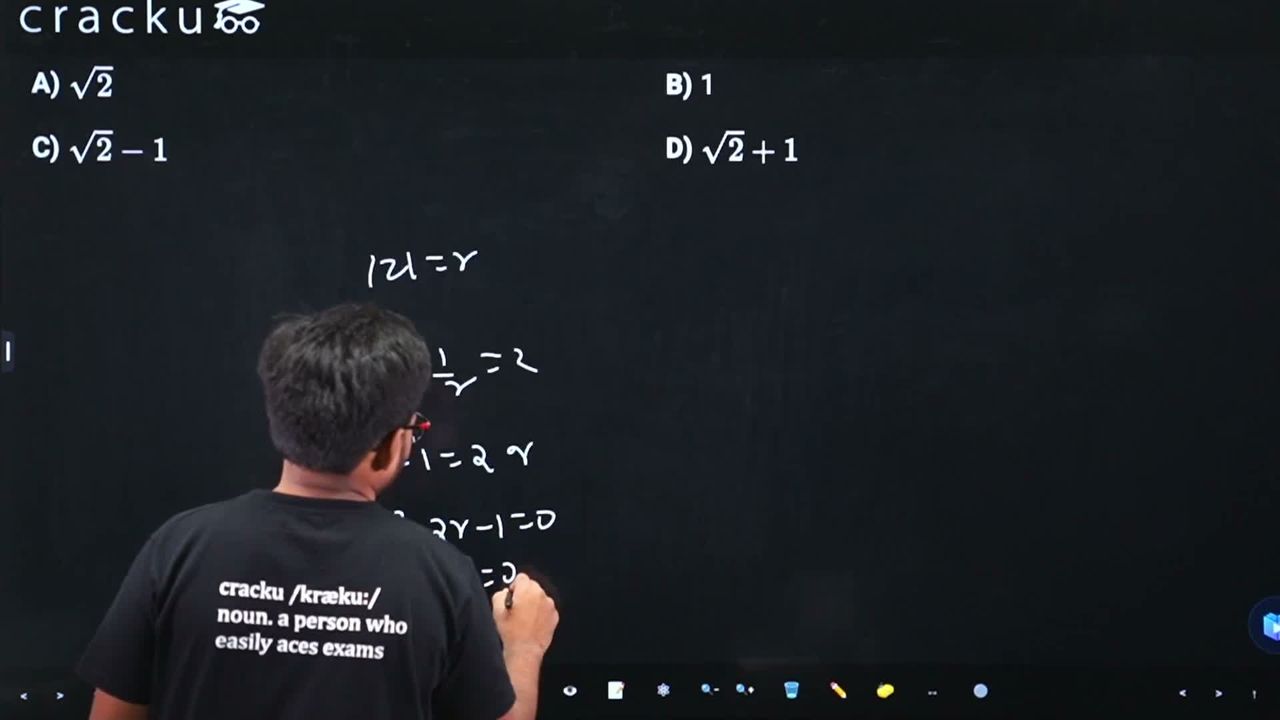
Click on the Email ☝️ to Watch the Video Solution
Create a FREE account and get:
_1.webp)

Educational materials for JEE preparation

Ask our AI anything

AI can make mistakes. Please verify important information.
AI can make mistakes. Please verify important information.
