
Join Our JEE Preparation Group
Prep with like-minded aspirants; Get access to free daily tests and study material.
Sign in
Please select an account to continue using cracku.in
↓ →
Join Our JEE Preparation Group
Prep with like-minded aspirants; Get access to free daily tests and study material.
The velocity of a small ball of mass 0.3 g and density 8 g cc$$^{-1}$$ when dropped in a container filled with glycerine becomes constant after some time. If the density of glycerine is 1.3 g cc$$^{-1}$$, then the value of viscous force acting on the ball will be $$x \times 10^{-4}$$ N, the value of x is _____ [use $$g = 10$$ m s$$^{-2}$$]
Correct Answer: 25
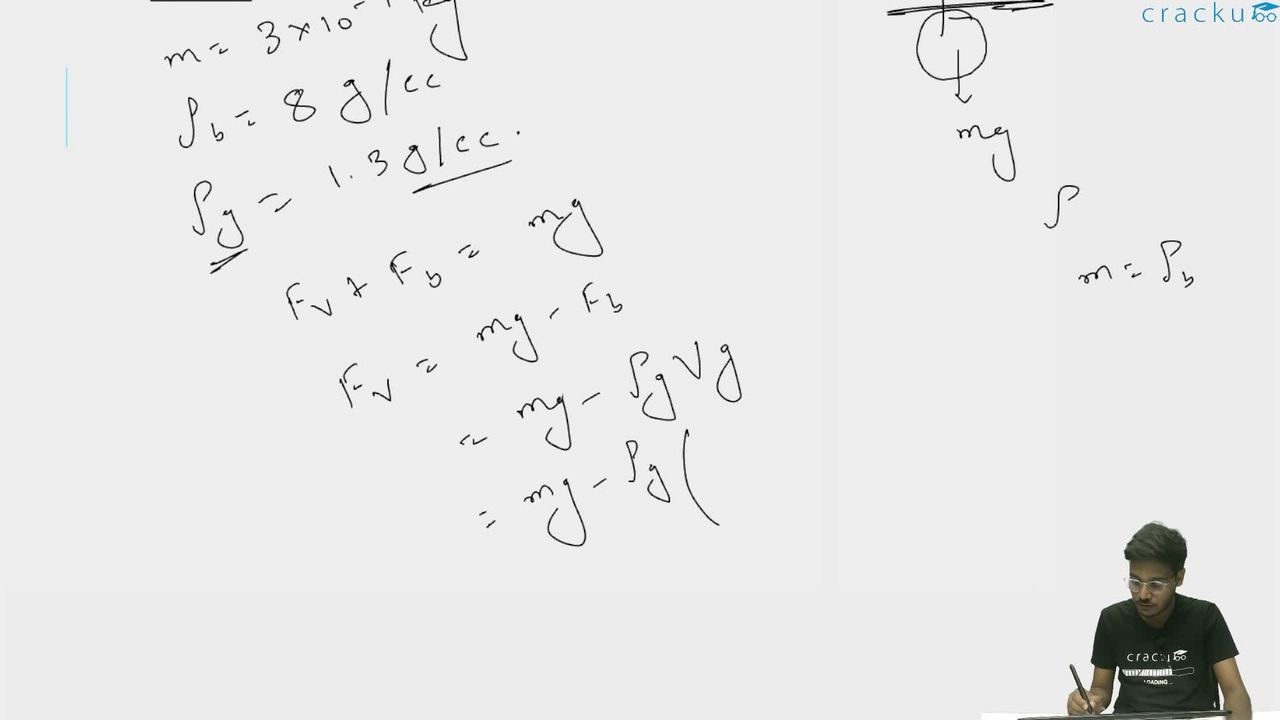
We have a small ball of mass $$m = 0.3$$ g $$= 3 \times 10^{-4}$$ kg and density $$\rho_b = 8$$ g/cc $$= 8000$$ kg/m$$^3$$, dropped in glycerine of density $$\rho_g = 1.3$$ g/cc $$= 1300$$ kg/m$$^3$$. When the ball reaches terminal velocity, its acceleration is zero, so the net force on the ball is zero.
The forces acting on the ball at terminal velocity are: (1) the weight $$W = mg$$ acting downward, (2) the buoyant force $$F_b$$ acting upward, and (3) the viscous force $$F_v$$ acting upward. At terminal velocity, these balance: $$mg = F_b + F_v$$
The volume of the ball is $$V = \frac{m}{\rho_b}$$. The buoyant force is $$F_b = \rho_g V g = \rho_g \cdot \frac{m}{\rho_b} \cdot g$$.
Now, the viscous force is: $$F_v = mg - F_b = mg - \frac{\rho_g}{\rho_b} mg = mg\left(1 - \frac{\rho_g}{\rho_b}\right)$$
Substituting the values: $$F_v = 3 \times 10^{-4} \times 10 \times \left(1 - \frac{1.3}{8}\right) = 3 \times 10^{-3} \times \left(1 - 0.1625\right) = 3 \times 10^{-3} \times 0.8375$$
$$F_v = 2.5125 \times 10^{-3}$$ N $$= 25.125 \times 10^{-4}$$ N.
Rounding to the nearest integer, $$x = 25$$.
Hence, the correct answer is 25.
Was this solution helpful?
Click on the Email ☝️ to Watch the Video Solution
Create a FREE account and get:
_1.webp)

Educational materials for JEE preparation

Ask our AI anything

AI can make mistakes. Please verify important information.
AI can make mistakes. Please verify important information.
