
Join Our JEE Preparation Group
Prep with like-minded aspirants; Get access to free daily tests and study material.
Sign in
Please select an account to continue using cracku.in
↓ →
Join Our JEE Preparation Group
Prep with like-minded aspirants; Get access to free daily tests and study material.
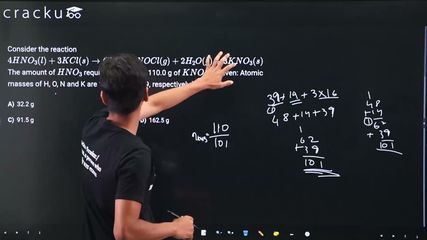
Consider the reaction
$$4HNO_3(l) + 3KCl(s) \to Cl_2(g) + NOCl(g) + 2H_2O(g) + 3KNO_3(s)$$
The amount of $$HNO_3$$ required to produce 110.0 g of $$KNO_3$$ is (Given: Atomic masses of H, O, N and K are 1, 16, 14 and 39, respectively.)
We have the balanced equation: $$4HNO_3(l) + 3KCl(s) \to Cl_2(g) + NOCl(g) + 2H_2O(g) + 3KNO_3(s)$$
We need to find the mass of $$HNO_3$$ required to produce 110.0 g of $$KNO_3$$. The molar mass of $$KNO_3 = 39 + 14 + 48 = 101$$ g/mol. The moles of $$KNO_3$$ produced are $$\frac{110.0}{101} \approx 1.089$$ mol.
From the stoichiometry, 4 moles of $$HNO_3$$ produce 3 moles of $$KNO_3$$. So the moles of $$HNO_3$$ required are: $$n_{HNO_3} = \frac{4}{3} \times 1.089 = 1.452$$ mol.
The molar mass of $$HNO_3 = 1 + 14 + 48 = 63$$ g/mol. The mass of $$HNO_3$$ required is: $$m = 1.452 \times 63 = 91.48 \approx 91.5$$ g.
Hence, the correct answer is Option C.
Was this solution helpful?
Click on the Email ☝️ to Watch the Video Solution
Create a FREE account and get:
_1.webp)

Educational materials for JEE preparation

Ask our AI anything

AI can make mistakes. Please verify important information.
AI can make mistakes. Please verify important information.
