
Join Our JEE Preparation Group
Prep with like-minded aspirants; Get access to free daily tests and study material.
Sign in
Please select an account to continue using cracku.in
↓ →
Join Our JEE Preparation Group
Prep with like-minded aspirants; Get access to free daily tests and study material.
A modulating signal $$2\sin(6.28 \times 10^6 t)$$ is added to the carrier signal $$4\sin(12.56 \times 10^9 t)$$ for amplitude modulation. The combined signal is passed through a non-linear square law device. The output is then passed through a band pass filter. The bandwidth of the output signal of band pass filter will be _____ MHz.
Correct Answer: 2
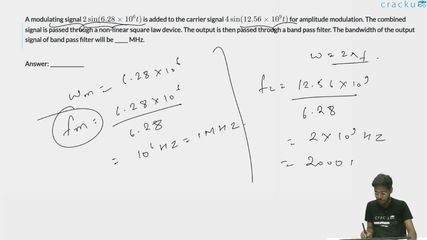
We have a modulating signal $$m(t) = 2\sin(6.28 \times 10^6 t)$$ and a carrier signal $$c(t) = 4\sin(12.56 \times 10^9 t)$$. The modulating frequency is $$f_m = \frac{\omega_m}{2\pi} = \frac{6.28 \times 10^6}{2\pi} = \frac{6.28 \times 10^6}{6.28} = 10^6$$ Hz $$= 1$$ MHz. The carrier frequency is $$f_c = \frac{12.56 \times 10^9}{2\pi} = \frac{12.56 \times 10^9}{6.28} = 2 \times 10^9$$ Hz $$= 2000$$ MHz.
The combined signal is $$y(t) = m(t) + c(t)$$. When this passes through a non-linear square law device, the output contains terms proportional to $$y(t)$$ and $$y(t)^2$$. Expanding $$y(t)^2 = [m(t) + c(t)]^2 = m(t)^2 + c(t)^2 + 2m(t)c(t)$$, we note that the cross-term $$2m(t)c(t)$$ produces frequencies at $$f_c + f_m$$ and $$f_c - f_m$$, which are the upper and lower sidebands of the AM signal. The terms $$m(t)^2$$ and $$c(t)^2$$ produce low-frequency and high-frequency components (at $$2f_m$$, DC, and $$2f_c$$) that lie outside the carrier band.
Now, the band pass filter is centred at the carrier frequency $$f_c$$. It allows through only the frequencies near $$f_c$$, namely the carrier at $$f_c = 2000$$ MHz, the upper sideband at $$f_c + f_m = 2001$$ MHz, and the lower sideband at $$f_c - f_m = 1999$$ MHz. All other frequency components are rejected.
The bandwidth of the output signal is the difference between the highest and lowest frequencies passed: $$\text{BW} = (f_c + f_m) - (f_c - f_m) = 2f_m = 2 \times 1 = 2 \text{ MHz}$$
Hence, the correct answer is 2.
Was this solution helpful?
Click on the Email ☝️ to Watch the Video Solution
Create a FREE account and get:
_1.webp)

Educational materials for JEE preparation

Ask our AI anything

AI can make mistakes. Please verify important information.
AI can make mistakes. Please verify important information.
