
Join Our JEE Preparation Group
Prep with like-minded aspirants; Get access to free daily tests and study material.
Sign in
Please select an account to continue using cracku.in
↓ →
Join Our JEE Preparation Group
Prep with like-minded aspirants; Get access to free daily tests and study material.
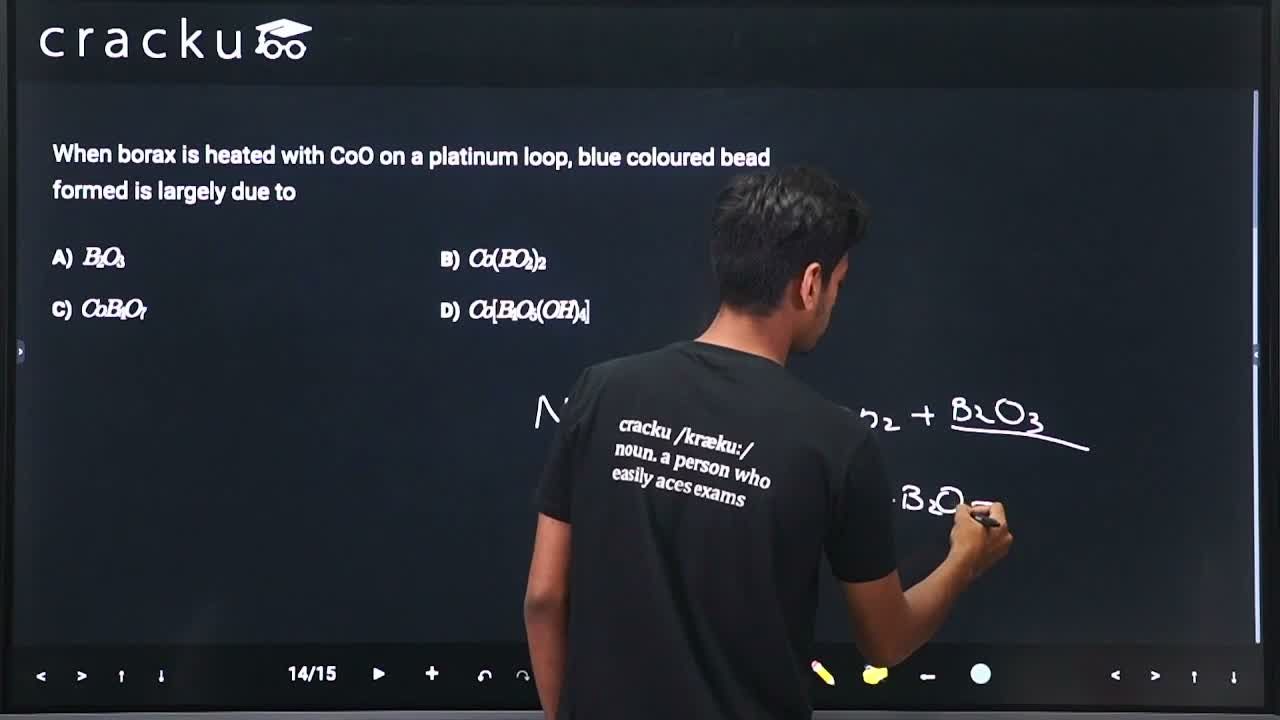
When borax is heated with CoO on a platinum loop, blue coloured bead formed is largely due to
We are asked to identify the compound responsible for the blue coloured bead when borax is heated with CoO on a platinum loop.
The borax bead test is a classic qualitative analysis technique. When borax ($$Na_2B_4O_7 \cdot 10H_2O$$) is heated, it first loses water and swells up, then melts into a transparent glassy bead. The key reaction during heating is:
$$Na_2B_4O_7 \xrightarrow{\Delta} 2NaBO_2 + B_2O_3$$
The $$B_2O_3$$ (boron trioxide) produced is a Lewis acid and reacts with metal oxides to form metaborates. When CoO is introduced into the hot borax bead, the following reaction occurs:
$$CoO + B_2O_3 \rightarrow Co(BO_2)_2$$
The product $$Co(BO_2)_2$$ is cobalt(II) metaborate, which imparts the characteristic deep blue colour to the bead. This blue colour is so distinctive that the borax bead test is considered a reliable confirmatory test for cobalt.
Among the given options, $$B_2O_3$$ (Option A) is colourless and merely serves as the acidic flux. Options C and D represent other possible boron-cobalt compounds, but the standard product formed in the borax bead test is the metaborate $$Co(BO_2)_2$$.
Hence, the correct answer is Option B.
Was this solution helpful?
Click on the Email ☝️ to Watch the Video Solution
Create a FREE account and get:
_1.webp)

Educational materials for JEE preparation

Ask our AI anything

AI can make mistakes. Please verify important information.
AI can make mistakes. Please verify important information.
