NTA JEE Main 1st February 2023 Shift 2
For the following questions answer them individually
NTA JEE Main 1st February 2023 Shift 2 - Question 41
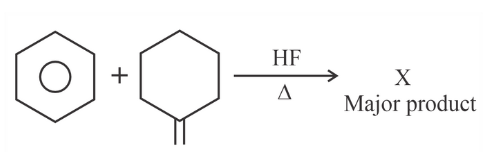
'X' is:
NTA JEE Main 1st February 2023 Shift 2 - Question 42
The industrial activity held least responsible for global warming is:
NTA JEE Main 1st February 2023 Shift 2 - Question 43
A metal M crystallizes into two lattices: face centred cubic (fcc) and body centred cubic (bcc) with unit cell edge length of $$2.0$$ and $$2.5$$ $$\text{\AA}$$ respectively. The ratio of densities of lattices fcc to bcc for the metal M is ______ (Nearest integer)

NTA JEE Main 1st February 2023 Shift 2 - Question 44
The graph which represents the following reaction is:
$$(\text{C}_6\text{H}_5)_3\text{C} - \text{Cl} \xrightarrow[\text{Pyridine}]{\text{OH}^-} (\text{C}_6\text{H}_5)_3\text{C} - \text{OH}$$
NTA JEE Main 1st February 2023 Shift 2 - Question 45
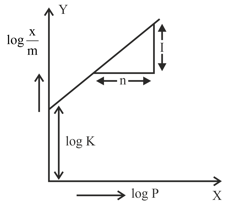
In figure, a straight line is given for Freundrich Adsorption ($$y = 3x + 2.505$$). The value of $$\frac{1}{n}$$ and log K are respectively.
NTA JEE Main 1st February 2023 Shift 2 - Question 46
Given below are two statements: one is labelled as Assertion (A) and the other is labelled as Reason (R).
Assertion (A): Cu$$^{2+}$$ in water is more stable than Cu$$^{+}$$.
Reason (R): Enthalpy of hydration for Cu$$^{2+}$$ is much less than that of Cu$$^{+}$$.
In the light of the above statements, choose the correct answer from the options given below:
NTA JEE Main 1st February 2023 Shift 2 - Question 47
Which element is not present in Nessler's reagent?
NTA JEE Main 1st February 2023 Shift 2 - Question 48
The complex cation which has two isomers is:
NTA JEE Main 1st February 2023 Shift 2 - Question 49
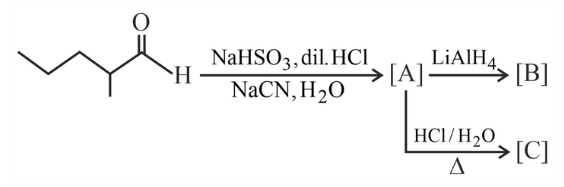
The structures of major products A, B and C in the following reaction sequence are:
NTA JEE Main 1st February 2023 Shift 2 - Question 50
In a reaction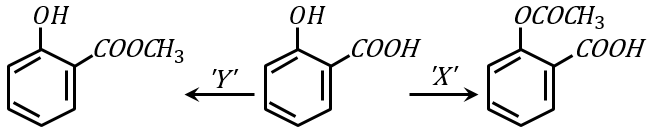
reagents 'X' and 'Y' respectively are: