
Join Our JEE Preparation Group
Prep with like-minded aspirants; Get access to free daily tests and study material.
Sign in
Please select an account to continue using cracku.in
↓ →
Join Our JEE Preparation Group
Prep with like-minded aspirants; Get access to free daily tests and study material.
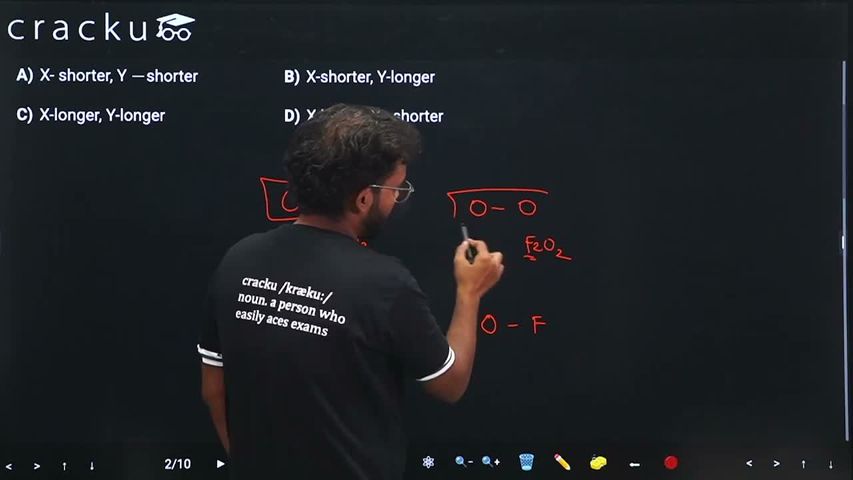
O $$-$$ O bond length in H$$_2$$O$$_2$$ is X than the O $$-$$ O bond length in F$$_2$$O$$_2$$. The O $$-$$ H bond length in H$$_2$$O$$_2$$ is Y than that of the O $$-$$ F bond in F$$_2$$O$$_2$$. Choose the correct option for X and Y from the given below.
We compare bond lengths in $$H_2O_2$$ and $$F_2O_2$$ (dioxygen difluoride, FOOF).
For X (O-O bond comparison): In $$H_2O_2$$, the O-O single bond has a length of about 1.47 Angstrom. In $$F_2O_2$$, the highly electronegative fluorine atoms draw electron density away from the O-O bond region, weakening it and increasing it to about 1.58 Angstrom. Since the O-O bond in $$H_2O_2$$ (1.47 Angstrom) is less than in $$F_2O_2$$ (1.58 Angstrom), X = shorter.
For Y (O-H vs O-F bond comparison): The O-H bond length in $$H_2O_2$$ is about 0.97 Angstrom. The O-F bond length in $$F_2O_2$$ is about 1.41 Angstrom. Since 0.97 Angstrom is less than 1.41 Angstrom, the O-H bond is shorter than the O-F bond. Thus Y = shorter.
The correct answer is Option A: X-shorter, Y-shorter.
Was this solution helpful?
Click on the Email ☝️ to Watch the Video Solution
Create a FREE account and get:
_1.webp)

Educational materials for JEE preparation

Ask our AI anything

AI can make mistakes. Please verify important information.
AI can make mistakes. Please verify important information.


