
Join Our JEE Preparation Group
Prep with like-minded aspirants; Get access to free daily tests and study material.
Sign in
Please select an account to continue using cracku.in
↓ →
Join Our JEE Preparation Group
Prep with like-minded aspirants; Get access to free daily tests and study material.
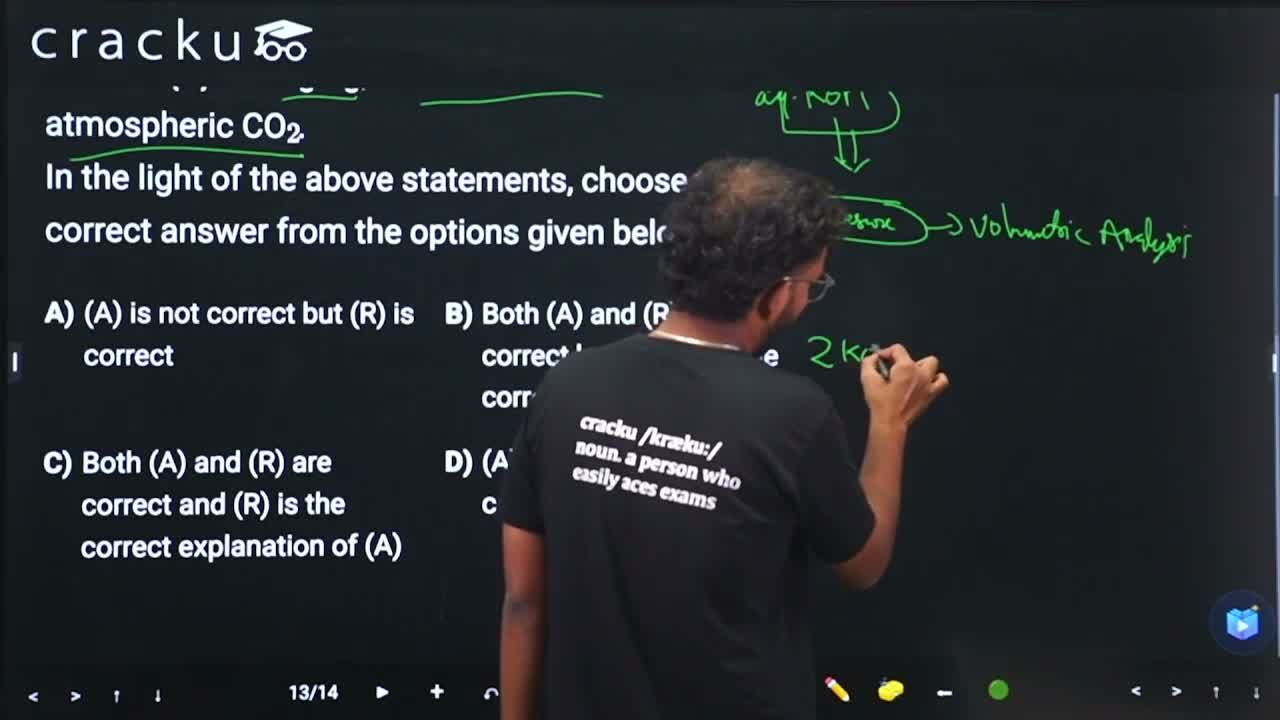
Given below are two statements: one is labelled as Assertion (A) and the other is labelled as Reason (R).
Assertion (A): An aqueous solution of KOH when for volumetric analysis, its concentration should be checked before the use.
Reason (R): On aging, KOH solution absorbs atmospheric CO$$_2$$.
In the light of the above statements, choose the correct answer from the options given below.
Assertion (A): An aqueous solution of KOH used in volumetric analysis should be standardized or its concentration should be checked before use.
Reason (R): KOH solution absorbs atmospheric $$CO_2$$ on standing.
The reason statement is correct because potassium hydroxide reacts readily with carbon dioxide present in air.
$$2KOH+CO_2\rightarrow K_2CO_3+H_2O$$
As a result, part of the KOH is converted into potassium carbonate, causing the concentration of the KOH solution to change with time.
The assertion is also correct. KOH is not a primary standard because it absorbs both moisture and $$CO_2$$ from the atmosphere. Therefore, the concentration calculated during preparation does not remain constant for long periods.
Before using KOH solution in volumetric analysis, its exact concentration must be determined by standardization against a suitable primary standard.
Thus, the concentration of KOH solution is checked before use because it absorbs atmospheric $$CO_2$$ and undergoes the reaction
$$2KOH+CO_2\rightarrow K_2CO_3+H_2O$$
Therefore, both Assertion (A) and Reason (R) are correct, and Reason (R) is the correct explanation of Assertion (A).
Was this solution helpful?
Click on the Email ☝️ to Watch the Video Solution
Create a FREE account and get:
_1.webp)

Educational materials for JEE preparation

Ask our AI anything

AI can make mistakes. Please verify important information.
AI can make mistakes. Please verify important information.


