
Join Our JEE Preparation Group
Prep with like-minded aspirants; Get access to free daily tests and study material.
Sign in
Please select an account to continue using cracku.in
↓ →
Join Our JEE Preparation Group
Prep with like-minded aspirants; Get access to free daily tests and study material.
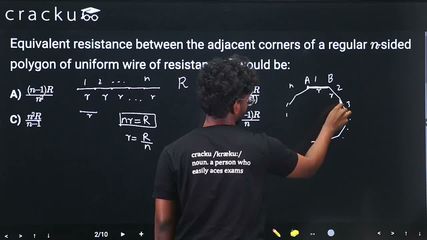
Equivalent resistance between the adjacent corners of a regular $$n$$-sided polygon of uniform wire of resistance $$R$$ would be:
We need to find the equivalent resistance between adjacent corners of a regular $$n$$-sided polygon made from a uniform wire of total resistance $$R$$.
Since the wire has total resistance $$R$$ and is divided into $$n$$ equal segments, each side has resistance $$\frac{R}{n}$$.
Between two adjacent corners there are two paths. The direct path is one side of the polygon, so its resistance is $$R_1 = \frac{R}{n}$$. The longer path goes through the remaining $$(n-1)$$ sides in series, giving resistance $$R_2 = \frac{(n-1)R}{n}$$.
These two paths form a parallel combination, so
$$\frac{1}{R_{\text{eq}}} = \frac{1}{R_1} + \frac{1}{R_2} = \frac{n}{R} + \frac{n}{(n-1)R}$$
which simplifies to
$$\frac{1}{R_{\text{eq}}} = \frac{n(n-1) + n}{R(n-1)} = \frac{n^2}{R(n-1)}\;.$$
Taking the reciprocal gives
$$R_{\text{eq}} = \frac{(n-1)R}{n^2}\;.$$
Thus the equivalent resistance between adjacent corners is $$\frac{(n-1)R}{n^2}\,.$$
Was this solution helpful?
Click on the Email ☝️ to Watch the Video Solution
Create a FREE account and get:
_1.webp)

Educational materials for JEE preparation

Ask our AI anything

AI can make mistakes. Please verify important information.
AI can make mistakes. Please verify important information.
