
Join Our JEE Preparation Group
Prep with like-minded aspirants; Get access to free daily tests and study material.
Sign in
Please select an account to continue using cracku.in
↓ →
Join Our JEE Preparation Group
Prep with like-minded aspirants; Get access to free daily tests and study material.
A metal M crystallizes into two lattices: face centred cubic (fcc) and body centred cubic (bcc) with unit cell edge length of $$2.0$$ and $$2.5$$ $$\text{\AA}$$ respectively. The ratio of densities of lattices fcc to bcc for the metal M is ______ (Nearest integer)
We need to find the ratio of densities of fcc to bcc lattices for metal M.
Formula: The density of a crystal lattice is given by:
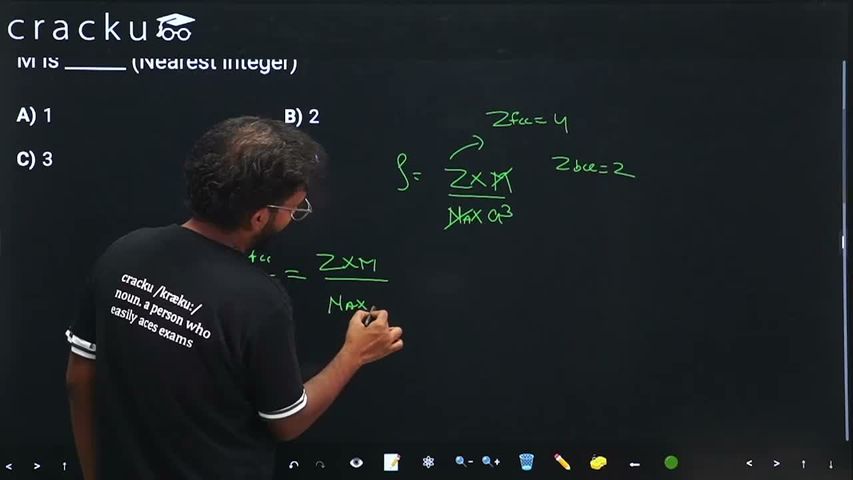
$$\rho = \frac{Z \times M}{N_A \times a^3}$$
where $$Z$$ is the number of atoms per unit cell, $$M$$ is the molar mass, $$N_A$$ is Avogadro's number, and $$a$$ is the edge length.
Number of atoms per unit cell.
For fcc: $$Z_{fcc} = 4$$
For bcc: $$Z_{bcc} = 2$$
Given edge lengths.
$$a_{fcc} = 2.0$$ Angstrom
$$a_{bcc} = 2.5$$ Angstrom
Calculate the ratio of densities.
Since the metal M is the same in both cases, $$M$$ and $$N_A$$ are the same:
$$\frac{\rho_{fcc}}{\rho_{bcc}} = \frac{Z_{fcc}}{Z_{bcc}} \times \frac{a_{bcc}^3}{a_{fcc}^3}$$
$$= \frac{4}{2} \times \frac{(2.5)^3}{(2.0)^3}$$
$$= 2 \times \frac{15.625}{8.0}$$
$$= 2 \times 1.953125$$
$$= 3.90625$$
Rounding to the nearest integer: $$\approx 4$$
The correct answer is $$\mathbf{4}$$ (Option D).
Was this solution helpful?
Click on the Email ☝️ to Watch the Video Solution
Create a FREE account and get:
_1.webp)

Educational materials for JEE preparation

Ask our AI anything

AI can make mistakes. Please verify important information.
AI can make mistakes. Please verify important information.


