
Join Our JEE Preparation Group
Prep with like-minded aspirants; Get access to free daily tests and study material.
Sign in
Please select an account to continue using cracku.in
↓ →
Join Our JEE Preparation Group
Prep with like-minded aspirants; Get access to free daily tests and study material.
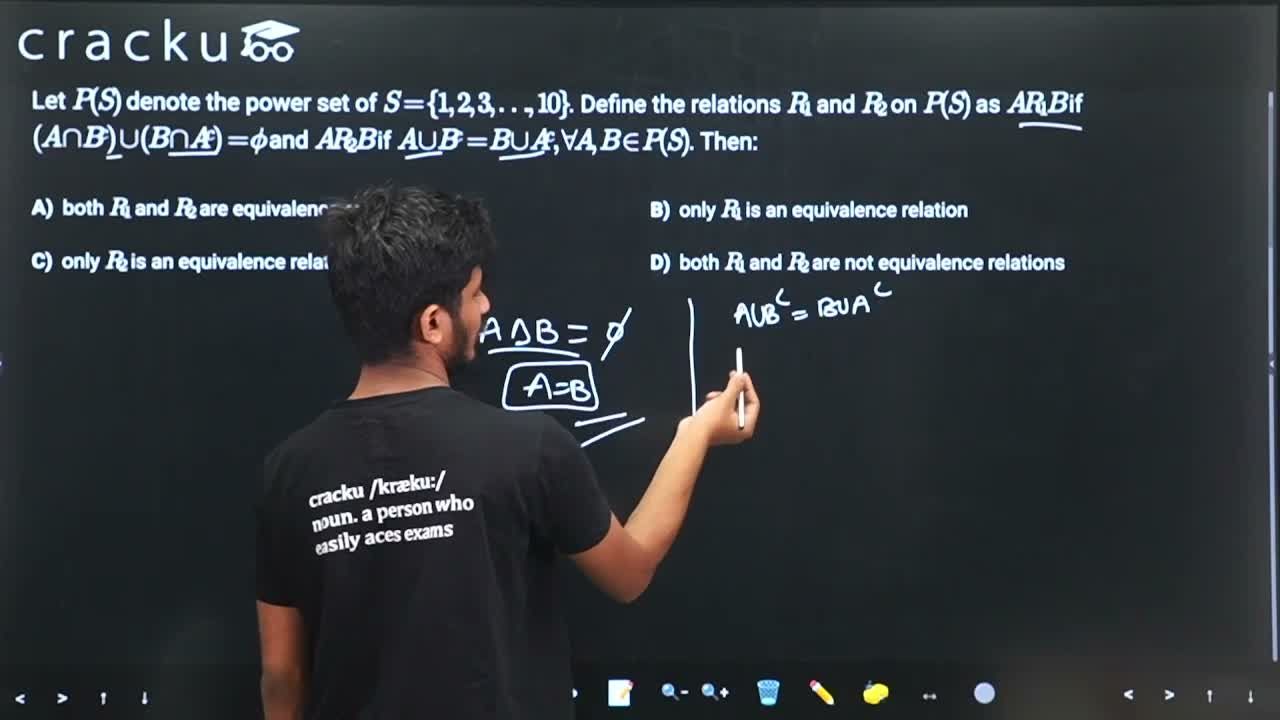
Let $$P(S)$$ denote the power set of $$S = \{1, 2, 3, \ldots, 10\}$$. Define the relations $$R_1$$ and $$R_2$$ on $$P(S)$$ as $$AR_1B$$ if $$(A \cap B^c) \cup (B \cap A^c) = \phi$$ and $$AR_2 B$$ if $$A \cup B^c = B \cup A^c, \forall A, B \in P(S)$$. Then:
Let $$P(S)$$ denote the power set of $$S = \{1, 2, 3, \ldots, 10\}$$.
Analysis of $$R_1$$:
$$AR_1B$$ if $$(A \cap B^c) \cup (B \cap A^c) = \phi$$
The expression $$(A \cap B^c) \cup (B \cap A^c)$$ is the symmetric difference $$A \triangle B$$.
$$A \triangle B = \phi$$ if and only if $$A = B$$.
So $$R_1$$ is the equality relation: $$AR_1B \iff A = B$$.
Check equivalence for $$R_1$$:
- Reflexive: $$A = A$$ for all $$A \in P(S)$$. $$\checkmark$$
- Symmetric: If $$A = B$$, then $$B = A$$. $$\checkmark$$
- Transitive: If $$A = B$$ and $$B = C$$, then $$A = C$$. $$\checkmark$$
Therefore, $$R_1$$ is an equivalence relation.
Analysis of $$R_2$$:
$$AR_2B$$ if $$A \cup B^c = B \cup A^c$$
We check when this equality holds by examining elements of $$S$$:
$$x \in A \cup B^c \iff x \in A \text{ or } x \notin B$$
$$x \in B \cup A^c \iff x \in B \text{ or } x \notin A$$
If $$x \in A$$ but $$x \notin B$$: Then $$x \in A \cup B^c$$ (true, since $$x \in A$$), but for $$x \in B \cup A^c$$ we need $$x \in B$$ (false) or $$x \notin A$$ (false). So $$x \notin B \cup A^c$$. The sets differ.
Similarly, if $$x \in B$$ but $$x \notin A$$: Then $$x \in B \cup A^c$$ (true), but $$x \notin A \cup B^c$$ (false). The sets differ.
Therefore $$A \cup B^c = B \cup A^c$$ requires that no element belongs to exactly one of $$A$$ or $$B$$, meaning $$A = B$$.
So $$R_2$$ is also the equality relation: $$AR_2B \iff A = B$$.
Check equivalence for $$R_2$$:
- Reflexive: $$A = A$$ for all $$A \in P(S)$$. $$\checkmark$$
- Symmetric: If $$A = B$$, then $$B = A$$. $$\checkmark$$
- Transitive: If $$A = B$$ and $$B = C$$, then $$A = C$$. $$\checkmark$$
Therefore, $$R_2$$ is an equivalence relation.
Since both $$R_1$$ and $$R_2$$ are equivalence relations, the correct answer is Option A: both $$R_1$$ and $$R_2$$ are equivalence relations.
Was this solution helpful?
Click on the Email ☝️ to Watch the Video Solution
Create a FREE account and get:
_1.webp)

Educational materials for JEE preparation

Ask our AI anything

AI can make mistakes. Please verify important information.
AI can make mistakes. Please verify important information.


