
Join Our JEE Preparation Group
Prep with like-minded aspirants; Get access to free daily tests and study material.
Sign in
Please select an account to continue using cracku.in
↓ →
Join Our JEE Preparation Group
Prep with like-minded aspirants; Get access to free daily tests and study material.
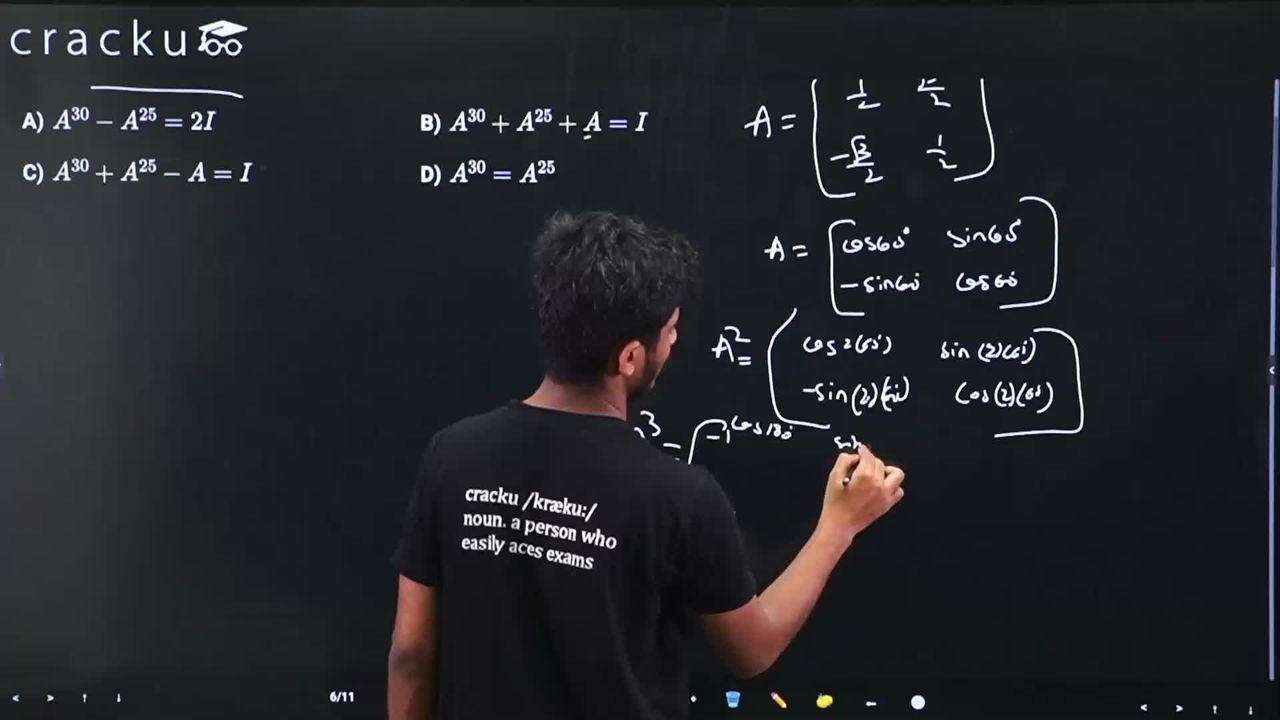
If $$A = \frac{1}{2}\begin{bmatrix} 1 & \sqrt{3} \\ -\sqrt{3} & 1 \end{bmatrix}$$ then,
Given $$A = \frac{1}{2}\begin{bmatrix} 1 & \sqrt{3} \\ -\sqrt{3} & 1 \end{bmatrix}$$, we can recognize this matrix as a rotation matrix by noting that $$A = \begin{bmatrix} \cos 60° & \sin 60° \\ -\sin 60° & \cos 60° \end{bmatrix}$$, which is precisely $$R(-60°)$$, a rotation by $$-60°$$.
Since $$A = R(-60°)$$, it follows in general that $$A^n = R(-60n°)$$ for any integer $$n$$.
Applying this to the thirtieth power gives $$A^{30} = R(-60° \times 30) = R(-1800°) = R(0°) = I$$, because $$-1800° = -5 \times 360°$$.
Similarly, for the twenty-fifth power one finds $$A^{25} = R(-60° \times 25) = R(-1500°) = R(-1500° + 1440°) = R(-60°) = A$$.
Checking the proposed relations, Option A asserts $$A^{30} - A^{25} = I - A = 2I$$, which would force $$A = -I$$ and is false. Option B asserts $$A^{30} + A^{25} + A = I + A + A = I + 2A \neq I$$, which also fails. Option C states $$A^{30} + A^{25} - A = I + A - A = I$$, which holds true. Option D claims $$A^{30} = A^{25}$$ or $$I = A$$, which is false.
Therefore the correct answer is Option C.
Was this solution helpful?
Click on the Email ☝️ to Watch the Video Solution
Create a FREE account and get:
_1.webp)

Educational materials for JEE preparation

Ask our AI anything

AI can make mistakes. Please verify important information.
AI can make mistakes. Please verify important information.


