
Join Our JEE Preparation Group
Prep with like-minded aspirants; Get access to free daily tests and study material.
Sign in
Please select an account to continue using cracku.in
↓ →
Join Our JEE Preparation Group
Prep with like-minded aspirants; Get access to free daily tests and study material.
Among following compounds, the number of those present in copper matte is ______
A. CuCO$$_3$$
B. Cu$$_2$$S
C. Cu$$_2$$O
D. FeO
Correct Answer: 1
Explanation
During the extraction of copper from copper pyrites, the roasted ore is mixed with silica and smelted in a reverberatory furnace.
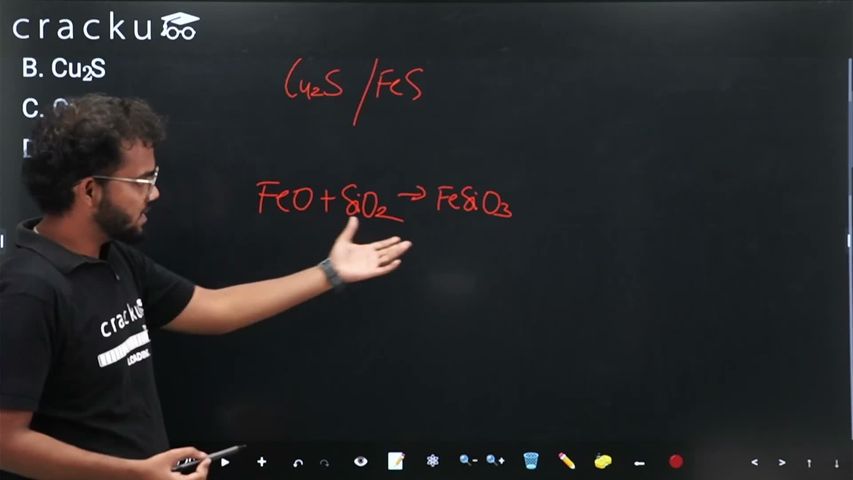
During smelting, iron oxide reacts with silica to form iron silicate slag.
$$FeO+SiO_2\rightarrow FeSiO_3$$
The slag is removed, while copper is obtained in the form of copper matte.
According to NCERT, copper matte consists of
$$Cu_2S \text{ and } FeS$$
Now, evaluating the given compounds:
$$CuCO_3$$ is a carbonate ore of copper and is not a constituent of copper matte.
Therefore,
$$CuCO_3$$
is not present.
$$Cu_2S$$ is one of the principal constituents of copper matte.
Therefore,
$$Cu_2S$$
is present.
$$Cu_2O$$ is formed later during the conversion process when part of $$Cu_2S$$ is oxidized. It is not a constituent of the initial copper matte.
Therefore,
$$Cu_2O$$
is not present.
$$FeO$$ is produced during roasting but reacts with silica to form iron silicate slag and is removed from the furnace.
$$FeO+SiO_2\rightarrow FeSiO_3$$
Therefore,
$$FeO$$
is not present in copper matte.
Hence, among the given compounds, only
$$Cu_2S$$
is present in copper matte.
Therefore, the total number of compounds present is
$$1$$
Hence, the correct answer is
$$1$$
Was this solution helpful?
Click on the Email ☝️ to Watch the Video Solution
Create a FREE account and get:
_1.webp)

Educational materials for JEE preparation

Ask our AI anything

AI can make mistakes. Please verify important information.
AI can make mistakes. Please verify important information.


