
Join Our JEE Preparation Group
Prep with like-minded aspirants; Get access to free daily tests and study material.
Sign in
Please select an account to continue using cracku.in
↓ →
Join Our JEE Preparation Group
Prep with like-minded aspirants; Get access to free daily tests and study material.
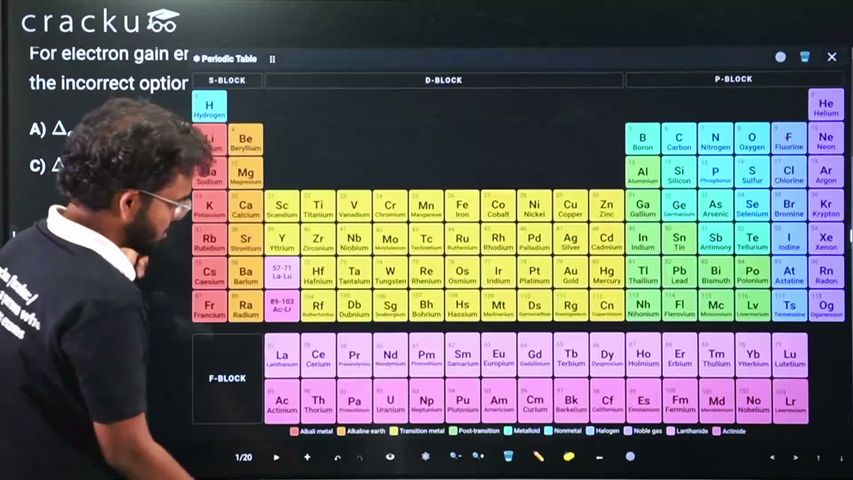
For electron gain enthalpies of the elements denoted as $$\Delta_{eg}$$H, the incorrect option is:
Electron gain enthalpy, $$\Delta_{eg}H$$, is the enthalpy change associated with the addition of an electron to an isolated gaseous atom.
For most non-metals, energy is released when an electron is added. Therefore, electron gain enthalpy values are generally negative.
As we move down a group, electron gain enthalpy usually becomes less negative because the incoming electron is added farther from the nucleus and experiences greater shielding.
An important exception occurs in the second period. Due to their very small size, elements such as fluorine and oxygen experience significant interelectronic repulsions, making their electron gain enthalpies less negative than expected.
The approximate electron gain enthalpy values are
$$F=-328\ \text{kJ mol}^{-1}$$
$$Cl=-349\ \text{kJ mol}^{-1}$$
$$I=-295\ \text{kJ mol}^{-1}$$
$$At\approx -270\ \text{kJ mol}^{-1}$$
$$S=-200\ \text{kJ mol}^{-1}$$
$$Se=-195\ \text{kJ mol}^{-1}$$
$$Te=-190\ \text{kJ mol}^{-1}$$
$$Po\approx -174\ \text{kJ mol}^{-1}$$
Checking each statement algebraically,
For Option A,
$$\Delta_{eg}H(Cl)<\Delta_{eg}H(F)$$
$$-349<-328$$
This statement is correct.
For Option B,
$$\Delta_{eg}H(Se)<\Delta_{eg}H(S)$$
$$-195<-200$$
This statement is incorrect because
$$-195>-200$$
For Option C,
$$\Delta_{eg}H(I)<\Delta_{eg}H(At)$$
$$-295<-270$$
This statement is correct.
For Option D,
$$\Delta_{eg}H(Te)<\Delta_{eg}H(Po)$$
$$-190<-174$$
This statement is correct.
Therefore, the only incorrect statement is
$$\Delta_{eg}H(Se)<\Delta_{eg}H(S)$$
Hence, the correct answer is
$$\text{Option B}$$
Was this solution helpful?
Click on the Email ☝️ to Watch the Video Solution
Create a FREE account and get:
_1.webp)

Educational materials for JEE preparation

Ask our AI anything

AI can make mistakes. Please verify important information.
AI can make mistakes. Please verify important information.


