
Join Our JEE Preparation Group
Prep with like-minded aspirants; Get access to free daily tests and study material.
Sign in
Please select an account to continue using cracku.in
↓ →
Join Our JEE Preparation Group
Prep with like-minded aspirants; Get access to free daily tests and study material.
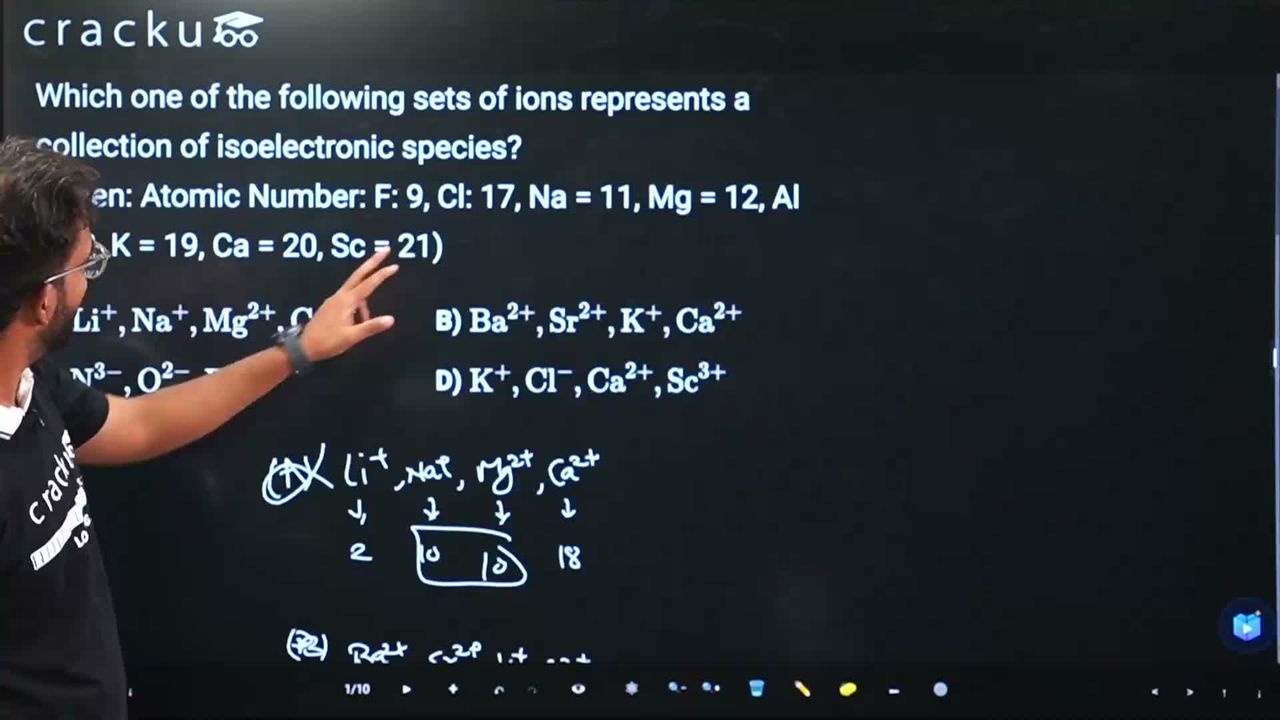
Which one of the following sets of ions represents a collection of isoelectronic species?
(Given: Atomic Number: F: 9, Cl: 17, Na = 11, Mg = 12, Al = 13, K = 19, Ca = 20, Sc = 21)
We need to identify which set of ions represents a collection of isoelectronic species (species with the same number of electrons).
Given atomic numbers: F = 9, Cl = 17, Na = 11, Mg = 12, Al = 13, K = 19, Ca = 20, Sc = 21.
Count electrons for each option.
Option A: $$Li^+, Na^+, Mg^{2+}, Ca^{2+}$$
$$Li^+ : 3 - 1 = 2$$ electrons
$$Na^+ : 11 - 1 = 10$$ electrons
$$Mg^{2+} : 12 - 2 = 10$$ electrons
$$Ca^{2+} : 20 - 2 = 18$$ electrons
Electron counts: 2, 10, 10, 18 — Not isoelectronic.
Option B: $$Ba^{2+}, Sr^{2+}, K^+, Ca^{2+}$$
$$Ba^{2+} : 56 - 2 = 54$$ electrons
$$Sr^{2+} : 38 - 2 = 36$$ electrons
$$K^+ : 19 - 1 = 18$$ electrons
$$Ca^{2+} : 20 - 2 = 18$$ electrons
Electron counts: 54, 36, 18, 18 — Not isoelectronic.
Option C: $$N^{3-}, O^{2-}, F^-, S^{2-}$$
$$N^{3-} : 7 + 3 = 10$$ electrons
$$O^{2-} : 8 + 2 = 10$$ electrons
$$F^- : 9 + 1 = 10$$ electrons
$$S^{2-} : 16 + 2 = 18$$ electrons
Electron counts: 10, 10, 10, 18 — Not isoelectronic.
Option D: $$K^+, Cl^-, Ca^{2+}, Sc^{3+}$$
$$K^+ : 19 - 1 = 18$$ electrons
$$Cl^- : 17 + 1 = 18$$ electrons
$$Ca^{2+} : 20 - 2 = 18$$ electrons
$$Sc^{3+} : 21 - 3 = 18$$ electrons
Electron counts: 18, 18, 18, 18 — All isoelectronic!
Conclusion.
All four ions in Option D have 18 electrons each, making them isoelectronic with the noble gas Argon (Ar, atomic number 18). They all have the electron configuration $$1s^2 2s^2 2p^6 3s^2 3p^6$$.
The correct answer is Option D: $$K^+, Cl^-, Ca^{2+}, Sc^{3+}$$.
Was this solution helpful?
Click on the Email ☝️ to Watch the Video Solution
Create a FREE account and get:
_1.webp)

Educational materials for JEE preparation

Ask our AI anything

AI can make mistakes. Please verify important information.
AI can make mistakes. Please verify important information.


