
Join Our JEE Preparation Group
Prep with like-minded aspirants; Get access to free daily tests and study material.
Sign in
Please select an account to continue using cracku.in
↓ →
Join Our JEE Preparation Group
Prep with like-minded aspirants; Get access to free daily tests and study material.
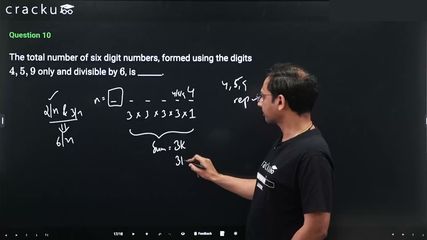
The total number of six digit numbers, formed using the digits $$4, 5, 9$$ only and divisible by $$6$$, is ______.
Correct Answer: 81
We need to find the total number of six-digit numbers formed using the digits $$4, 5, 9$$ only, that are divisible by $$6$$.
A number is divisible by $$6$$ if it is divisible by both $$2$$ and $$3$$. First, for divisibility by $$2$$, the last digit must be even. Among $$\{4, 5, 9\}$$, only $$4$$ is even, so the last digit must be $$4$$. Since the last digit is fixed as $$4$$, divisibility by $$3$$ requires the sum of the first five digits plus $$4$$ to satisfy $$\text{Sum of first 5 digits} + 4 \equiv 0 \pmod{3}$$, which means $$\text{Sum of first 5 digits} \equiv 2 \pmod{3}$$.
Each of the five positions can be filled with $$4$$, $$5$$, or $$9$$, whose residues modulo $$3$$ are: $$4 \equiv 1 \pmod{3}$$, $$5 \equiv 2 \pmod{3}$$, and $$9 \equiv 0 \pmod{3}$$. Since the residues $$\{0, 1, 2\}$$ are equally likely and each position independently takes any residue, the number of 5-tuples with sum $$\equiv r \pmod{3}$$ is the same for each $$r \in \{0, 1, 2\}$$. The total number of 5-tuples is $$3^5 = 243$$, so there are $$\frac{243}{3} = 81$$ 5-tuples for each residue class.
We need the sum of the first five digits to be $$\equiv 2 \pmod{3}$$, which gives $$81$$ valid combinations for those digits. Therefore, the total number of six-digit numbers is 81.
Was this solution helpful?
Click on the Email ☝️ to Watch the Video Solution
Create a FREE account and get:
_1.webp)

Educational materials for JEE preparation

Ask our AI anything

AI can make mistakes. Please verify important information.
AI can make mistakes. Please verify important information.
