
Join Our JEE Preparation Group
Prep with like-minded aspirants; Get access to free daily tests and study material.
Sign in
Please select an account to continue using cracku.in
↓ →
Join Our JEE Preparation Group
Prep with like-minded aspirants; Get access to free daily tests and study material.
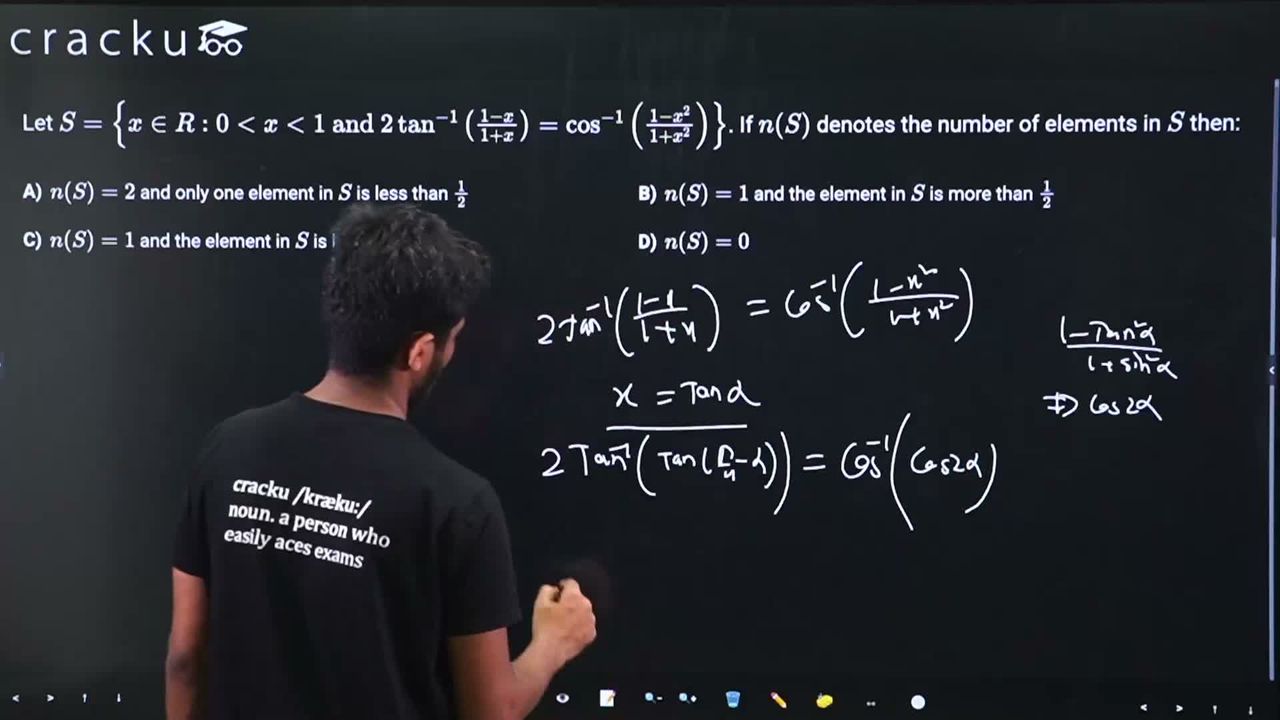
Let $$S = \left\{x \in R : 0 < x < 1 \text{ and } 2\tan^{-1}\left(\frac{1-x}{1+x}\right) = \cos^{-1}\left(\frac{1-x^2}{1+x^2}\right)\right\}$$. If $$n(S)$$ denotes the number of elements in $$S$$ then:
Let $$x \in (0,1)$$ and set $$\alpha = \tan^{-1}x$$. Because $$0 \lt x \lt 1$$, we get $$0 \lt \alpha \lt \frac{\pi}{4}$$.
The given equation is
$$2 \tan^{-1}\!\left(\frac{1-x}{1+x}\right)=\cos^{-1}\!\left(\frac{1-x^{2}}{1+x^{2}}\right)\qquad -(1)$$
Step 1 : Simplify the left-hand side
Recall the identity $$\tan^{-1}\!\left(\frac{1-t}{1+t}\right)=\frac{\pi}{4}-\tan^{-1}t$$ for all $$t \gt 0$$.
Put $$t=x$$: then
$$\tan^{-1}\!\left(\frac{1-x}{1+x}\right)=\frac{\pi}{4}-\tan^{-1}x=\frac{\pi}{4}-\alpha.$$
Hence
$$\text{LHS}=2\Bigl(\frac{\pi}{4}-\alpha\Bigr)=\frac{\pi}{2}-2\alpha\qquad -(2)$$
Step 2 : Simplify the right-hand side
For $$\alpha=\tan^{-1}x$$ we have the double-angle identity
$$\cos 2\alpha=\frac{1-\tan^{2}\alpha}{1+\tan^{2}\alpha}=\frac{1-x^{2}}{1+x^{2}}.$$
Therefore
$$\text{RHS}=\cos^{-1}\!\left(\frac{1-x^{2}}{1+x^{2}}\right)=\cos^{-1}(\cos 2\alpha)\qquad -(3)$$
Step 3 : Evaluate $$\cos^{-1}(\cos 2\alpha)$$
The principal value of $$\cos^{-1}y$$ lies in $$[0,\pi]$$. Since $$0\lt\alpha\lt\frac{\pi}{4}$$, it follows that $$0\lt2\alpha\lt\frac{\pi}{2}$$ which is already inside $$[0,\pi]$$. Hence
$$\cos^{-1}(\cos 2\alpha)=2\alpha\qquad -(4)$$
Step 4 : Equate the two sides
From $$(2)$$ and $$(4)$$ substitute into $$(1)$$:
$$\frac{\pi}{2}-2\alpha = 2\alpha.$$
Solve for $$\alpha$$:
$$\frac{\pi}{2}=4\alpha \;\Longrightarrow\; \alpha=\frac{\pi}{8}.$$
Step 5 : Convert back to $$x$$
$$\alpha=\tan^{-1}x=\frac{\pi}{8}\;\Longrightarrow\; x=\tan\frac{\pi}{8}.$$
Using the known value $$\tan\frac{\pi}{8}=\sqrt{2}-1\approx0.414$$,
$$x=\sqrt{2}-1.$$
Step 6 : Verify range and count solutions
The obtained $$x$$ satisfies $$0\lt x\lt1$$, and $$x\approx0.414\lt\frac{1}{2}.$br We found exactly one solution.
Therefore $$n(S)=1$$ and that single element is less than $$$$\frac{1}{2}$$$$.
Hence, Option C is correct.
Was this solution helpful?
Click on the Email ☝️ to Watch the Video Solution
Create a FREE account and get:
_1.webp)

Educational materials for JEE preparation

Ask our AI anything

AI can make mistakes. Please verify important information.
AI can make mistakes. Please verify important information.


