
Join Our JEE Preparation Group
Prep with like-minded aspirants; Get access to free daily tests and study material.
Sign in
Please select an account to continue using cracku.in
↓ →
Join Our JEE Preparation Group
Prep with like-minded aspirants; Get access to free daily tests and study material.
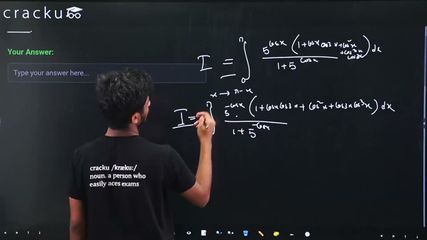
If $$\int_0^{\pi} \frac{5^{\cos x}(1+\cos x \cos 3x + \cos^2 x + \cos^3 x \cos 3x) dx}{1+5^{\cos x}} = \frac{k\pi}{16}$$, then $$k$$ is equal to ______.
Correct Answer: 13
$$$\displaystyle\int_0^{\pi} \frac{5^{\cos x}\left(1 + \cos x\cos 3x + \cos^2 x + \cos^3 x\cos 3x\right)}{1 + 5^{\cos x}}\, dx = \frac{k\pi}{16}$$$. Find $$k$$.
Let $$g(x) = 1 + \cos x\cos 3x + \cos^2 x + \cos^3 x\cos 3x$$. Factor by grouping to obtain $$g(x) = (1 + \cos^2 x) + \cos x\cos 3x(1 + \cos^2 x) = (1 + \cos^2 x)(1 + \cos x\cos 3x)\,.$$
Define $$f(x) = \frac{5^{\cos x}}{1 + 5^{\cos x}}$$. Under the substitution $$x \to \pi - x$$, we have $$\cos x \to -\cos x$$ so that $$f(\pi - x) = \frac{5^{-\cos x}}{1 + 5^{-\cos x}} = \frac{1}{1 + 5^{\cos x}}$$. Moreover, $$g(\pi - x) = (1 + \cos^2 x)(1 + (-\cos x)(-\cos 3x)) = (1 + \cos^2 x)(1 + \cos x\cos 3x) = g(x)\,. $$ Therefore $$f(x) + f(\pi - x) = 1$$ and $$g$$ is symmetric about $$x = \pi/2$$. Adding the original integral to its version under this substitution gives$$2I = \int_0^{\pi}g(x)\,dx\,.$$
Using the identity $$\cos 3x = 4\cos^3 x - 3\cos x$$, one finds$$\cos x\cos 3x = 4\cos^4 x - 3\cos^2 x$$and hence$$g(x) = (1 + \cos^2 x)(1 + 4\cos^4 x - 3\cos^2 x)\,.$$Expanding leads to$$g(x) = 1 - 2\cos^2 x + \cos^4 x + 4\cos^6 x = \sin^4 x + 4\cos^6 x\,.$$
By the standard reduction formulas,$$\int_0^{\pi}\sin^4 x\,dx = \frac{3\pi}{8}\quad\text{and}\quad\int_0^{\pi}\cos^6 x\,dx = \frac{5\pi}{16}\,. $$It follows that$$\int_0^{\pi}g(x)\,dx = \frac{3\pi}{8} + 4\cdot\frac{5\pi}{16} = \frac{13\pi}{8}\,.$$
Hence$$2I = \frac{13\pi}{8}\quad\Longrightarrow\quad I = \frac{13\pi}{16}\,, $$so that comparing with $$\frac{k\pi}{16}$$ gives $$k = 13\,. $$
Answer: 13
Click on the Email ☝️ to Watch the Video Solution
Create a FREE account and get:
_1.webp)

Educational materials for JEE preparation

Ask our AI anything

AI can make mistakes. Please verify important information.
AI can make mistakes. Please verify important information.


