
Join Our JEE Preparation Group
Prep with like-minded aspirants; Get access to free daily tests and study material.
Sign in
Please select an account to continue using cracku.in
↓ →
Join Our JEE Preparation Group
Prep with like-minded aspirants; Get access to free daily tests and study material.
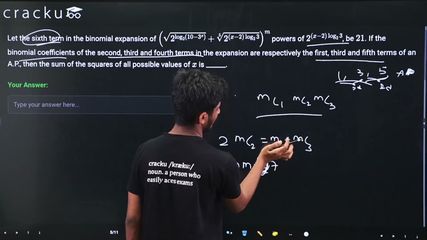
Let the sixth term in the binomial expansion of $$\left(\sqrt{2^{\log_2(10-3^x)}} + \sqrt[5]{2^{(x-2)\log_2 3}}\right)^m$$ powers of $$2^{(x-2)\log_2 3}$$, be $$21$$. If the binomial coefficients of the second, third and fourth terms in the expansion are respectively the first, third and fifth terms of an A.P., then the sum of the squares of all possible values of $$x$$ is ______.
Correct Answer: 4
We are given the binomial expansion of $$(\sqrt{2^{\log_2(10-3^x)}} + \sqrt[5]{2^{(x-2)\log_2 3}})^m$$.
First, simplify the terms. The first term is $$\sqrt{2^{\log_2(10-3^x)}} = (10-3^x)^{1/2}$$ and the second term is $$\sqrt[5]{2^{(x-2)\log_2 3}} = \bigl(2^{\log_2 3}\bigr)^{(x-2)/5} = 3^{(x-2)/5},$$ so the expression becomes $$( (10-3^x)^{1/2} + 3^{(x-2)/5} )^m$$.
Next, the binomial coefficients of the 2nd, 3rd, and 4th terms are $$\binom{m}{1}, \binom{m}{2}, \binom{m}{3},$$ which correspond to the 1st, 3rd, and 5th terms of an arithmetic progression. For these three terms to be equally spaced we require $$\binom{m}{2} - \binom{m}{1} = \binom{m}{3} - \binom{m}{2},$$ that is $$2\binom{m}{2} = \binom{m}{1} + \binom{m}{3}.$$ Substituting the values of the binomial coefficients gives $$m(m-1) = m + \frac{m(m-1)(m-2)}{6},$$ which simplifies to $$6(m-1) = 6 + (m-1)(m-2),$$ then $$6m - 6 = 6 + m^2 - 3m + 2,$$ leading to $$m^2 - 9m + 14 = 0$$ and hence $$(m-2)(m-7) = 0.$$ Since the 6th term must exist ($$m\ge5$$), we choose $$m=7$$.
Now using the 6th term condition, $$T_6 = \binom{7}{5} \cdot \bigl((10-3^x)^{1/2}\bigr)^2 \cdot \bigl(3^{(x-2)/5}\bigr)^5 = 21$$ implies $$21\,(10-3^x)\,3^{x-2} = 21$$ and thus $$(10-3^x)\,3^{x-2} = 1.$$ Letting $$t = 3^x$$ transforms this into $$(10 - t)\frac{t}{9} = 1,$$ which simplifies to $$10t - t^2 = 9,$$ then $$t^2 - 10t + 9 = 0,$$ so $$(t-1)(t-9) = 0.$$ Therefore $$t=1\implies x=0$$ or $$t=9\implies x=2.$$
Both values are valid since for $$x=0$$ we have $$10-1=9\gt 0$$ and for $$x=2$$ we have $$10-9=1\gt 0$$. The sum of squares of all possible values of $$x$$ is $$0^2 + 2^2 = 0 + 4 = 4$$.
Was this solution helpful?
Click on the Email ☝️ to Watch the Video Solution
Create a FREE account and get:
_1.webp)

Educational materials for JEE preparation

Ask our AI anything

AI can make mistakes. Please verify important information.
AI can make mistakes. Please verify important information.


