
Join Our JEE Preparation Group
Prep with like-minded aspirants; Get access to free daily tests and study material.
Sign in
Please select an account to continue using cracku.in
↓ →
Join Our JEE Preparation Group
Prep with like-minded aspirants; Get access to free daily tests and study material.
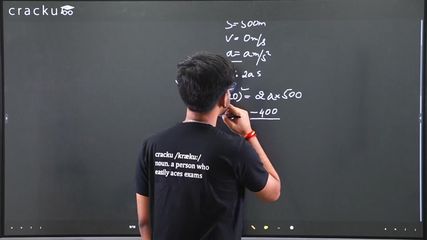
For a train engine moving with speed of $$20$$ ms$$^{-1}$$, the driver must apply brakes at a distance of $$500$$ m before the station for the train to come to rest at the station. If the brakes were applied at half of this distance, the train engine would cross the station with speed $$\sqrt{x}$$ ms$$^{-1}$$. The value of $$x$$ is ______. (Assuming same retardation is produced by brakes)
Correct Answer: 200
Scenario 1: Full stopping distance
Initial velocity $$u = 20 \text{ m/s}$$
Final velocity $$v_1 = 0 \text{ m/s}$$
Displacement $$s_1 = 500 \text{ m}$$
$$v_1^2 - u^2 = 2as_1$$
$$0^2 - (20)^2 = 2a(500)$$
$$-400 = 1000a$$
$$a = -0.4 \text{ m/s}^2$$
Scenario 2: Half the stopping distance
The brakes are now applied at half the distance, meaning the train travels $$s_2 = 250 \text{ m}$$ while decelerating. We want to find its speed $$v_2$$ as it crosses the station.
Initial velocity $$u = 20 \text{ m/s}$$
Acceleration $$a = -0.4 \text{ m/s}^2$$
Displacement $$s_2 = 250 \text{ m}$$
$$v_2^2 - u^2 = 2as_2$$
$$v_2^2 - (20)^2 = 2(-0.4)(250)$$
$$v_2^2 - 400 = -0.8(250)$$
$$v_2^2 - 400 = -200$$
$$v_2^2 = 200$$
$$v_2 = \sqrt{200} \text{ m/s}$$
Was this solution helpful?
Click on the Email ☝️ to Watch the Video Solution
Create a FREE account and get:
_1.webp)

Educational materials for JEE preparation

Ask our AI anything

AI can make mistakes. Please verify important information.
AI can make mistakes. Please verify important information.
