
Join Our JEE Preparation Group
Prep with like-minded aspirants; Get access to free daily tests and study material.
Sign in
Please select an account to continue using cracku.in
↓ →
Join Our JEE Preparation Group
Prep with like-minded aspirants; Get access to free daily tests and study material.
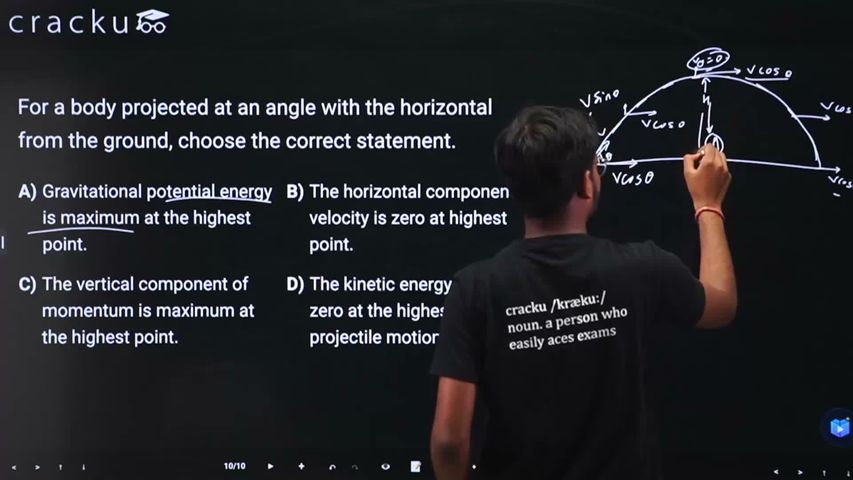
For a body projected at an angle with the horizontal from the ground, choose the correct statement.
We need to identify the correct statement about a body projected at an angle with the horizontal from the ground.
Analyzing each option:
Option A: Gravitational potential energy is maximum at the highest point.
At the highest point, the body reaches its maximum height. Since gravitational potential energy $$U = mgh$$, and $$h$$ is maximum at the highest point, the GPE is indeed maximum there. This statement is correct.
Option B: The horizontal component of velocity is zero at the highest point.
In projectile motion, the horizontal component of velocity remains constant throughout the flight ($$v_x = u\cos\theta$$). It is never zero (unless the projection angle is 90°, which is not a general case). This statement is incorrect.
Option C: The vertical component of momentum is maximum at the highest point.
At the highest point, the vertical component of velocity is zero, so the vertical component of momentum $$p_y = mv_y = 0$$, which is its minimum magnitude, not maximum. This statement is incorrect.
Option D: The kinetic energy is zero at the highest point.
At the highest point, the body still has horizontal velocity $$v_x = u\cos\theta$$, so $$KE = \frac{1}{2}m(u\cos\theta)^2 \neq 0$$. This statement is incorrect.
The answer is Option A: Gravitational potential energy is maximum at the highest point.
Was this solution helpful?
Click on the Email ☝️ to Watch the Video Solution
Create a FREE account and get:
_1.webp)

Educational materials for JEE preparation

Ask our AI anything

AI can make mistakes. Please verify important information.
AI can make mistakes. Please verify important information.
