
Join Our JEE Preparation Group
Prep with like-minded aspirants; Get access to free daily tests and study material.
Sign in
Please select an account to continue using cracku.in
↓ →
Join Our JEE Preparation Group
Prep with like-minded aspirants; Get access to free daily tests and study material.
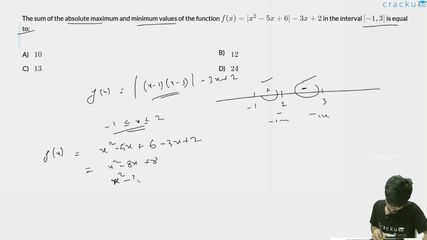
The sum of the absolute maximum and minimum values of the function $$f(x) = |x^2 - 5x + 6| - 3x + 2$$ in the interval $$[-1, 3]$$ is equal to:
Given $$f(x)=\left|x^{2}-5x+6\right|-3x+2$$ on the closed interval $$[-1,\,3]$$. Write the quadratic inside the modulus in factored form:
$$x^{2}-5x+6=(x-2)(x-3)$$
Its zeros are $$x=2$$ and $$x=3$$, which lie inside $$[-1,3]$$. Hence the sign of $$x^{2}-5x+6$$ is:
• positive on $$[-1,\,2]$$, because a test point $$x=0$$ gives $$6\gt0$$.
• negative on $$(2,\,3]$$, because a test point $$x=2.5$$ gives $$-0.25\lt0$$.
Therefore split $$f(x)$$ into two smooth pieces.
Case 1:
For $$x\in[-1,\,2]$$, $$|x^{2}-5x+6|=x^{2}-5x+6$$, so
$$f_1(x)=x^{2}-5x+6-3x+2=x^{2}-8x+8.$$ Find extrema of $$f_1(x)$$ on $$[-1,\,2]$$.
Derivative: $$f_1'(x)=2x-8.$$ Set $$f_1'(x)=0\ \Rightarrow\ 2x-8=0\ \Rightarrow\ x=4,$$ which lies outside $$[-1,2]$$. Thus only the endpoints need checking.
$$f_1(-1)=(-1)^{2}-8(-1)+8=1+8+8=17$$
$$f_1(2)=2^{2}-8\cdot2+8=4-16+8=-4$$
On $$[-1,2]$$: absolute maximum $$=17$$, absolute minimum $$=-4$$.
Case 2:
For $$x\in[2,\,3]$$, $$|x^{2}-5x+6|=-(x^{2}-5x+6)=-x^{2}+5x-6,$$ so
$$f_2(x)=-x^{2}+5x-6-3x+2=-x^{2}+2x-4.$$ Find extrema of $$f_2(x)$$ on $$[2,\,3]$$.
Derivative: $$f_2'(x)=-2x+2.$$ Set $$f_2'(x)=0\ \Rightarrow\ -2x+2=0\ \Rightarrow\ x=1,$$ which lies outside $$[2,3]$$. Again, check only the endpoints.
$$f_2(2)=-(2)^{2}+2\cdot2-4=-4+4-4=-4$$
$$f_2(3)=-(3)^{2}+2\cdot3-4=-9+6-4=-7$$
On $$[2,3]$$: absolute maximum $$=-4$$, absolute minimum $$=-7$$.
Combining both cases, on the whole interval $$[-1,3]$$ we have absolute maximum value $$=17$$ (at $$x=-1$$) and absolute minimum value $$=-7$$ (at $$x=3$$).
Required sum = $$17+(-7)=10$$.
Hence the correct option is Option A $$(10)$$.
Was this solution helpful?
Click on the Email ☝️ to Watch the Video Solution
Create a FREE account and get:
_1.webp)

Educational materials for JEE preparation

Ask our AI anything

AI can make mistakes. Please verify important information.
AI can make mistakes. Please verify important information.


