
Join Our JEE Preparation Group
Prep with like-minded aspirants; Get access to free daily tests and study material.
Sign in
Please select an account to continue using cracku.in
↓ →
Join Our JEE Preparation Group
Prep with like-minded aspirants; Get access to free daily tests and study material.
The molality of a $$10\%(v/V)$$ solution of di-bromine solution in CCl$$_4$$ (carbon tetrachloride) is x. $$x = $$ ______ $$\times 10^{-2}$$ M. (Nearest integer)
[Given: molar mass of Br$$_2 = 160$$ g mol$$^{-1}$$, atomic mass of C $$= 12$$ g mol$$^{-1}$$, atomic mass of Cl $$= 35.5$$ g mol$$^{-1}$$, density of dibromine $$= 3.2$$ g cm$$^{-3}$$, density of CCl$$_4 = 1.6$$ g cm$$^{-3}$$]
Correct Answer: 139
We need to find the molality of a $$10\%$$ (v/V) solution of dibromine (Br$$_2$$) in CCl$$_4$$.
Interpret 10% (v/V).
$$10\%$$ (v/V) means 10 mL of Br$$_2$$ is present in 100 mL of solution.
Find the mass of Br$$_2$$ (solute).
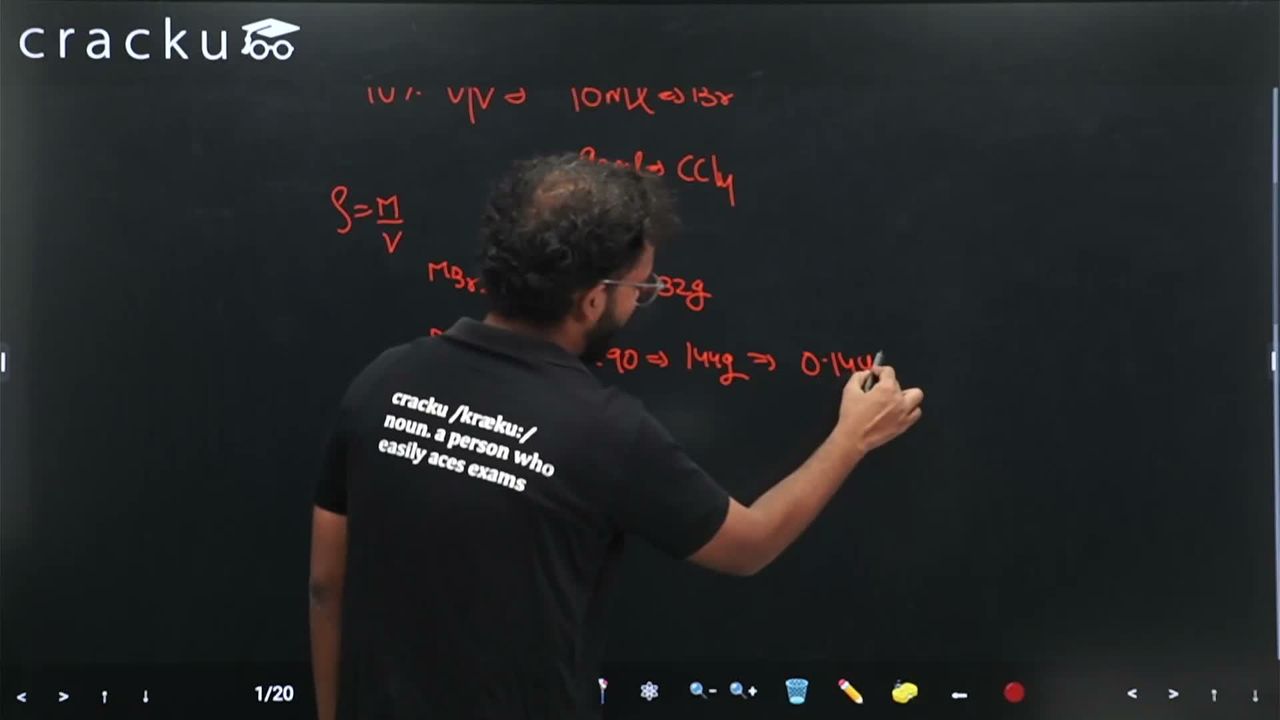
Mass of Br$$_2$$ = Volume $$\times$$ Density = $$10 \times 3.2 = 32$$ g
Moles of Br$$_2$$ = $$\frac{32}{160} = 0.2$$ mol
Find the mass of CCl$$_4$$ (solvent).
Volume of CCl$$_4$$ = Total volume $$-$$ Volume of Br$$_2$$ = $$100 - 10 = 90$$ mL
Mass of CCl$$_4$$ = $$90 \times 1.6 = 144$$ g = $$0.144$$ kg
Calculate molality.
$$ \text{Molality} = \frac{\text{Moles of solute}}{\text{Mass of solvent (kg)}} = \frac{0.2}{0.144} = 1.3889 \text{ mol/kg} $$
Express in the required form.
$$x \times 10^{-2} = 1.3889$$
$$x = 138.89 \approx 139$$ (nearest integer)
The answer is $$\boxed{139}$$.
Was this solution helpful?
Click on the Email ☝️ to Watch the Video Solution
Create a FREE account and get:
_1.webp)

Educational materials for JEE preparation

Ask our AI anything

AI can make mistakes. Please verify important information.
AI can make mistakes. Please verify important information.


