
Join Our JEE Preparation Group
Prep with like-minded aspirants; Get access to free daily tests and study material.
Sign in
Please select an account to continue using cracku.in
↓ →
Join Our JEE Preparation Group
Prep with like-minded aspirants; Get access to free daily tests and study material.
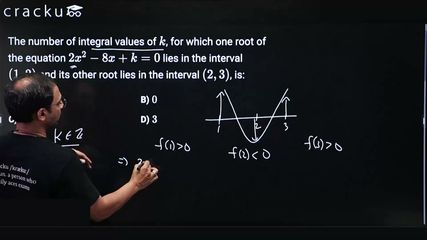
The number of integral values of $$k$$, for which one root of the equation $$2x^2 - 8x + k = 0$$ lies in the interval $$(1, 2)$$ and its other root lies in the interval $$(2, 3)$$, is:
Let $$f(x)=2x^{2}-8x+k$$. The quadratic has real roots only when its discriminant is positive:
$$\Delta = (-8)^{2}-4\cdot2\cdot k = 64-8k \gt 0 \;\;\Longrightarrow\;\; k \lt 8.$$
Denote the two roots by $$\alpha$$ and $$\beta$$. From Vieta’s relations,
$$\alpha+\beta=\frac{8}{2}=4,\qquad \alpha\beta=\frac{k}{2}.$$
The condition “one root in $$(1,2)$$ and the other in $$(2,3)$$” forces the smaller root to lie in $$(1,2)$$ and the larger in $$(2,3)$$ (because $$\alpha+\beta=4$$).
Hence let $$\alpha\in(1,2)$$. Then $$\beta=4-\alpha\in(2,3).$$
Using $$\alpha\beta=\dfrac{k}{2}$$, we obtain
$$k =2\alpha\beta =2\alpha(4-\alpha) =8\alpha-2\alpha^{2}.$$
As $$\alpha$$ varies in $$(1,2)$$, the expression $$8\alpha-2\alpha^{2}$$ takes every value between
$$k_{\min}=8\cdot1-2\cdot1^{2}=6 \quad\text{and}\quad k_{\max}=8\cdot2-2\cdot2^{2}=8.$$
Because the endpoints $$\alpha=1$$ and $$\alpha=2$$ are not included, we actually have
$$6 \lt k \lt 8.$$
The only integer that satisfies $$6 \lt k \lt 8$$ is $$k=7.$$
Therefore exactly one integral value of $$k$$ meets the given requirement.
Hence, the required number of integral values is $$1$$. (Option C)
Was this solution helpful?
Click on the Email ☝️ to Watch the Video Solution
Create a FREE account and get:
_1.webp)

Educational materials for JEE preparation

Ask our AI anything

AI can make mistakes. Please verify important information.
AI can make mistakes. Please verify important information.


