91- 6303239042
 CAT WhatsApp Group



CAT PYQs PDF
Preparing for CAT 2026, your first step is to check the previous years' questions. CAT previous years' questions give you a clear view of the question styles tested in the actual exam. But which CAT questions should you solve first? You can begin with topic-wise PYQs and later move to complete slot-wise papers. CAT has 68 questions across VARC, DILR and Quant in the recent pattern, with 24 questions in VARC and 22 each in DILR and QA.
CAT Topic-wise PYQs
Here, you can download CAT topic-wise PYQs for each section. Start with individual topics when you need to practice a concept, then move to mixed and full-length papers.
Check section-wise PYQs below: -
These questions help you revise the concepts and help you manage the time during the CAT 2026 exam.
CAT VARC Topic-wise PYQs
VARC requires regular exposure to different question structures. Reading Comprehension remains the largest part of the section, while para-based questions form the key Verbal Ability component. Recent CAT analysis shows RC taking roughly two-thirds of VARC, although the exact mix can change.
CAT DILR Topic-wise PYQs
DILR improves through repeated exposure to unfamiliar sets. Recent CAT 2025 analysis found Logical Reasoning at about 59% of DILR questions, with mixed DI-LR caselets and pure DI forming the remaining share.
CAT Quant Topic-wise PYQs
Arithmetic, Algebra and Geometry consistently form a substantial part of the CAT Quant syllabus. If practised well, QA can become your highest-scoring section.
CAT PYQ Topic-wise Weightage
The expected question count can vary across CAT slots, so these figures should be treated as preparation ranges. Recent papers still show clear concentration around RC, Arithmetic, Algebra and core DILR sets.
Topic | Expected Questions | Approx. Weightage |
Reading Comprehension | 16 | ~67% |
Para Jumbles | 2 | ~8% |
Para Summary | 2 | ~8% |
Sentence Insertion | 2 | ~8% |
Odd One Out | 2 | ~8% |
Arrangements & Seating Puzzles | 2–4 | ~10–18% |
Tables & Charts | 2–4 | ~10–18% |
Games & Tournaments | 2–4 | ~10–18% |
Selection & Distribution | 2–4 | ~10–18% |
Routes & Networks | 1–3 | ~5–14% |
Mathematical Reasoning | 1–3 | ~5–14% |
Venn Diagrams | 1–2 | ~5–9% |
Ranking & Ordering | 1–2 | ~5–9% |
Caselets & Mixed DI Sets | 2–4 | ~10–18% |
Arithmetic | 8–9 | ~35–40% |
Algebra | 5–7 | ~25–30% |
Geometry & Mensuration | 3–4 | ~15–20% |
Number System | 2–3 | ~10–15% |
Modern Mathematics | 1–2 | ~5–10% |
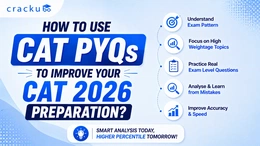
How to Use CAT PYQs for Preparation
Begin topic-wise: Solve PYQs after finishing a concept instead of waiting until revision.
Maintain an error log: Record concept gaps, calculation slips and questions that consumed excessive time.
Check solutions carefully: A correct answer is useful, but the shortest method can improve your next attempt.
Repeat difficult questions: Revisit incorrect PYQs after a few days without looking at the solution.
Move from topics to sets: DILR should gradually shift from individual questions to complete sets.
Add a timer: Once accuracy improves, solve PYQs under realistic sectional limits.
Track patterns: Mark repeated concepts and question structures across different CAT years.
Use slot-wise papers: Full CAT previous papers help you understand the pressure created by mixed topics.
Take PYQs online: Attempting actual papers as timed tests gives you a closer exam-like experience.
How many years of CAT PYQs should I solve?
You should ideally cover at least five years of CAT PYQs, such as CAT 2021 to CAT 2025. Older papers can be added for extra practice if you have enough preparation time. Recent papers deserve greater attention because CAT's question style and section structure can shift over time.
- Start with CAT 2021–2025 topic-wise PYQs during concept preparation. Solve questions from a topic after completing its concepts and basic practice.
- Move to slot-wise papers after completing the syllabus. Attempt CAT 2021, 2022, 2023, 2024 and 2025 papers slot by slot instead of mixing questions randomly.
- Treat each slot as a separate paper. For example, you can attempt CAT 2025 Slot 1 first, followed by Slot 2 and Slot 3. Repeat the same approach for the earlier years.
- Use sectional papers as timed tests. Cracku provides previous CAT sectional papers with options to download the PDF or take the paper as an online test.
- Combine PYQs with free full-length CAT mocks. First solve topic-wise PYQs, then take full mocks, analyse mistakes and return to weak topics.
- After your CAT admit card is released, make the final phase more slot-focused. Check your assigned exam slot and start taking mocks at the same time of day.
- Attempt complete PYQs within the actual sectional limits. Take VARC, DILR and QA papers within their respective 40-minute limits, rather than treating PYQs only as question banks.
- Use the online format for final practice. Cracku's previous sectional papers support online attempts, helping you practise the timing and pressure of a real CAT section.
CAT PYQs PDF: Conclusion
CAT PYQs are very useful for understanding the CAT exam pattern, important topics, and question types. Solving topic-wise previous year questions helps improve concepts, accuracy, and familiarity with VARC, DILR, and QA.
Start with topic-wise PYQs and track your mistakes using an error log. Once you complete the syllabus, solve full CAT previous year papers with a timer. Combine PYQs with mocks and revision to improve your speed, accuracy, and confidence for CAT 2026.