91- 6303239042
 CAT WhatsApp Group



 Preferred Source

 Google Discover
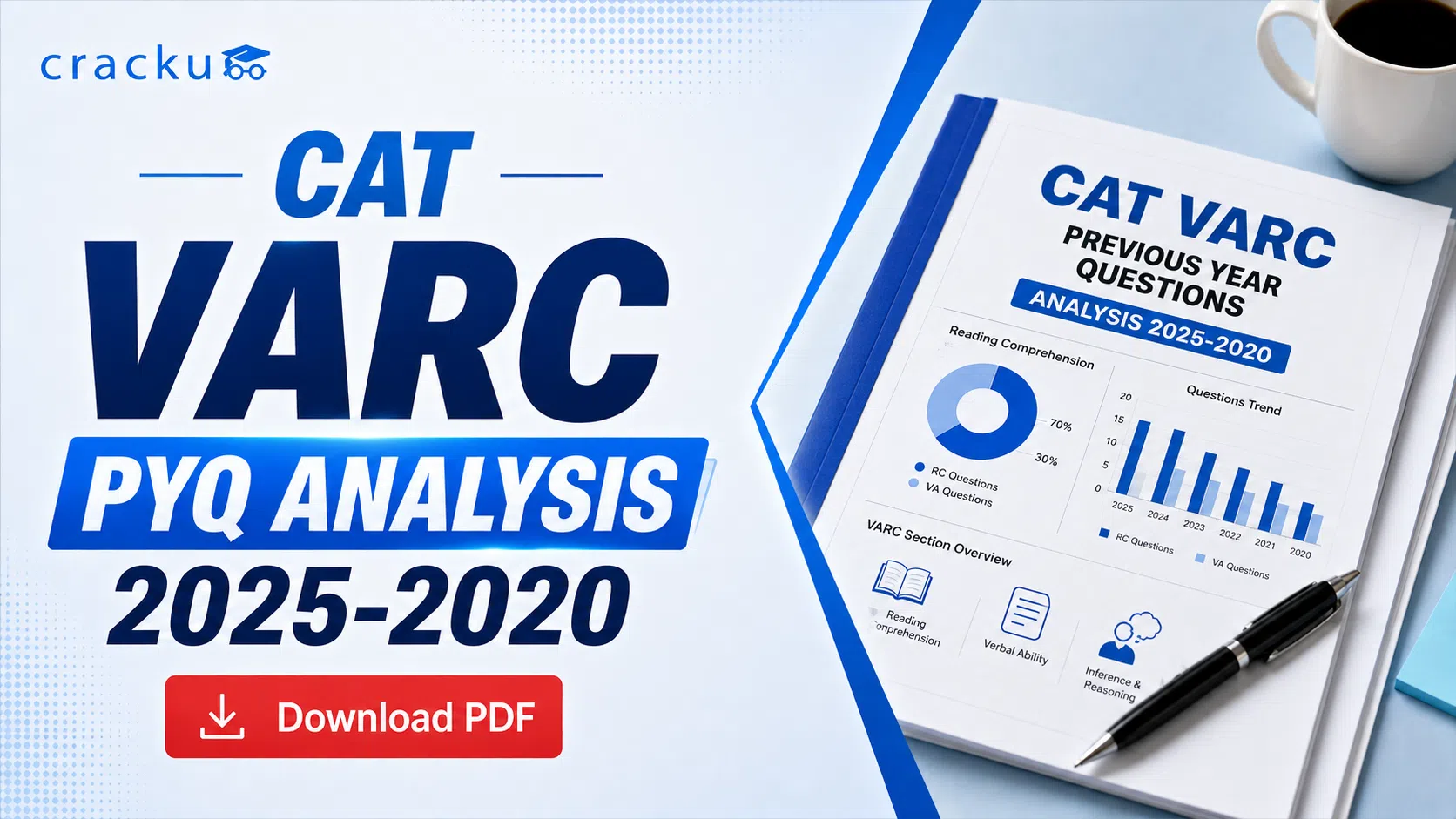
CAT VARC PYQ Analysis 2026
CAT VARC has kept its basic structure fairly stable, but question framing has become noticeably trickier. From 2025 to 2020, RC continued taking the larger share of the VARC section. The main change in VARC appeared in inference, reasoning, and closely worded answer choices.
Meanwhile, VA kept rotating between para summary, para jumbles, odd one out, and sentence insertion. Therefore, your preparation needs reading depth, logical thinking, and regular question analysis. The CAT VARC PYQs can show which patterns repeated and what topics have high weightage. But building strategy still depends on you.
CAT VARC Previous Year Papers 2025-2020 PDF
Following are the CAT VARC Previous Year Papers Slot-wise from 2020 to 2025 with video and Text solutions:
CAT Year | Slot | Download PDF |
2025 | Slot 1 | |
Slot 2 | ||
Slot 3 | ||
2024 | Slot 1 | |
Slot 2 | ||
Slot 3 | ||
2023 | Slot 1 | |
Slot 2 | ||
Slot 3 | ||
2022 | Slot 1 | |
Slot 2 | ||
Slot 3 | ||
2021 | Slot 1 | |
Slot 2 | ||
Slot 3 | ||
2020 | Slot 1 | |
Slot 2 | ||
Slot 3 |
CAT VARC PYQ Analysis From 2025 to 2020
The past six years show a fairly stable VARC structure with changing question difficulty. RC continued dominating the section, while VA remained comparatively smaller.
Year | Total VARC Questions | RC Questions | VA Questions |
2025 | 24 | 16 | 8 |
2024 | 24 | 16 | 8 |
2023 | 24 | 16 | 8 |
2022 | 24 | 16 | 8 |
2021 | 24 | 16 | 8 |
2020 | 26 | 18 | 8 |
RC has therefore remained the main scoring area throughout these papers. However, direct passage-based questions have gradually become less dominant.
The answer choices also became closer, making elimination more important during timed attempts. You cannot rely only on finding an exact sentence from the passage anymore.
CAT VARC Previous Year Questions Analysis: Year-wise Trends
CAT VARC has changed through question framing rather than constant structural changes. The RC section remained dominant, while VA types continued rotating.
Year | RC Focus | VA Pattern | Major RC Characteristics |
2025 | Inference and interpretation | Mixed VA formats | Dense passages with closely framed options |
2024 | Analytical and conceptual | Summary, Odd One Out, Sentence Insertion | Abstract themes, social issues, science |
2023 | Reasoning and inference | PJ, Summary, Odd One Out, Sentence Insertion | Economics, literature, philosophy |
2022 | Fact and inference | PJ, Summary, Odd One Out, Sentence Insertion | Management, technology, humanities |
2021 | Critical reasoning and inference | Para Jumbles, Summary, Odd One Out | Technology, environment, literature |
2020 | Fact and inference | Para Jumbles, Summary, Odd One Out | Science, history, psychology, technology |
The genres have remained broad, so restricting your reading to business articles can hurt your preparation.
Philosophy, psychology, sociology, science, history, economics, and literature can all appear. The subject itself is rarely the real problem. Understanding the author's argument matters far more during the actual paper.
Also Read: CAT RC Types 2026: Genres, Strategies & Cheat Sheet PDF
CAT VARC Topic-wise Weightage and Analysis
RC accounts for the larger portion of VARC questions, making it the first area to strengthen. Within RC, question types have shown a clear preference for detail and inference.
CAT RC Question Type Weightage
Question Type | Questions (2025–2020) | Topics Where It Commonly Appears | What You Need to Do |
Specific Detail | 29 | Science, History, Economics, Technology, Sociology | Locate the correct information and verify its context |
Inference | 23 | Philosophy, Psychology, Sociology, Economics, Science | Understand what logically follows from the passage |
Argument Analysis | 15 | Philosophy, Economics, Social Issues, Politics | Identify claims, reasons, assumptions, and conclusions |
Structure & Function | 15 | Literature, History, Science, Sociology | Understand why an idea, example, or paragraph appears |
Main Idea | 9 | Philosophy, Literature, Social Issues, Economics | Identify the central argument without getting distracted |
Application | 8 | Science, Technology, Economics, Environment | Apply the passage's logic to a new situation |
Tone | 1 | Literature, Philosophy, Social Issues | Identify the author's attitude toward the subject |
Specific-detail questions appeared most frequently across the analysed papers. However, inference remains equally important because it demands deeper passage understanding.
Argument analysis and structure-based questions also deserve regular practice. They test whether you understand why the author presents an idea, rather than simply what appears.
CAT VA Question Type Weightage
VA Question Type | Share in VA Portion |
31% | |
31% | |
22% | |
16% |
Para Summary and Para Jumbles together form the largest VA share in the analysed distribution. Their questions reward logical flow rather than vocabulary-heavy preparation.
Odd One Out also needs attention because the correct choice depends on identifying the paragraph's central connection. Para Completion requires you to understand the direction of the argument before selecting the missing sentence.
Most Important CAT VARC Topics Based on PYQs
Your VARC preparation should give more time to question types that repeatedly test reasoning. RC deserves the first priority because it contributes the largest question share.
Priority | Topic | What to Practice |
Very High | Locate supporting information without overreading | |
Very High | Critical Reasoning | Understand implied meaning and logical conclusions |
Very High | Para Completion and Summary | Identify the central idea and remove extra details |
Very High | Para Jumbles | Track chronology, links, references, and argument flow |
High | Critical Reasoning | Understand claims, reasons, assumptions, and conclusions |
High | Reading Comprehension | Identify why a sentence or paragraph appears |
High | Odd One Out | Find the sentence breaking the central connection |
Moderate | Reading Comprehension | Capture the author's central argument |
Moderate | Critical Reasoning | Extend the passage's logic to a new situation |
Moderate | Para Completion and Summary | Continue the author's existing thought logically |
One important point stands out from these PYQs. CAT VARC is not heavily dependent on difficult vocabulary.
Your reading should instead build awareness of arguments, context, structure, and implied meaning. That shift can make your preparation more focused.
Also Read: CAT VARC Cheat Sheet PDF by Sayali Mam, Download Now
Most Repeated CAT VARC Topics in Previous Year Papers
The same broad areas keep returning, even when their exact question framing changes.
Reading Comprehension
RC remains the heart of VARC because it consistently occupies the larger question share. The passages can move from philosophy to science without warning.
You should therefore practice RC passages across unrelated subjects instead of sticking to familiar themes.
Inference-Based Questions
Inference has become one of the most useful areas to practice from recent PYQs. The answer may not appear directly anywhere in the passage.
You need to connect the author's statements and identify what logically follows. Avoid selecting an option simply because it sounds reasonable.
Para Summary
Para Summary has remained a dependable VA area across recent CAT papers. The challenge lies in separating the central idea from supporting details.
A strong summary should capture the paragraph's argument without adding a new opinion. Watch for options that sound broad but miss the author's actual point.
Para Jumbles
Para Jumbles test logical sequencing instead of grammar alone. Look for opening sentences, pronoun links, chronology, examples, and cause-effect relationships.
However, their presence has varied across recent papers. Therefore, keep them in your practice routine without depending entirely on their appearance.
Odd One Out
Odd One Out requires a slightly different approach from regular paragraph sequencing. You need to identify four sentences that share one logical thread.
The remaining sentence usually discusses a related idea without fitting that specific thread.
Argument Analysis and Structure
These questions reward close reading and careful reasoning. You need to understand how different statements connect within the passage.
The question can ask about a claim, supporting argument, example, or structural purpose. Reading for the author's logic makes these questions easier to handle.
CAT 2025 VARC Slot-wise PYQ Analysis
CAT 2025 continued with 16 RC questions and 8 VA questions per slot. The difficulty remained moderate to difficult across the paper.
Slot | Difficulty | Broad Focus |
Slot 1 | Moderate to Difficult | Dense RCs and reasoning-based questions |
Slot 2 | Moderate to Difficult | Inference, detail, and mixed VA |
Slot 3 | Moderate to Difficult | Closely worded options and conceptual RCs |
The slots did not follow identical topic distributions. This matters because CAT can shift the weightage without changing the section structure.
CAT 2025 VARC Slot 1 Topic-wise Analysis
Slot 1 featured the familiar RC-heavy structure with a strong reasoning component. The question framing made careful reading more valuable than fast scanning.
Area | Major Question Focus |
|
RC | Specific details and inference |
Argument analysis | |
Structure and author's reasoning | |
|
VA | Para Summary |
Odd One Out | |
Sentence-based logical arrangement |
You could find direct questions within the slot, but the options demanded careful verification. A quick keyword match could easily lead you toward a trap.
CAT 2025 VARC Slot 2 Topic-wise Analysis
Slot 2 continued the same broad structure but tested interpretation through closely framed choices.
Area | Major Question Focus |
|
RC | Inference and specific details |
Argument and structure | |
Main idea and interpretation | |
|
VA | Para Summary |
Odd One Out | |
Sentence-based questions |
A few RC questions could appear approachable initially but become difficult during option elimination. That is why passage understanding should come before answer hunting.
CAT 2025 VARC Slot 3 Topic-wise Analysis
Slot 3 also maintained the 16 RC and 8 VA structure. The section continued rewarding candidates who could separate close options.
Area | Major Question Focus |
|
RC | Inference |
Specific detail | |
Argument analysis | |
Structure and author's intent | |
|
VA | Para Summary |
Odd One Out | |
Sentence-based questions |
The key lesson from Slot 3 is simple. Your preparation cannot depend on one expected question distribution.
CAT VARC Difficulty Level: Previous Year Trend
The VARC difficulty has moved up and down across recent CAT papers. However, the question framing has gradually become more demanding.
Year | Questions | Difficulty | Major Reason |
2025 | 24 | Moderate to Difficult | Dense RCs and greater interpretation |
2024 | 24 | Moderate to Difficult | Abstract themes and close answer choices |
2023 | 24 | Moderate to Difficult | Stronger inference and option traps |
2022 | 24 | Moderate | More manageable passages and mixed VA |
2021 | 26 | Moderate to Difficult | Tough RCs and reasoning requirements |
2020 | 26 | Difficult | Longer RC workload and demanding comprehension |
One clear shift appears across these papers: CAT increasingly asks what the author implies.
Earlier preparation could lean more heavily toward locating information. Recent papers reward understanding the argument behind that information.
The answer options have also become psychologically deceptive. Two options can appear correct until you verify them against the complete passage.
Key Takeaways from CAT VARC PYQ Analysis
PYQs should work as a diagnostic tool rather than another question bank. Use them to understand your mistakes, weak areas, and reading habits.
Observation | What You Should Do |
RC dominates VARC | Give RC regular practice time |
Specific Detail appears frequently | Practice accurate passage scanning |
Inference remains highly important | Focus on implied meaning and logical connections |
Para Summary stays relevant | Practice identifying the central argument |
Para Jumbles remain important | Build sequencing and connection skills |
Options are increasingly close | Strengthen elimination instead of guessing |
RC genres keep changing | Read philosophy, science, history, and social issues |
Difficulty varies across slots | Practice mixed sets instead of fixed patterns |
Vocabulary is less central | Focus on context and reasoning |
PYQs reveal recurring traps | Review every incorrect attempt carefully |
A practical VARC routine can begin with one quality RC each day. Follow it with a short VA set covering different question types.
Spend a little extra time checking why each wrong option failed. This habit builds the elimination skill that recent CAT papers increasingly demand.
Conclusion: CAT VARC PYQ Analysis
CAT VARC PYQ analysis shows that Reading Comprehension continues to dominate the section, while inference, argument analysis and closely framed options demand deeper understanding. For VA, practising Para Summary, Para Jumbles, Odd One Out and sentence-based questions can prepare you for changing question distributions.
Instead of using CAT VARC previous year questions only as practice sets, analyse why each option is correct or incorrect. The strongest takeaway from recent PYQs is clear: CAT VARC increasingly rewards careful reading, logical interpretation and intelligent elimination rather than shortcuts.