91- 6303239042
 CAT WhatsApp Group


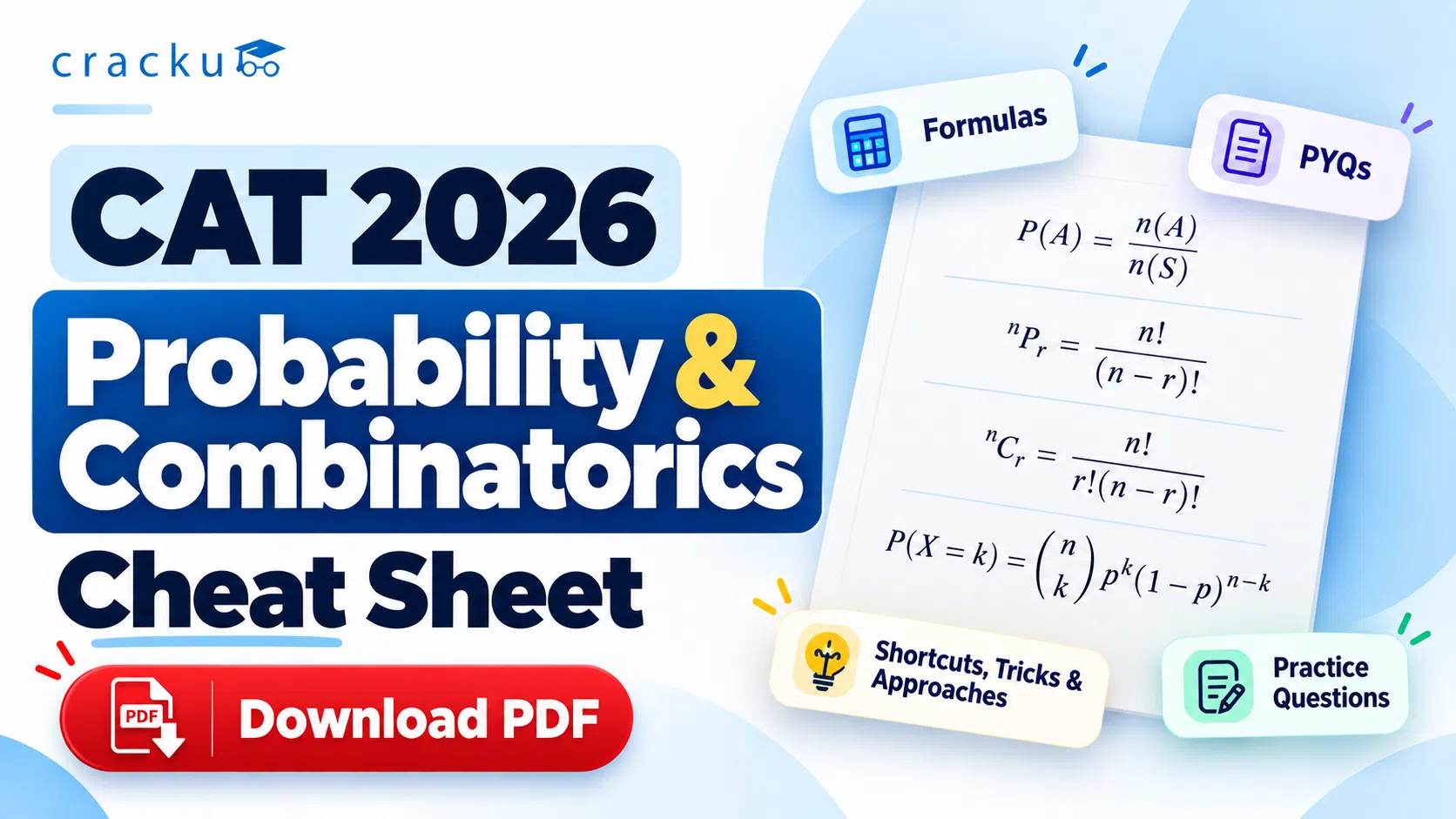
CAT Probability and Combinatorics Cheat Sheet 2026
Probability and Combinatorics are important topics in the CAT Quantitative Aptitude syllabus, particularly under Modern Maths. Questions from these topics test logical counting, arrangements, selections and the ability to calculate the probability of different outcomes. A strong understanding of Permutation and Combination also helps students solve probability-based questions more efficiently.
The CAT Probability and Combinatorics Cheat Sheet 2026 brings together important formulas, counting principles, probability rules and useful shortcuts for quick revision. It covers topics ranging from basic permutations and combinations to conditional probability, circular arrangements, binomial theorem and derangements.
Students preparing for CAT 2026 can use this cheat sheet alongside CAT Previous Year Questions to strengthen their conceptual understanding and practise applying formulas in exam-level problems.
Download CAT Probability and P&C; Cheat Sheet PDF
The CAT Probability and Permutation Combination Cheat Sheet PDF is designed to help aspirants revise important Modern Maths concepts without repeatedly going through lengthy notes.
The PDF contains essential formulas covering probability, arrangements, selections, counting principles, distributions and advanced combinatorics. It is particularly useful during the final stages of CAT preparation when students need quick access to important formulas.
By downloading the CAT Modern Maths Formula PDF, students can revise key concepts before attempting topic-wise practice questions, sectional tests and mock tests.
Instead of memorising formulas separately, students should understand the conditions under which each formula applies. This makes it easier to identify the correct approach when solving unfamiliar questions.
CAT Modern Maths Important Topics for CAT 2026
Modern Maths includes several interconnected concepts, and understanding their relationship makes preparation more efficient. Probability often depends on combinations, while arrangement-based questions require a strong understanding of factorials and counting principles.
The following table covers the important topics in the CAT Probability and Combinatorics:
Important Topic | Key Concepts to Revise |
Probability | Basic probability, conditional probability, independent events |
Permutations and Combinations | Factorials, arrangements, selections |
Counting Principles | Addition rule, multiplication rule |
Circular Arrangements | Circular permutations, rotational symmetry |
Distribution and Partitioning | Identical and distinct objects, integer solutions |
Binomial Theorem | Binomial coefficients, expansion |
Advanced Combinatorics | Derangements, pigeonhole principle |
Other Probability Concepts | Expected value, Bayes' theorem, binomial probability |
For effective preparation, students should begin with counting principles and basic Permutation and Combination concepts before moving to probability. This sequence is useful because many probability questions become straightforward once students can correctly count favourable and total outcomes.
Students can also refer to the CAT Syllabus 2026 to understand how Modern Maths fits into the overall Quantitative Aptitude preparation.
Also Read: CAT 2026 Quant Important Topics: Check Topic-Wise Weightage
Important Probability and Permutation Combination Formulas for CAT
Knowing the important CAT Probability and Combinatorics Formulas is essential for solving Modern Maths questions accurately. However, understanding when to apply a formula is more important than simply memorising it.
Permutation and Combination Formulas for CAT
Concept | Formula |
Permutation | \(\displaystyle {}^nP_r=\frac{n!}{(n-r)!}\) |
Combination | \(\displaystyle {}^nC_r=\frac{n!}{r!(n-r)!}\) |
Relationship between P&C; | \(\displaystyle {}^nP_r={}^nC_r\times r!\) |
Circular Arrangement | \((n-1)!\) |
Arrangements with Repetitions | \(\displaystyle \frac{n!}{p!q!}\) |
Non-negative Integer Solutions | \(\displaystyle {}^{n+r-1}C_{r-1}\) |
The last formula counts the number of non-negative integer solutions of \(x_1+x_2+\cdots+x_r=n\).
Important CAT Probability Formulas
Concept | Formula |
Basic Probability | \(\displaystyle P(A)=\frac{\text{Favourable Outcomes}}{\text{Total Outcomes}}\) |
Complementary Probability | \(P(A^c)=1-P(A)\) |
Addition Rule | \(P(A\cup B)=P(A)+P(B)-P(A\cap B)\) |
Independent Events | \(P(A\cap B)=P(A)P(B)\) |
Conditional Probability | \(\displaystyle P(A\mid B)=\frac{P(A\cap B)}{P(B)}\) |
Expected Value | \(\displaystyle E(X)=\sum x_iP(X=x_i)\) |
For example, if three students must be selected from eight students, the number of selections is \({}^8C_3=56\). However, if the selected students must occupy three different positions, the number of arrangements becomes \({}^8P_3=336\).
This difference between selection and arrangement is one of the most important concepts in CAT Permutation and Combination Questions.
Students who find these concepts difficult can strengthen their fundamentals through a structured CAT Quant Course before attempting advanced Modern Maths problems.
CAT Probability and P&C; Shortcuts and Tricks
Learning CAT Probability Shortcuts and Tricks can help students reduce unnecessary calculations and improve their problem-solving speed. Most shortcuts involve recognising the structure of a question and choosing a simpler counting method.
The following approaches are useful when solving Probability and Permutation Combination questions.
Question Pattern | Faster Solving Approach |
At least one event occurs | Calculate the complementary probability |
Selecting objects without order | Use combinations |
Arranging objects in positions | Use permutations |
Objects must remain together | Treat them as one block |
Identical objects are distributed | Apply the stars and bars method |
Repeated letters appear | Divide by factorials of repetitions |
Circular seating arrangement | Fix one object first |
Events occur without replacement | Use conditional probabilities |
Example: Find the probability of obtaining at least one head when a fair coin is tossed four times.
Instead of counting every favourable outcome separately, use the complementary probability rule.
\[ P(\text{At least one head})=1-P(\text{No heads}) \]
\[ =1-\left(\frac12\right)^4=\frac{15}{16} \]
This method reduces calculations and is particularly useful for questions involving conditions such as at least one, none or not all.
Students should practise identifying whether a question requires direct counting, complementary counting, casework or conditional probability rather than applying formulas mechanically.
How to Solve CAT Probability and Combinatorics Questions Faster?
Students often struggle with Probability and Combinatorics because they begin calculating before understanding the question's structure. A better approach is to classify the problem and identify the restrictions before selecting a formula.
Follow these steps while practising CAT Probability and Combinatorics Questions:
- Identify the requirement: Determine whether the question involves arrangement, selection, distribution or probability.
- Check the restrictions: Look for conditions such as identical objects, no repetition, at least one, exactly two or without replacement.
- Choose the counting method: Decide whether to use permutations, combinations, multiplication principles or complementary counting.
- Calculate systematically: Count favourable and total outcomes using consistent assumptions.
- Verify your answer: Check for overcounting, missing cases and incorrect assumptions about independence.
For example, when selecting two cards from a standard deck of 52 cards without replacement, the probability that both are aces is:
\[ P=\frac{4}{52}\times\frac{3}{51}=\frac{1}{221} \]
The probability changes after selecting the first card because the card is not replaced.
After completing topic-wise practice, students should attempt CAT Sectional Tests to identify whether their mistakes arise from conceptual confusion, incorrect counting or excessive calculation time.
Regular practice through CAT Mock Tests can further help students apply these concepts under actual examination time constraints.
Also Read: Top CAT Permutations & Combinations and Probability Questions PDF
How to Use the CAT Modern Maths Cheat Sheet for Revision?
The CAT Modern Maths Cheat Sheet is most effective when used as a revision and error-correction resource rather than as a replacement for concept learning.
Students should revise formulas systematically and practise different question types to understand how the same concept can appear in multiple forms.
The following five-day revision plan can help strengthen formula recall and problem-solving accuracy.
Revision Stage | What to Do |
Day 1 | Revise counting principles, factorials and P&C; formulas |
Day 2 | Practise arrangements, selections and restrictions |
Day 3 | Revise basic, conditional and complementary probability |
Day 4 | Solve mixed Probability and Combinatorics questions |
Day 5 | Attempt timed questions and analyse mistakes |
After each practice session, note the formulas that were difficult to recall and the conditions that were overlooked. Revisit those concepts before the next session.
Students who are already comfortable with the fundamentals should solve CAT Previous Year Papers to practise applying multiple concepts within the same question.
During the final preparation phase, formula revision can also be combined with a CAT Crash Course to address weaker areas and improve overall Quantitative Aptitude performance.
CAT Probability and Combinatorics Cheat Sheet 2026: Conclusion
The CAT Probability and Combinatorics Cheat Sheet 2026 provides a convenient way to revise important Probability, Permutation and Combination formulas, counting principles and problem-solving approaches. Understanding the difference between arrangements, selections, dependent events and independent events is essential for solving Modern Maths questions accurately.
Students should use the downloadable cheat sheet for quick revision, practise different question patterns and review their mistakes regularly. Combining formula revision with timed practice, previous year questions and a structured CAT 2026 Course can help aspirants approach Probability and Combinatorics questions with greater confidence during the examination.