91- 6303239042




 Preferred Source

 Google Discover
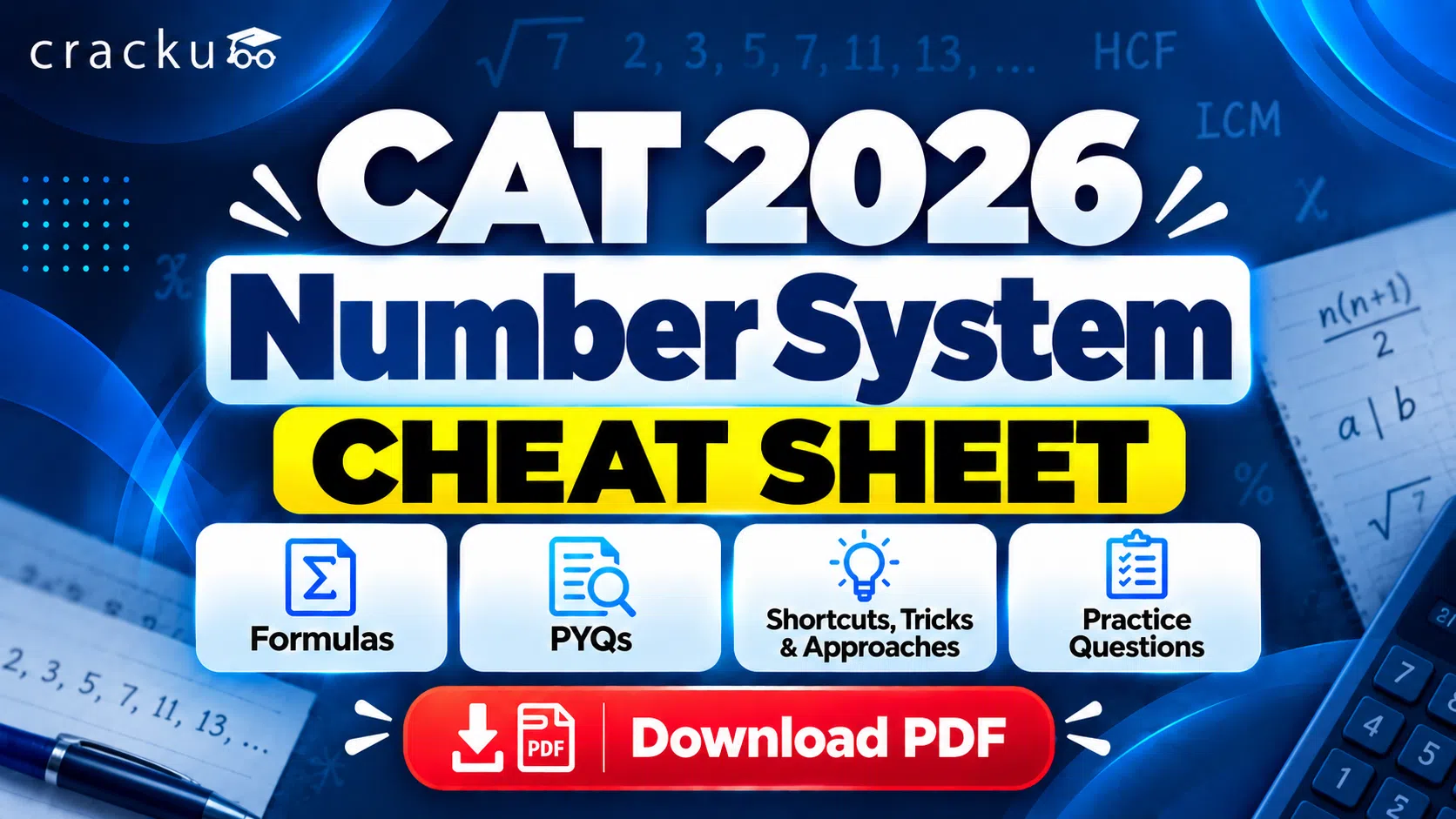
CAT Number System Cheat Sheet 2026
Number System is an important part of CAT Quantitative Aptitude because it tests how comfortably you can work with integers, factors, divisibility, remainders, digits and number properties. Unlike Arithmetic, where questions often follow familiar applications, Number System questions can require you to identify a hidden pattern before performing any calculation.
The CAT Number System Cheat Sheet 2026 brings the most useful formulas, concepts and shortcuts together for quick revision. It is particularly useful once you have completed the basics and started solving CAT Previous Year Questions, because you can use the sheet to quickly revisit a concept whenever you get stuck.
Number System should not be prepared by memorising dozens of isolated results. The better approach is to understand why a property works, know where it can be applied and practise identifying it quickly in CAT-level questions.
CAT Number System Cheat Sheet Download PDF
The CAT Number System Cheat Sheet PDF is designed to work as a compact revision resource rather than a substitute for concept learning. Keep it open while practising questions and use it to revisit formulas or properties that you repeatedly forget.
A downloadable cheat sheet is particularly useful during the final stages of preparation. Instead of going through complete notes before every mock, you can quickly revise important concepts such as divisibility, factors, HCF-LCM, remainders, cyclicity and factorials.
For better results, combine formula revision with CAT Mock Tests. Whenever a Number System question takes too long or you use an inefficient approach in a mock, identify the underlying concept and revise that specific part of the cheat sheet.
CAT Number System Important Topics 2026
The Number System syllabus can appear broad, but most CAT questions are built around a manageable set of fundamental ideas. Aspirants should prioritise concepts that help them manipulate numbers efficiently rather than treating every subtopic as equally important.
Topic | What You Should Know |
Divisibility | Divisibility rules, factors and multiples |
HCF and LCM | Prime factorisation, HCF-LCM relationships |
Factors | Number and sum of factors |
Remainders | Modular reasoning and remainder properties |
Units Digit | Cyclicity of powers |
Factorials | Trailing zeroes and highest powers |
Base Systems | Conversion between number bases |
Digits | Formation of numbers and digit-based conditions |
Integers | Positive, negative, odd and even integers |
Prime Numbers | Prime factorisation and properties |
While going through the CAT syllabus, do not study these as completely independent chapters. Several questions combine two or more concepts. A remainder question, for example, may require knowledge of cyclicity, while a factorial problem may ultimately depend on prime factorisation.
This overlap is why topic-wise practice is valuable. Once the fundamentals are clear, solving CAT Number System questions from previous papers helps you understand which concepts CAT actually tests and how they are disguised within questions.
Also Read: CAT 2026 Quant Important Topics: Check Topic-Wise Weightage
CAT Number System Formulas and Concepts
A Number System formula sheet becomes useful only when you understand the conditions under which each result applies. The following are some of the most important concepts to revise.
Sum of Natural Numbers
Sum of the first (n) natural numbers:
1 + 2 + 3 + ... + n = n(n + 1)/2
Sum of the first (n) odd numbers:
1 + 3 + 5 + ... = n²
Sum of the first (n) even numbers:
2 + 4 + 6 + ... + 2n = n(n + 1)
HCF and LCM
For two positive integers (a) and (b):
HCF(a, b) × LCM(a, b) = a × b
This relationship applies directly to two positive integers. Be careful about blindly extending it to three or more numbers.
Number of Factors
If
N = p₁ᵃ × p₂ᵇ × p₃ᶜ
where (p₁, p₂, p₃) are distinct primes, then:
Number of positive factors = (a + 1)(b + 1)(c + 1)
This prime-factorisation approach is one of the most useful tools in Number System questions.
Sum of Factors
For:
N = pᵃqᵇ
the sum of all positive factors is:
[(pᵃ⁺¹ − 1)/(p − 1)] × [(qᵇ⁺¹ − 1)/(q − 1)]
Trailing Zeroes in a Factorial
The number of trailing zeroes in (n!) is:
⌊n/5⌋ + ⌊n/25⌋ + ⌊n/125⌋ + ...
Continue until the denominator becomes greater than (n).
Remainder Basics
If:
N = dq + r
then (r) is the remainder when (N) is divided by (d), where:
0 ≤ r < d
For large powers, identifying a repeating remainder cycle is usually much faster than calculating the entire number.
Units Digit Cyclicity
Powers often repeat their units digits in cycles.
For example:
2¹, 2², 2³, 2⁴... → 2, 4, 8, 6...
The cycle length is 4. Therefore, the units digit of a large power such as (2^{103}) can be determined using the remainder when 103 is divided by 4.
Students who need deeper conceptual practice should use a structured CAT Quant Course alongside the cheat sheet rather than relying only on formula memorisation.
Also Read: CAT Formula PDF 2026, Topic-wise Quant Formula Sheet
CAT Number System Shortcuts and Tricks
Number System questions can become calculation-heavy if approached mechanically. The goal is to recognise mathematical structure before calculating.
Use prime factorisation early: If a question involves factors, divisibility, HCF, LCM or factorials, prime factorisation is often the cleanest starting point.
Look for cyclicity in large powers: Never attempt to calculate a huge exponent directly when the question asks only for the units digit or remainder. Search for the repeating pattern first.
Translate divisibility into factors: If a number must be divisible by 12, think of the requirement as divisibility by (3 \times 4). Breaking conditions into prime factors can make them easier to handle.
Check parity before calculating: Odd-even properties can eliminate answer choices immediately. For example, odd + odd is even, while odd × odd remains odd.
Use answer options strategically: CAT is an aptitude exam, so a complete algebraic derivation is not always necessary. Substitution, elimination and testing answer choices can sometimes reduce a lengthy Number System problem to a few steps.
The real shortcut is therefore not a memorised trick. It is recognising the mathematical property that makes unnecessary calculation disappear. Practising these approaches through CAT Sectional Tests helps develop that recognition under time pressure.
Also Read: CAT Quant Cheat Sheet 2026: Important PYQs, Formulas PDF
CAT Number System Important Questions and PYQs PDF
Practising CAT Number System important questions and PYQs is the best way to understand how concepts such as divisibility, factors, remainders, cyclicity and factorials are actually tested in the exam. While a cheat sheet helps you recall formulas quickly, previous year questions teach you when and how to apply them.
CAT Number System Questions PDF is particularly useful for topic-wise practice. Instead of solving complete CAT papers every time, you can focus specifically on Number System questions and identify the concepts that require more revision.
While solving CAT Number System PYQs, classify questions based on the underlying idea rather than simply marking them right or wrong. For example:
Question Type | Concept to Focus On |
Factors and divisors | Prime factorisation, number of factors |
Remainders | Modular arithmetic, cyclicity |
Units digit | Cyclic patterns of powers |
HCF and LCM | Prime powers and factor relationships |
Factorials | Trailing zeroes, highest power of a prime |
Divisibility | Divisibility rules and prime factors |
Digit-based questions | Place value and number formation |
Integer problems | Odd-even, positive-negative properties |
A useful method is to solve a question first without referring to the cheat sheet. If you cannot identify the approach within a reasonable time, check the relevant concept, close the sheet and attempt the question again. This forces you to retrieve the concept instead of merely recognising it while reading.
Also use CAT Previous Year Papers to understand how Number System questions appear alongside Arithmetic, Algebra and Geometry in an actual CAT Quant section. This is important because topic-wise practice builds conceptual strength, while full-paper practice develops question selection and time management.
During revision, maintain a small list of Number System PYQs that you either got wrong or solved inefficiently. Reattempting these questions after a few days is more valuable than repeatedly solving only familiar questions. The goal is to reach a stage where you can quickly identify the underlying property and decide whether the question is worth attempting in the exam.
How to Use the CAT Number System Cheat Sheet for Revision?
Do not simply read the cheat sheet repeatedly. Passive revision creates familiarity, but CAT requires retrieval and application.
A more effective revision cycle is:
Learn Concept → Revise Formula → Solve PYQs → Analyse Errors → Reattempt → Test in Mocks
Start by revising one topic, such as remainders or factors. Then solve a small set of questions without referring to the sheet. Every time you forget a formula, misapply a property or take an unnecessarily long route, mark that concept.
After a few practice sessions, your personal revision priorities will become clear. One student may repeatedly struggle with factorials, while another may understand the theory but fail to recognise cyclicity quickly enough.
During the final weeks, your cheat sheet should become a diagnostic tool. Revise the weak areas identified through mocks instead of reading every formula with equal attention.
Students who still have substantial portions of Quant remaining can combine this process with a CAT Crash Course to consolidate concepts and shift progressively towards timed practice.
A useful final-stage routine is to revise Number System formulas briefly, solve 5–10 mixed questions and then analyse every incorrect or slow attempt. This is much more productive than spending an hour simply rereading formulas.
Also Read: CAT Probability Cheat Sheet 2026 Formula, PYQ Download PDF
CAT Number System Cheat Sheet 2026: Conclusion
The CAT Number System Cheat Sheet 2026 is most effective when used as a revision and problem-solving companion. Focus on divisibility, factors, HCF-LCM, remainders, cyclicity, factorials, digits and integer properties, but make sure you understand how these concepts interact within CAT questions.
Use the cheat sheet alongside CAT study material, topic-wise PYQs and timed mocks. As CAT 2026 approaches, reduce passive theory revision and spend more time identifying patterns, choosing efficient approaches and analysing mistakes. A strong command of the Number System is not about remembering the maximum number of formulas. It is about recognising the right property quickly enough to turn a seemingly complicated question into a manageable one.