91- 6303239042
 CAT WhatsApp Group


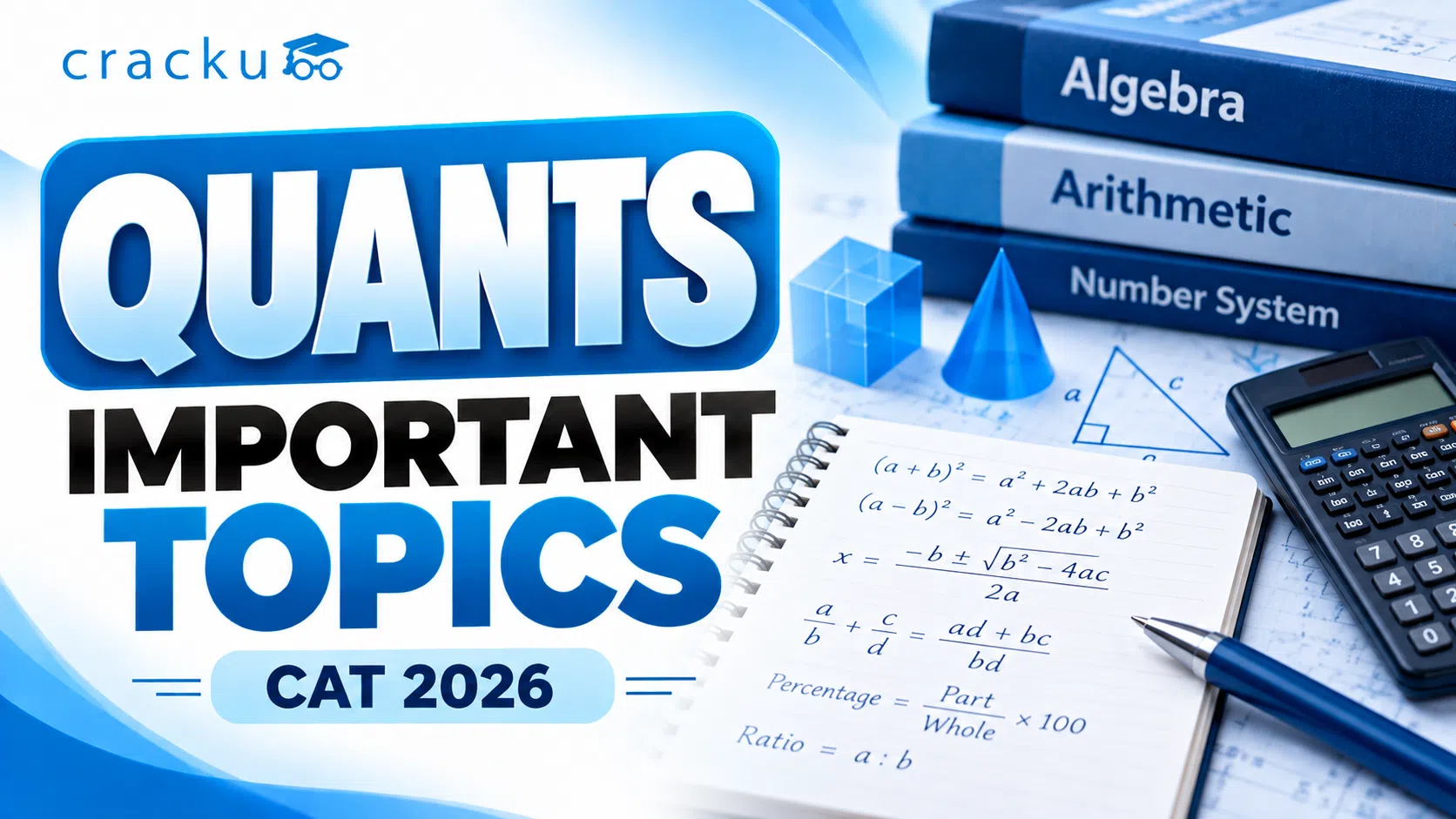
CAT Quant Important Topics 2026
The CAT Quantitative Aptitude (QA) section tests a candidate’s understanding of mathematical concepts, problem-solving ability and numerical skills. Knowing the CAT Quant Important Topics 2026 can help aspirants structure their preparation and allocate time to areas that have appeared frequently in previous CAT papers. The CAT syllabus broadly covers Arithmetic, Algebra, Geometry, Number System and Modern Mathematics.
Arithmetic and Algebra generally form a significant portion of the section, while Geometry, Number System and Modern Mathematics make up the remaining questions. However, the number and difficulty of questions from each topic can vary across slots and years. Along with covering the CAT syllabus, candidates should practise previous-year questions, strengthen their fundamentals and develop speed and accuracy
CAT Quant Section Overview 2026
The Quantitative Aptitude (QA) section is one of the three sections in CAT. Based on the latest available CAT exam pattern, QA has 22 questions to be attempted in 40 minutes, making speed, accuracy and question selection important. The CAT 2025 paper followed the same 22-question QA structure, with 14 MCQs and 8 TITA questions.
CAT Quant Section: Key Highlights
Feature | CAT Quant 2026 |
Number of Questions | 22 |
Time Limit | 40 minutes |
Total Marks | 66 |
Question Types | MCQs + TITA |
Correct Answer | +3 marks |
Incorrect MCQ | -1 mark |
Incorrect TITA | No negative marking |
Difficulty | Moderate to difficult, based on recent papers |
Major Areas | Arithmetic, Algebra, Geometry, Number System, Modern Maths |
Also Read: CAT Quant 2 Month Study Plan for 99+ Percentile in CAT 2026
Important Arithmetic Topics for CAT 2026
Arithmetic is one of the most important CAT Quant Important Topics 2026 sections. The questions generally test conceptual understanding, calculation skills and the ability to apply concepts across different situations.
Key Arithmetic Topics for CAT 2026
Topic | Important Concepts to Cover |
Percentage change, successive percentage change, population and expenditure-based problems | |
Cost price, selling price, marked price, discounts, successive discounts | |
Direct and inverse proportion, variations, partnership | |
Weighted average, replacement problems, combined averages | |
Mixture ratios, concentration, replacement and weighted mixtures | |
Relative speed, trains, boats & streams, races | |
Work efficiency, combined work, pipes & cisterns | |
SI, CI, growth and depreciation | |
Partnership | Investment ratios, profit sharing, changing investments |
Topics to Prioritise
For CAT 2026 preparation, focus particularly on:
- Percentages
- Ratio & Proportion
- Averages
- Profit, Loss & Discount
- Time, Speed & Distance
- Time & Work
- Mixtures & Alligation
- Simple & Compound Interest
Previous Year Arithmetic Topics with Weightage Trends
Arithmetic has consistently been an important part of the CAT Quantitative Aptitude section. Analysing previous-year papers can help identify the topics that appear most frequently and understand their relative importance. The table below highlights the weightage and trends of key Arithmetic topics based on previous CAT papers, helping aspirants prioritise their preparation for CAT 2026.
Arithmetic Topic | CAT 2024 | CAT 2025 | Trend |
Ratio & Proportion | 2–3 | 4 | High |
Percentages | 2–3 | 3 | High |
Profit, Loss & Discount | 3 | 3 | Consistent |
Time, Speed & Distance | 3 | 3 | Consistent |
Mixtures & Alligation | 3 | 3 | Consistent |
Partnership | — | 3 | Appeared prominently |
Time & Work | 2 | 2 | Consistent |
Simple & Compound Interest | 3 | 2 | Consistent |
Averages | 3 | 2 | Consistent |
Also Read: CAT Arithmetic PYQs with Video Solutions & Formula PDF
Important Algebra Topics for CAT 2026
Algebra is another important area in the CAT Quantitative Aptitude section and can include questions ranging from basic equations to more application-based problems. A strong understanding of algebraic concepts, formulas and problem-solving techniques can help aspirants tackle these questions efficiently.
Key Algebra Topics for CAT 2026
Topic | Important Concepts to Cover |
One and two variables, simultaneous equations, applications | |
Roots, nature of roots, equations and applications | |
Linear and quadratic inequalities, modulus-based inequalities | |
Domain and range, types of functions, composite functions | |
Logarithmic properties, equations and applications | |
Laws of indices, simplification and surd-based equations | |
Polynomials | Remainder theorem, factor theorem, roots and coefficients |
Maxima & Minima | Algebraic optimisation and value-based problems |
Also Read: CAT Algebra PYQs with Video Solutions & Formulas PDF
Important Geometry Topics for CAT 2026
Geometry and Mensuration formed a consistent part of the CAT 2025 Quantitative Aptitude section. Across all three slots, 3 Geometry & Mensuration questions appeared in each slot, accounting for 9 questions in total in one detailed analysis. Other analyses classify some questions differently and report up to 10 Geometry & Mensuration questions, so the exact count can vary by source and classification. Checkout the weightage of CAT Quant Important Topics 2026
Key Geometry Topics and Sub-Topics: CAT 2025
Geometry Topic | Key Sub-Topics |
Similarity, congruence, Pythagoras theorem, area, perimeter, angle properties | |
Chords, tangents, cyclic quadrilaterals, angles in circles | |
Distance, midpoint, slope, equation of a line, area using coordinates | |
Rectangles, squares, rhombus, parallelogram, area and properties | |
Polygons | Regular polygons, interior and exterior angles, hexagons |
2D areas and perimeters, 3D surface areas and volumes | |
Lines & Angles | Parallel lines, transversals, angle relationships and geometric properties |
Also Read: CAT Geometry PYQs PDF with Video Solutions, Download Now
Important Number System Topics for CAT 2026
Number System is a recurring component of the CAT Quantitative Aptitude section. In CAT 2025, different analyses classified around 5–8 questions across the three slots under Number System, depending on how multi-concept questions were categorised. Commonly tested areas included digits, divisibility, remainders, factors and divisors, and powers.
For CAT 2026, aspirants should focus on the following Number System topics:
Number System Topic | Key Sub-Topics |
Divisibility | Divisibility rules, divisibility-based problems |
Remainders | Remainder theorem, cyclicity, modular arithmetic |
Factors & Divisors | Number of factors, sum of factors, prime factorisation |
HCF & LCM | Properties, applications and factor-based problems |
Prime Numbers | Prime factorisation, co-prime numbers, prime properties |
Digits | Digit-based equations, number formation, digit restrictions |
Powers & Indices | Cyclicity of powers, last digits, units digit |
Factorials | Trailing zeroes, factors of factorials |
Perfect Squares & Cubes | Properties, identification and factor-based questions |
Base System | Number conversion and operations in different bases |
Important Modern Maths Topics for CAT 2026
Modern Mathematics covers a relatively smaller but varied portion of the CAT Quantitative Aptitude section. Questions generally test logical reasoning, counting techniques and the application of basic mathematical concepts.
For CAT 2026 preparation, aspirants should focus on the following topics:
Modern Maths Topic | Key Sub-Topics |
Permutation & Combination | Arrangements, selections, circular permutations, repetition and restrictions |
Probability | Basic probability, conditional probability, independent events and complementary probability |
Set Theory | Venn diagrams, union, intersection, complement and inclusion-exclusion |
Binomial Theorem | Expansion, coefficients, general term and middle term |
AP, GP, special series and sum-based problems | |
Progressions | Arithmetic and geometric progressions, nth term and sum of terms |
Tips to Maximize Your Score in 2026
Scoring well in CAT Quant requires more than knowing formulas. A focused preparation strategy, regular practice and effective question selection can help improve both accuracy and speed. Keep the following tips in mind while preparing for CAT 2026:
- Strengthen your fundamentals: Build a clear understanding of core concepts before moving to advanced questions.
- Prioritise high-frequency topics: Focus on Arithmetic, Algebra, Geometry, Number System and Modern Maths based on previous-year trends.
- Practise mental calculations: Improve your speed with percentages, fractions, ratios, squares and common calculations.
- Solve previous-year CAT questions: This helps you understand the difficulty level, question patterns and different ways concepts are tested.
- Focus on accuracy: Avoid unnecessary attempts, particularly in MCQs where incorrect answers carry negative marking.
- Develop question-selection skills: Learn to identify questions that can be solved efficiently and avoid spending too much time on difficult problems.
- Take regular sectional mocks: Practise solving Quant within the 40-minute section limit to improve time management.
- Analyse every mock: Review incorrect answers, unanswered questions and questions that took too long to solve.
Also Read: CAT Quants PYQ Analysis 2026, Difficulty, Repeated Topics
Key Takeaways for CAT Quant 2026
The CAT Quant section tests your conceptual understanding, calculation ability and approach to problem-solving. Keeping the previous-year trends and preparation priorities in mind, here are the key takeaways for CAT 2026:
- Build strong fundamentals: Focus on understanding concepts rather than relying solely on formulas and shortcuts.
- Prioritise important topics: Give adequate attention to Arithmetic and Algebra, while covering Geometry, Number System and Modern Maths thoroughly.
- Use previous-year papers: CAT questions can test familiar concepts in unfamiliar ways, making PYQs an important part of preparation.
- Practise question selection: Learn to identify questions that match your strengths and can be solved efficiently.
- Improve speed and accuracy: Regular timed practice can help you manage the 40-minute Quant section more effectively.
- Analyse your mistakes: Review mocks and practice sets to identify conceptual gaps, calculation errors and time-consuming approaches.
Also Read: Easiest CAT Quant Topics for Beginners, Where to Start First
CAT Quant Important Topics 2026: Conclusion
Understanding the CAT Quant Important Topics 2026 can help you organise your preparation and spend more time on areas that regularly appear in the exam. Arithmetic and Algebra deserve strong attention, but Geometry, Number System and Modern Maths should also be covered thoroughly to avoid gaps in your preparation.
Instead of focusing only on formulas or topic weightage, combine concept building with CAT previous-year questions, timed sectional tests and detailed mock analysis. Prioritise your weaker areas while improving speed, accuracy and question selection. A balanced preparation strategy across the complete CAT Quant syllabus will put you in a stronger position on exam day.