91- 6303239042




 Preferred Source

 Google Discover

CAT Profit and Loss PYQs
Profit, Loss and Discount is an important part of Arithmetic in the CAT Quantitative Aptitude section. While the basic concepts are usually straightforward, CAT questions often combine percentages, successive discounts, marked price, cost price and selling price in ways that require careful interpretation.
Practising CAT Profit, Loss and Discount PYQs is therefore more useful than simply memorising formulas. Previous year questions help you understand how CAT frames Arithmetic problems, which information is actually relevant and when a direct percentage approach can save time.
Before beginning topic-wise PYQ practice, students should be comfortable with the basic concepts covered in the CAT syllabus, particularly percentages, ratios and arithmetic calculations. Profit and Loss questions frequently use these concepts together.
A good approach is to solve each PYQ without looking at the solution first. After solving it, compare your method with the given solution and identify whether the same answer could have been reached with fewer calculations.
Download CAT Profit and Loss PYQs PDF
A CAT Profit, Loss and Discount PYQs PDF makes topic-wise practice easier because you do not have to search through complete previous year papers for relevant questions.
The PDF can be used at different stages of preparation. During concept building, solve questions slowly and focus on understanding the relationship between cost price, selling price, marked price and discount. During revision, attempt the same questions with a time limit.
Students should also solve broader CAT Arithmetic Questions after completing topic-wise Profit, Loss and Discount practice. This is important because the actual CAT exam does not tell you which Arithmetic concept needs to be applied.
For a more exam-like experience, combine PYQ practice with CAT Mock Tests. A question that feels easy during isolated practice can become more difficult when it appears unexpectedly during a timed Quant section.
CAT Profit and Loss Previous Year Questions
CAT Profit and Loss Previous Year Questions are useful for understanding how arithmetic concepts such as cost price, selling price, profit percentage, loss percentage, discounts and successive changes are tested in the exam. These questions often combine multiple concepts, making the right setup more important than lengthy calculations.
Practising the CAT Profit and Loss PYQs given below will help you identify common question patterns, improve calculation speed and learn efficient approaches used in actual CAT questions.
Important Profit and Loss Formulas for CAT
Knowing the important formulas can reduce unnecessary calculations, but formulas should be treated as tools rather than shortcuts that replace conceptual understanding.
Here are some of the most useful CAT Arithmetic formulas for Profit, Loss and Discount:
Concept | Formula |
Profit | Selling Price − Cost Price |
Loss | Cost Price − Selling Price |
Profit % | (Profit / Cost Price) × 100 |
Loss % | (Loss / Cost Price) × 100 |
Selling Price at Profit of x% | CP × (100 + x)/100 |
Selling Price at Loss of x% | CP × (100 − x)/100 |
Discount | Marked Price − Selling Price |
Discount % | (Discount / Marked Price) × 100 |
Selling Price after x% Discount | MP × (100 − x)/100 |
Successive Discounts of a% and b% | a + b − ab/100 |
One important distinction students should remember is the base value. Profit and loss percentages are normally calculated on cost price, whereas discount percentage is calculated on marked price.
This distinction is responsible for many avoidable mistakes.
For example, if an item costing ₹800 is sold at a profit of 25%, its selling price is:
₹800 × 1.25 = ₹1,000
If the same item has a marked price of ₹1,250 and receives a 20% discount:
₹1,250 × 0.80 = ₹1,000
Both routes produce the same selling price, but the percentage bases are different.
Keep these formulas in a short revision sheet rather than repeatedly reading an entire chapter. Students who need structured concept-building and topic-wise practice can also use a CAT Quant Course alongside PYQs.
How to Solve Profit and Loss Questions in CAT?
CAT Profit and Loss questions should not always be approached by immediately assigning variables and forming equations. In many questions, choosing a convenient base value can make the calculation significantly shorter.
For percentage-heavy questions, taking the cost price or marked price as 100 is particularly useful.
Suppose an article is marked 25% above its cost price and then sold at a 20% discount. Instead of assuming an unknown cost price, take:
Cost Price = 100
Marked Price = 125
Selling Price = 125 × 80/100 = 100
Therefore, there is neither profit nor loss.
This approach converts percentages into simple numbers and makes the relationship much easier to visualise.
While solving CAT Profit, Loss and Discount questions, follow this process:
Also watch for questions involving successive percentage changes. A 20% increase followed by a 20% decrease does not return the original value because the second percentage operates on a different base.
Once you are comfortable with direct questions, practise mixed Arithmetic sets through CAT Sectional Tests. This helps develop the ability to identify the required concept without being told the topic beforehand.
How to Use Profit and Loss PYQs for CAT 2026?
Simply completing CAT PYQs is not enough. The real improvement comes from analysing how you solved them.
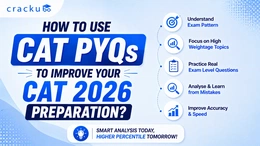
A useful practice cycle for CAT 2026 is:
Start by solving Profit, Loss and Discount PYQs without strict time pressure. At this stage, focus on understanding the structure of each question.
For every incorrect or slow question, identify the reason. Was the concept unclear? Did you choose the wrong percentage base? Was the calculation unnecessarily long? Did you miss a simpler ratio or percentage approach?
Maintain a small error log containing only questions that taught you something useful. This becomes far more valuable during final revision than repeatedly solving questions you already know.
After completing topic-wise PYQs, move to mixed CAT Previous Year Papers. This tests whether you can recognise a Profit, Loss or Discount problem when it appears among questions from Algebra, Geometry, Number Systems and other Arithmetic topics.
During the final phase of preparation, students following a CAT Crash Course or revision schedule should focus more on reattempting marked PYQs and analysing mock-test errors rather than continuously collecting new questions.
The objective is not to solve the maximum number of Profit and Loss questions. It is to reach a stage where you can quickly recognise the underlying structure and choose an efficient method.
CAT Profit and Loss PYQs: Conclusion
CAT Profit, Loss and Discount PYQs are useful because they show how basic Arithmetic concepts are converted into aptitude-based questions. Instead of relying only on formula memorisation, focus on identifying the correct percentage base, understanding the relationship between cost price, marked price and selling price, and reducing unnecessary calculations.
For CAT 2026 preparation, use PYQs in multiple rounds. First solve them for understanding, then reattempt difficult questions for speed and finally test the concepts through sectional tests and full-length mocks. Combining PYQs with consistent revision and a structured CAT 2026 Course can help build both accuracy and question-selection skills for the Quantitative Aptitude section.