91- 6303239042
 CAT WhatsApp Group


 Preferred Source

 Google Discover
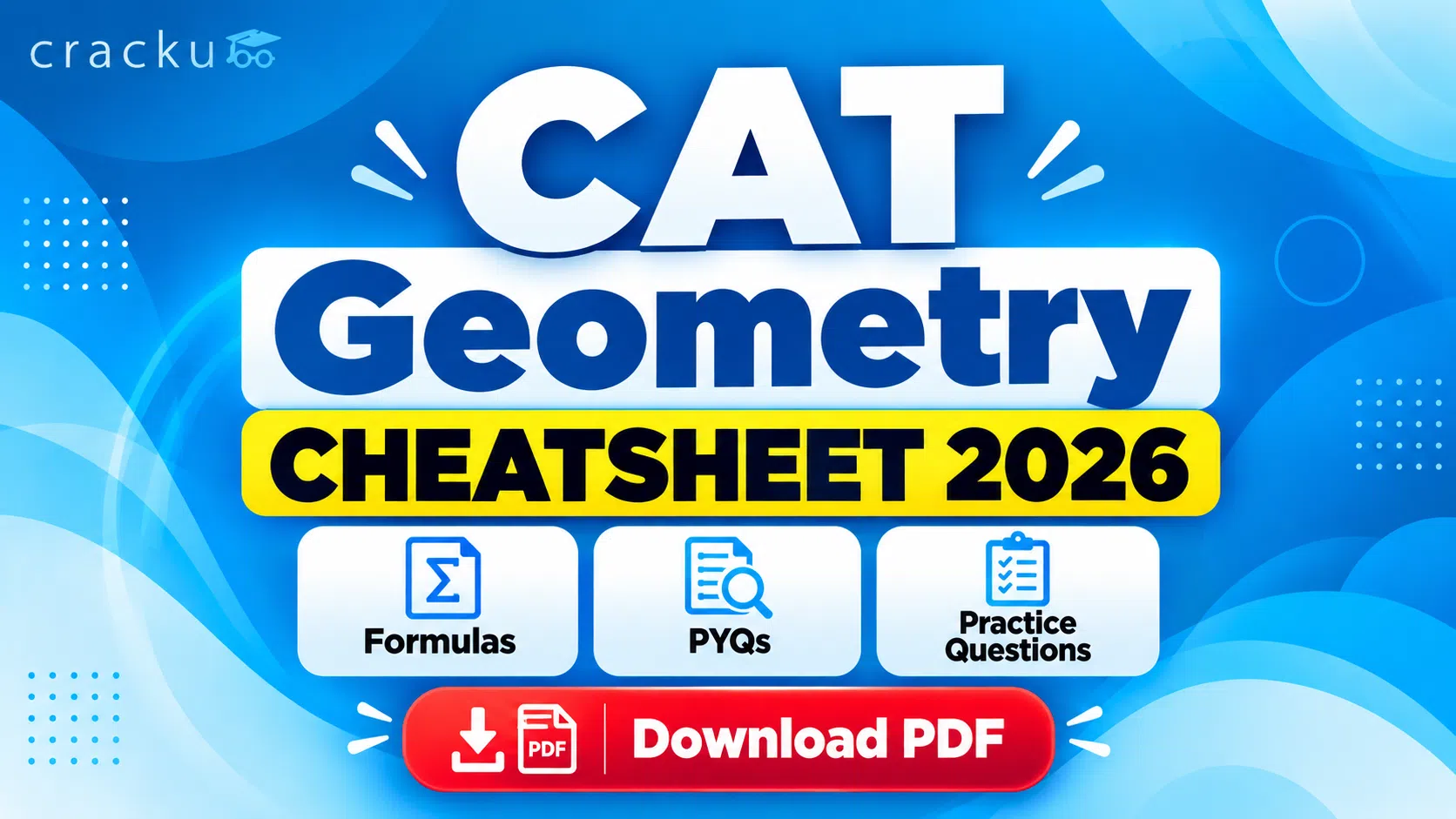
CAT Geometry Cheat Sheet
A CAT Geometry Cheat Sheet is a compact revision resource that brings important formulas, properties and geometric relationships into one place. Geometry questions in CAT Quant are rarely about direct formula substitution alone. They often require you to recognize a hidden relationship in the figure and then decide which theorem or formula can simplify the problem.
The best way to use a cheat sheet is therefore not to memorize every line mechanically. For each formula, connect it with a diagram and at least one representative question. For example, revising the Pythagoras theorem should also remind you of special triangles, while revising circle tangents should immediately bring tangent-radius properties to mind.
Students covering the CAT Syllabus can use the Geometry cheat sheet alongside their regular CAT Quant preparation. It is particularly useful after completing a topic, before solving PYQs, and during the final revision phase.
Cracku's Geometry learning resources cover triangles, circles, polygons and other Geometry concepts through concept lessons, tests and solved questions.
Download CAT Geometry Cheat Sheet PDF
The CAT Geometry Cheat Sheet PDF is useful when you want a quick revision resource without going through complete notes again. Keep the PDF accessible while practising initially, but gradually reduce your dependence on it so that important formulas and properties become automatic.
A practical revision cycle is: learn the concept, revise the cheat sheet, solve questions without looking at it, and then return to the sheet only for formulas you could not recall. Students who still have conceptual gaps can supplement the PDF with a structured CAT Quant Course rather than trying to learn Geometry only through formula memorisation.
You can also maintain a small error list beside the PDF. Whenever you forget a formula or miss an important property in a question, add that concept to the list. Over time, this creates a personalized revision sheet focused on your actual weaknesses.
Also Read, CAT Algebra Cheat Sheet 2026, Formulas with Questions PDF
Important Geometry Formulas for CAT
The important Geometry formulas for CAT include formulas and properties from triangles, circles, quadrilaterals, polygons, coordinate geometry and mensuration. Cracku's existing Geometry resources similarly cover these core areas.
These formulas should be treated as starting points rather than the complete preparation strategy. CAT questions can combine a basic formula with similarity, ratios, angle properties or an unfamiliar diagram. This is why formula revision should eventually be tested through CAT Mock Tests, where you also have to decide whether a Geometry question is worth attempting under time pressure.
CAT Geometry Important Topics
The CAT Geometry Important Topics extend beyond standard area and perimeter formulas. A strong preparation plan should cover the concepts below:
- Triangles: similarity, congruence, Pythagoras theorem, area, medians, angle bisectors, inradius, circumradius and special triangles.
- Circles: chords, tangents, arcs, sectors and important angle properties.
- Quadrilaterals and Polygons: squares, rectangles, parallelograms, rhombuses, trapeziums and interior/exterior angles.
- Coordinate Geometry: distance, midpoint, slope and equations of straight lines.
- Mensuration: areas, surface areas and volumes of common 2D and 3D figures.
Cracku's current Geometry topic resources include dedicated learning and practice material for areas such as triangles, polygons and circles.
Do not give every topic equal revision time. Use CAT Sectional Tests and previous-year questions to identify whether your problem is formula recall, visualization, concept selection or calculation speed. This diagnosis is more useful than simply solving another large batch of random questions.
Students beginning their overall preparation can also use Free CAT Preparation resources to strengthen fundamentals before moving to timed Geometry practice.
Also Read: CAT 2026 Quant Important Topics: Check Topic-Wise Weightage
How to Use the CAT Geometry Cheat Sheet
The most effective way to use a Geometry cheat sheet is through active recall. Instead of repeatedly reading formulas, cover the formula column and try to reproduce each result from memory. Wherever possible, draw the corresponding figure as well.
A simple four-step method works well:
Step 1: Learn the concept. Understand why the formula or property works instead of memorising an isolated expression.
Step 2: Recall without looking. After completing a topic, close your notes and reproduce its important formulas on paper.
Step 3: Apply immediately. Solve a small set of questions based on the formulas you revised. This converts passive recall into usable problem-solving ability.
Step 4: Track mistakes. Separate errors into concept errors, formula-recall errors, calculation mistakes and poor question selection.
This approach becomes especially useful closer to the exam, when a CAT Crash Course can combine rapid revision with focused practice, mocks and analysis. Cracku's current crash-course structure includes targeted revision, question practice, full-length mocks and sectional tests.
Your wider CAT study Material should also include previous-year papers. If the same Geometry property repeatedly causes trouble, return to that concept instead of repeatedly memorising the formula.
Also Read, CAT Arithmetic Cheat Sheet 2026, Formulas, Questions PDF
Geometry Formula-Wise Practice Questions
Geometry formula-wise practice questions bridge the gap between knowing a formula and recognizing when to apply it. Instead of solving 30 random Geometry questions together, initially group questions according to the underlying concept.
For example, solve a short set based on triangle similarity, followed by questions involving area ratios. Then practise chords and tangents separately before combining different circle concepts. Once individual concepts become comfortable, move to mixed Geometry sets where the required formula is not identified beforehand.
A useful progression is:
This progression matters because actual CAT questions do not tell you which formula to use. Formula-wise practice builds recognition, while mixed practice tests whether you can independently identify the correct approach.
Cracku also provides CAT Geometry practice resources with questions and video solutions, while its Geometry Marathon includes practice across triangles, circles, quadrilaterals, polygons, coordinate geometry and mensuration.
As CAT approaches, shift progressively from isolated formula practice to PYQs and timed Quant practice. Aspirants following a complete CAT 2026 Course can integrate the cheat sheet into this cycle as a revision tool rather than treating it as a substitute for concept learning.
Ultimately, a Geometry cheat sheet is most valuable when it helps you retrieve the right concept quickly. Revise formulas frequently, practise their applications, analyse mistakes and repeatedly return to weak areas. That turns a formula sheet from a collection of equations into a practical CAT Quant revision system.
Also Read: CAT Geometry PYQs PDF with Video Solutions, Download Now
CAT Geometry Cheat Sheet: Conclusion
The CAT Geometry Cheat Sheet can make revision faster by keeping important formulas, theorems and properties from triangles, circles, polygons, coordinate geometry and mensuration in one place. However, the real benefit comes from connecting every formula with a diagram and understanding when that concept should be applied.
Use the cheat sheet for active recall, then reinforce the formulas through CAT Geometry questions, PYQs, sectional tests and mocks. As your preparation progresses, reduce your dependence on the sheet and focus on retrieving the right concept independently. The goal is not simply to remember more formulas, but to recognize and apply the right one quickly during CAT.









































![Top CAT Geometry Cricles Questions [Download PDF]](/media/cache/37/35/373563e7d0820dbbf9f140c7f5878cc0.webp "Top CAT Geometry Cricles Questions [Download PDF]")

![Top CAT Geometry Quadrilateral Questions [Download PDF]](/media/cache/40/f1/40f1b4335dd86db76388b2e81193758f.webp "Top CAT Geometry Quadrilateral Questions [Download PDF]")




![Top 10 - CAT Geometry Triangles Questions [Download PDF]](/media/cache/95/e1/95e12a34d491e2927874fa1244dc3c71.webp "Top 10 - CAT Geometry Triangles Questions [Download PDF]")
![Top CAT Geometry Triangles Questions [PDF]](/media/cache/2d/40/2d40909ccde09df6707398e3678e445f.webp "Top CAT Geometry Triangles Questions [PDF]")
![Top CAT Geometry Miscellaneous Questions [PDF]](/media/cache/8e/37/8e3760242131aca7d1c068e3459d64a9.webp "Top CAT Geometry Miscellaneous Questions [PDF]")