91- 6303239042
 CAT WhatsApp Group


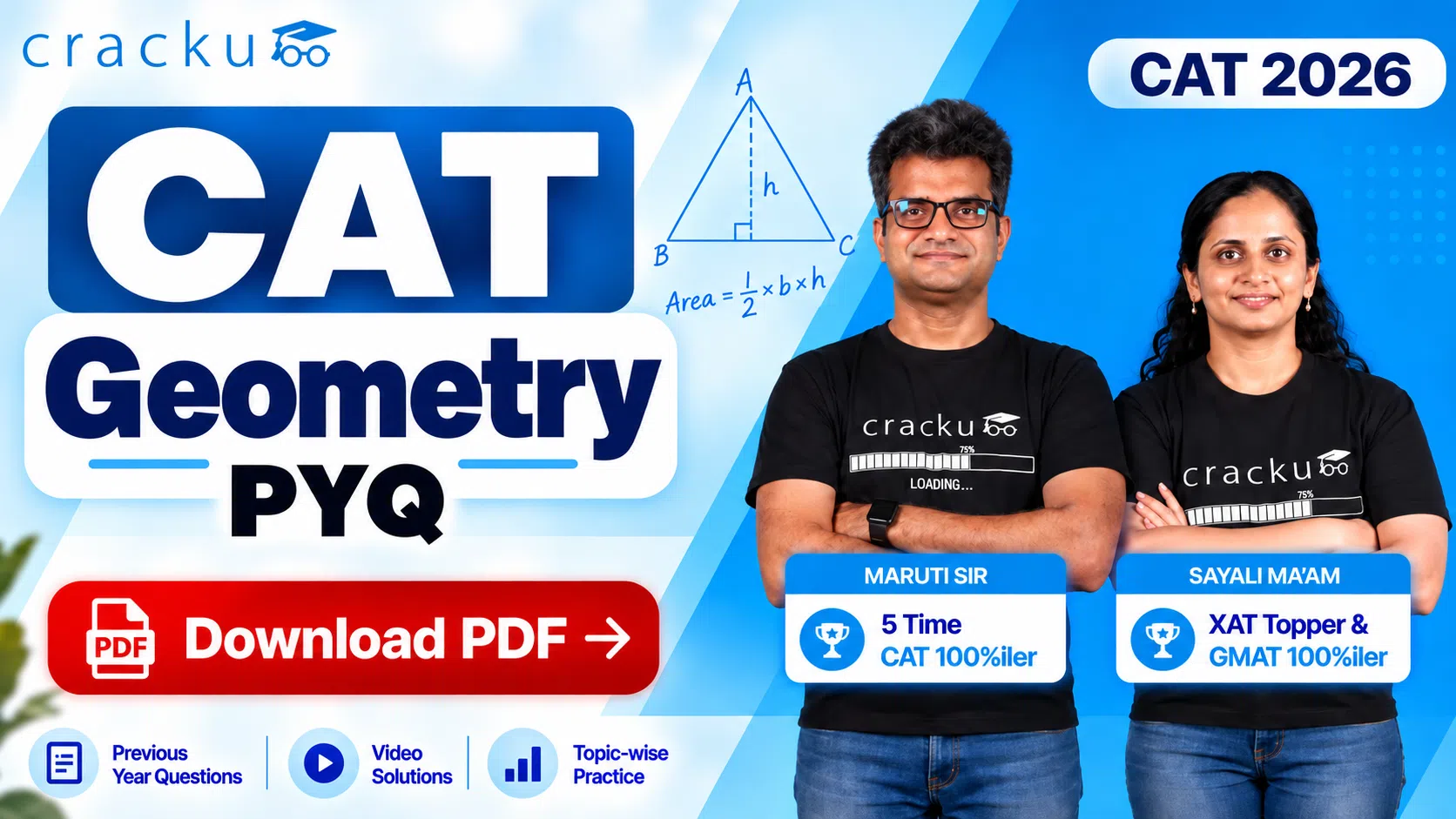
CAT Geometry PYQ
Geometry is one of the most important areas within CAT Quantitative Aptitude because the questions often test interpretation more than lengthy calculation. A student may remember dozens of formulas and still struggle if they cannot identify which geometric relationship the question is actually testing.
This is where CAT geometry previous year questions become especially useful. PYQs show how CAT converts familiar concepts such as triangles, circles, quadrilaterals, coordinate geometry and mensuration into aptitude-based problems. Studying the geometry questions asked in CAT also helps aspirants understand which concepts repeatedly appear in different forms.
Download CAT Geometry PYQ PDF
A CAT geometry questions with solutions PDF is particularly useful for topic-wise practice because it brings previous year Geometry questions together in one place. Instead of moving through complete CAT papers looking for Geometry problems, aspirants can practise them as a focused set.
CAT Geometry PYQ Questions with Solutions
The real value of CAT geometry PYQs with solutions comes from studying the method behind the answer. CAT geometry questions frequently allow more than one approach, and the shortest solution may depend on spotting a theorem, constructing an auxiliary line, using similarity or eliminating answer options.
CAT 2025 Geometry Questions
Question 1
The (x, y) coordinates of vertices P, Q and R of a parallelogram PQRS are (-3, -2), (1, -5) and (9, 1), respectively. If the diagonal SQ intersects the x-axis at (a, 0) , then the value of a is
correct answer:- 4
Question 2
In a circle with center C and radius $$6\sqrt{2}$$ cm, PQ and SR are two parallel chords separated by one of the diameters. If $$\angle PQC=45^{0}$$, and the ratio of the perpendicular distance of $$PQ$$ and $$SR$$ from $$C$$ is $$3:2$$, then the area, in sq. cm, of the quadrilateral $$PQRS$$ is
correct answer:- 3
Question 3
If the length of a side of a rhombus is 36 cm and the area of the rhombus is 396 sq. cm, then the absolute value of the difference between the lengths, in cm, of the diagonals of the rhombus is
correct answer:- 60
CAT 2024 Geometry Questions
Question 1
The coordinates of the three vertices of a triangle are: (1, 2), (7, 2), and (1, 10). Then the radius of the incircle of the triangle is
correct answer:- 2
Question 2
Three circles of equal radii touch (but not cross) each other externally. Two other circles, X and Y, are drawn such that both touch (but not cross) each of the three previous circles. If the radius of X is more than that of Y, the ratio of the radii of X and Y is
correct answer:- 1

Question 3
ABCD is a trapezium in which AB is parallel to CD. The sides AD and BC when extended, intersect at point E. If AB = 2 cm, CD = 1 cm, and perimeter of ABCD is 6 cm, then the perimeter, in cm, of $$\triangle AEB$$ is
correct answer:- 1
CAT 2023 Geometry Questions
Question 1
Let C be the circle $$x^{2} + y^{2} + 4x - 6y - 3 = 0$$ and L be the locus of the point of intersection of a pair of tangents to C with the angle between the two tangents equal to $$60^{\circ}$$. Then, the point at which L touches the line $$x$$ = 6 is
correct answer:- 2
Question 2
A quadrilateral ABCD is inscribed in a circle such that AB : CD = 2 : 1 and BC : AD = 5 : 4. If AC and BD intersect at the point E, then AE : CE equals
correct answer:- 3
Question 3
In a right-angled triangle ∆ABC, the altitude AB is 5 cm, and the base BC is 12 cm. P and Q are two points on BC such that the areas of $$\triangle ABP, \triangle ABQ$$ and $$\triangle ABC$$ are in arithmetic progression. If the area of ∆ABC is 1.5 times the area of $$\triangle ABP$$, the length of PQ, in cm, is
correct answer:- 2
CAT 2022 Geometry Questions
Question 1
A trapezium $$ABCD$$ has side $$AD$$ parallel to $$BC, \angle BAD = 90^\circ, BC = 3$$ cm and $$AD= 8$$ cm. If the perimeter of this trapezium is 36 cm, then its area, in sq. cm, is
correct answer:- 66

Question 2
All the vertices of a rectangle lie on a circle of radius R. If the perimeter of the rectangle is P, then the area of the rectangle is
correct answer:- 2
Question 3
Let ABCD be a parallelogram such that the coordinates of its three vertices A, B, C are (1, 1), (3, 4) and (−2, 8), respectively. Then, the coordinates of the vertex D are
correct answer:- 4
CAT 2021 Geometry Questions
Question 1
If the area of a regular hexagon is equal to the area of an equilateral triangle of side 12 cm, then the length, in cm, of each side of the hexagon is
correct answer:- 4
Question 2
Suppose the length of each side of a regular hexagon ABCDEF is 2 cm.It T is the mid point of CD,then the length of AT, in cm, is
correct answer:- 1
Question 3
A circle of diameter 8 inches is inscribed in a triangle ABC where $$\angle ABC = 90^\circ$$. If BC = 10 inches then the area of the triangle in square inches is
CAT Geometry Formulas PDF
A CAT Geometry Formulas PDF should function as a revision sheet, not as the primary way to learn Geometry. Formula memorisation without understanding the corresponding diagram usually creates problems when CAT changes the presentation of a familiar concept.
The geometry formulas required for CAT are not exceptionally large in number. The challenge is knowing when and how to use them. Your Geometry formula revision should cover the following areas:
Area | What to Revise |
Triangles | Area, Pythagoras theorem, similarity, congruence, angle properties, special triangles |
Circles | Chords, tangents, sectors, arcs and angle properties |
Quadrilaterals | Parallelogram, rectangle, square, rhombus and trapezium properties |
Polygons | Interior and exterior angles |
Coordinate Geometry | Distance, midpoint, slope and basic line concepts |
Mensuration | Area, perimeter, surface area and volume |
Advanced Applications | Area ratios, combined figures and geometric transformations where relevant |
For stronger retention, attach a small diagram to important formulas. Geometry is visual, so remembering a relationship through a figure is often easier than recalling an isolated equation.
During the final weeks before CAT 2026, formula revision should become increasingly selective. Spend more time revising formulas and properties that you repeatedly forget in mocks and Geometry PYQ CAT practice instead of rereading every formula with equal frequency.
Also Read: CAT Ratio and Proportion PYQs with Video Solutions PDF
CAT Geometry Important Topics
Understanding the important geometry topics for CAT helps aspirants use their preparation time efficiently. Not every Geometry chapter deserves exactly the same amount of practice. Your priority should depend on conceptual importance, recurrence across previous papers and how easily a topic connects with other areas.
CAT Geometry Topic | Questions per Year Across CAT Slots | Priority |
Lines, Angles & Triangles | 2–4 | Very High |
Circles | 1–3 | High |
Quadrilaterals & Polygons | 1–3 | High |
Mensuration | 1–3 | High |
Coordinate Geometry | 0–2 | Medium |
Other/Mixed Geometry Concepts | 0–2 | Medium |
Geometry & Mensuration Overall | 5–9 | High |
Triangles should generally receive substantial attention. Similarity, area ratios, Pythagorean relationships, angle properties and special triangles can appear independently or inside more complicated figures. Solving a good mix of triangles CAT questions is particularly useful because triangle concepts frequently overlap with circles, quadrilaterals and mensuration.
Circles are another important area. Aspirants should be comfortable with chords, tangents, radii, cyclic figures and basic angle relationships. Circle-based Geometry CAT questions can become significantly easier when the correct theorem is recognised immediately.
Quadrilaterals and polygons require strong familiarity with their fundamental properties. Instead of memorising separate lists, understand how properties change between a parallelogram, rectangle, rhombus, square and trapezium.
Mensuration combines Geometry with arithmetic and algebra. Questions involving area, surface area or volume may require ratios, percentages or equations, making them useful for developing cross-topic flexibility.
Coordinate Geometry should also be covered, particularly fundamental concepts such as distance, midpoint, slope and properties of lines. Aspirants do not need to overcomplicate this area, but should be comfortable applying these concepts quickly.
For students wondering how to prepare Geometry for CAT, a practical sequence is:
Core concepts → Topic-wise PYQs → Mixed Geometry practice → Sectional tests → CAT mocks
After every cat mock, separately review Geometry questions even if you did not attempt them during the test. An unattempted question that could have been solved in 90 seconds is just as important to analyse as an incorrectly attempted question.
Also Read: CAT Exam Syllabus 2026, Section-wise Pattern, Download PDF
CAT Geometry PYQ: Conclusion
CAT geometry previous year questions should be used to understand how Geometry is tested, not merely to count how many questions you have solved. The biggest improvement comes when aspirants start recognising familiar structures inside unfamiliar diagrams.
Use a CAT geometry questions with solutions PDF alongside concise formula revision, topic-wise practice and regular mock analysis. Focus especially on triangles, circles, quadrilaterals, mensuration and fundamental coordinate geometry concepts, while allowing your own PYQ and mock performance to determine where additional practice is needed.
Most importantly, reattempt difficult CAT Geometry PYQs. If a question that initially took eight minutes can later be solved correctly in two or three minutes, your preparation has produced measurable improvement. That combination of concept recognition, question selection and execution is what makes Geometry practice genuinely useful on CAT exam day.
Also Read, CAT PYQs PDF: Topic-wise Questions with Video Solutions





































![Top CAT Geometry Cricles Questions [Download PDF]](/media/cache/37/35/373563e7d0820dbbf9f140c7f5878cc0.webp "Top CAT Geometry Cricles Questions [Download PDF]")
![Top CAT Geometry Triangles Questions [PDF]](/media/cache/2d/40/2d40909ccde09df6707398e3678e445f.webp "Top CAT Geometry Triangles Questions [PDF]")
![Top 10 - CAT Geometry Triangles Questions [Download PDF]](/media/cache/95/e1/95e12a34d491e2927874fa1244dc3c71.webp "Top 10 - CAT Geometry Triangles Questions [Download PDF]")

![Top CAT Geometry Miscellaneous Questions [PDF]](/media/cache/8e/37/8e3760242131aca7d1c068e3459d64a9.webp "Top CAT Geometry Miscellaneous Questions [PDF]")