91- 6303239042
 CAT WhatsApp Group


 Preferred Source

 Google Discover
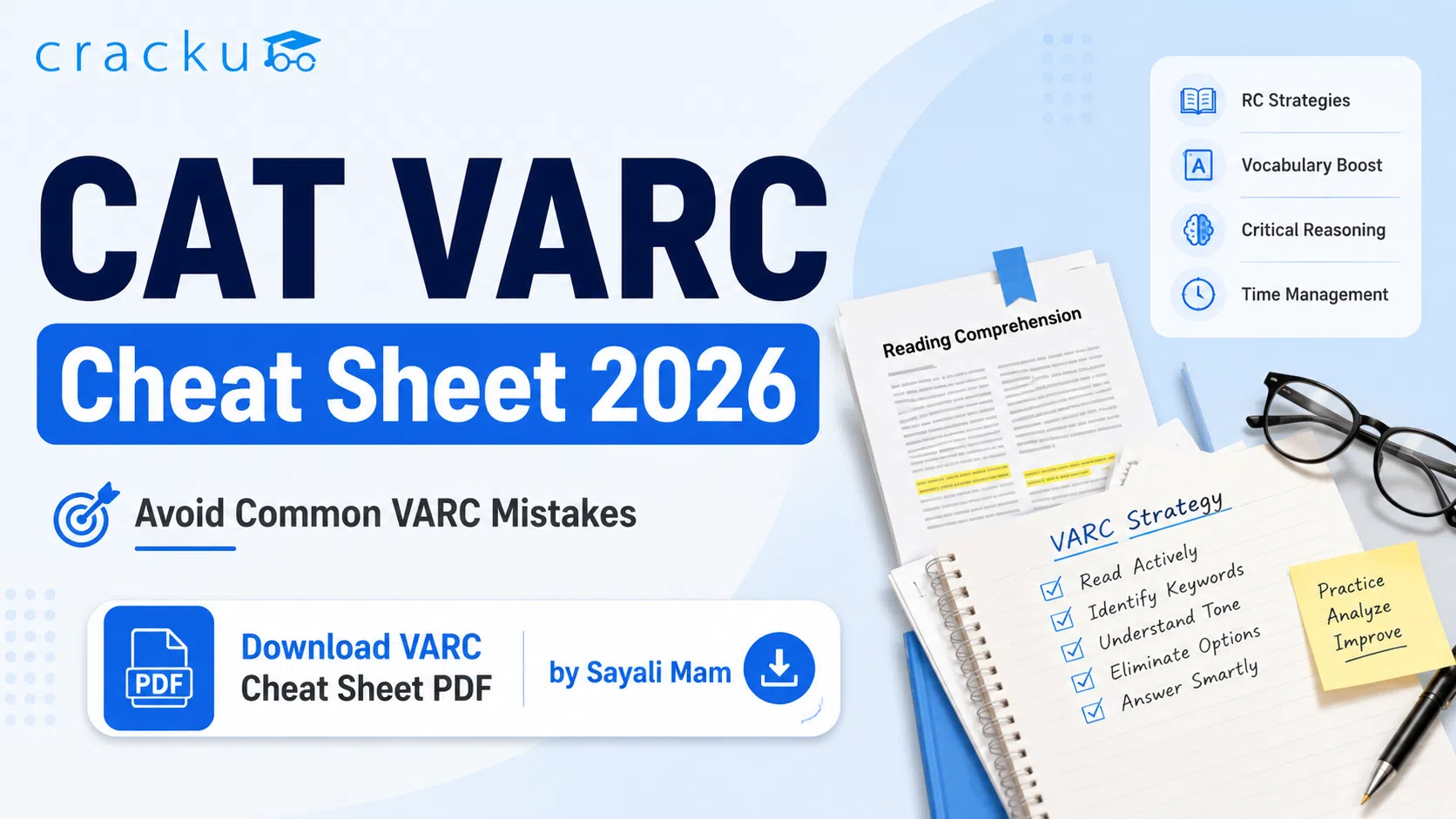
CAT VARC Cheat Sheet 2026
Struggling with Reading Comprehension and Verbal Ability in CAT? You are not alone. VARC is the section where many students either gain a big lead or lose precious marks. The good news is that VARC is not about how strong your English is. It is about how well you can understand what the author is trying to say, and that is a skill you can build. This blog breaks down a clear, practical VARC strategy so you know exactly what to do from today.
What is VARC in CAT?
VARC (Verbal Ability and Reading Comprehension) is the first section of the CAT exam. It tests your ability to read, comprehend, and analyse written passages. The section includes:
- Reading Comprehension (RC) passages
- Para Summary
- Para Jumbles
- Odd Sentence Out
- Sentence Insertion
A common myth is that only students with strong English backgrounds can score well here. That is not true. VARC is not a language test. It rewards students who read actively and think clearly.
Why Do Students Struggle in VARC?
Before jumping into strategy, it helps to understand the root cause of poor VARC performance. Most students face one or more of these issues:
- They read an RC passage fully but still cannot pick the right option between two close choices
- Their VARC scores are wildly inconsistent, say 35 in one mock and 18 in the next
- They run out of time in the section
- They do not know how to approach VA questions like para jumbles
The fix for all of these starts with building the right habits, not just practising more questions.
CAT VARC Preparation Tips
Build the Habit of Active Reading
Reading speed is not something you are born with. It is built. Most students have trained their brain on short-form content like Instagram Reels and YouTube Shorts. Expecting that brain to focus on a 500-word CAT passage is a recipe for struggle.
Here is what you should do every single day:
- Read two articles from diverse topics
- After each paragraph, write a one-line summary in a dedicated register
- This process of reading, thinking, and writing is called active reading
Do not worry about whether your summary is perfect. The act of writing it down makes your understanding clearer and trains your brain to find the core idea quickly, which is exactly what CAT RC questions test.
Where to read from: Cracku Daily Articles (free resource) compiles three quality articles every day from different topic areas. You can find the link in the description.
Build Base Knowledge Across Topics
Even with a strong reading habit, some passages will feel unfamiliar. This happens because you have no base knowledge in that domain. The first time you read about, say, behavioural economics or history, it takes more effort. The second time is much easier.
The solution is to read across all kinds of topics: Science, history, economics, culture, philosophy, technology, and more. Do not stick to only one area.
Topic Area | Example Sources |
Science & Nature | The Smithsonian, Nature.com |
Economics & Policy | The Economist, Yale Global |
Culture & Society | Aeon, The Guardian |
Technology | NY Times Magazine |
History & Archaeology | Public Books, History.com |
Master the Three Linking Structures for VA Questions
Para Summary is essentially the same skill as RC, just applied to a shorter passage. But for Para Jumbles, Odd Sentence Out, and Para Completion, you need one specific skill: the ability to link sentences together.
Here are the three linking structures you must actively look for in every VA question:
Logical Links - One sentence may expand on, illustrate, or give an example of the previous sentence. Spotting this connection tells you which sentences belong together.
Transition Words - Words and phrases like "however," "therefore," "in contrast," and "for instance" signal how the current sentence relates to the previous one.
Grammatical Clues - Pronouns like "he," "she," "it," or "they" always refer back to a noun in a previous sentence. If the pronoun has no matching noun nearby, the sentence order is wrong.
Train yourself to consciously look for these three signals in every VA question you practice.
Spot and Avoid Trap Options in RC
Two options often look equally correct in RC. The way to break the tie is to know the common trap types:
Trap Type | What It Looks Like |
Small Distortion | One word is changed or exaggerated compared to what the passage says |
Logical Distortion | A false cause-effect relationship is introduced |
Scope Mismatch | The option is too broad or too narrow compared to the passage |
Tone Mismatch | The emotional tone of the option does not match the author's stance |
Extreme Language | Options using words like "always," "never," or "only" are usually wrong |
When two options seem correct, ask yourself: does this option go beyond what the passage actually says? If yes, eliminate it.
Analyse Every Mock You Take
This is the most overlooked part of VARC preparation. Taking mocks without analysing them is like getting a medical report and never reading it.
After every mock, go through every VARC question you got wrong and ask:
- Was it a comprehension issue? (Did I misread the passage?)
- Was it an option elimination issue? (Did I fall for a trap?)
- Was it a time management issue? (Did I rush?)
- Was it a careless mistake?
Each wrong question is telling you something specific. If you do not find the reason, you will repeat the mistake in the next mock.
Start with Cracku's three free CAT mocks if you have not already. Use them to identify where your weak points actually are.
Why Is This VARC Cheat Sheet Important?
Most CAT aspirants spend months preparing for Quant and LRDI, but treat VARC as an afterthought. That is a costly mistake. VARC is not just scoreable, it is one of the most improvable sections if you follow the right approach. Here is why this cheat sheet matters:
- Created by Sayali Mam (CAT 99.97%iler)
- Covers both RC and VA in one place, so you are not hunting across multiple resources
- Gives you a clear daily action plan, not vague advice like "read more"
- Focuses on the real reasons behind wrong answers, so you stop repeating mistakes
- Built around what actually works, including active reading, mock analysis, and sentence linking
- Helps you stay consistent by giving you a simple routine to follow every day until November
Whether you are starting strong or starting from scratch, this cheat sheet gives you a structured path forward.
CAT RC Sources 2025: Slot-Wise Breakdown
One of the best ways to prepare for RC is to read from the same kinds of sources that CAT actually uses. Below is the slot-wise list of RC passages from CAT 2025, including their direct sources and word counts.
Slot 1
RC Topic | Direct Source | Word Count |
Electronic Music | JSTOR | 507 |
Uncertain Times | Aeon Magazine | 540 |
Legal and Criminal Responsibility | Internet Archives | 535 |
Income Inequality | Semantic Scholar | 516 |
Slot 2
RC Topic | Direct Source | Word Count |
ChatGPT and Open AI | The Guardian | 508 |
Astronomy | NA | 514 |
Cave Fish | Knowledgeable Magazine | 534 |
Literature | NA | 485 |
Slot 3
RC Topic | Direct Source | Word Count |
Forest Act | Forest Act Document | 510 |
Tribal Verse | NCERT | 508 |
Dam | Boston Review | 506 |
AI Morality | Aeon | 499 |
A few clear takeaways from this data. First, RC passages in CAT typically range between 485 to 540 words, so that is the reading length you should train yourself for daily. Second, sources like Aeon, The Guardian, JSTOR are recurring across years. Make these part of your regular reading list. Third, topics span a wide range from science and technology to law, literature, and social issues, which is exactly why reading across diverse areas is non-negotiable.
The One Thing That Separates High Scorers
High VARC scorers are not always the smartest students in the room. They are usually the most consistent ones. They keep reading when others stop. They keep analysing when others just move on.
A real example: A content manager at Cracku, went to a government school and had very low confidence in English. He committed to active reading every day and posted a photo of his written main idea of the articles daily for accountability. He ended up scoring the highest in the VARC section among everyone who was preparing alongside him. His weakness became his strength, purely through daily consistency.
CAT VARC CheatSheet: Conclusion
- VARC is a comprehension test, not a language test
- Read two articles daily and write one-line paragraph summaries
- Read from diverse topics to build background knowledge
- Look for logical links, transition words, and grammatical clues in VA questions
- Eliminate trap options by checking for distortion, scope, tone, and extreme words
- Analyse every mock to find the specific reason behind each mistake
Start today. Keep the habit going until November. RC and VA will both become your strengths.