91- 6303239042


 Group
Group

How to Attempt a VARC Sectional Test Effectively
A VARC sectional test is much more than a practice session. It's a chance to practice your reading skills, make decisions, and gain confidence in your reading, which is very important for the CAT examination. VARC is the first section in CAT, so a good score here is important to carry through the rest of the paper. Hence, all sections must be taken seriously as they would be in the actual test. To take the VARC Section effectively during mocks and eventually in the CAT 2026 exam, a candidate must know how to approach this section, different ways to attempt, etc. Follow this article to know more!
CAT VARC Exam Pattern 2025
Understanding the VARC structure of the CAT exam is the foremost step that candidates should do in order to ace this section. While Reading Comprehension consists of the majority of the section (66.67%), Verbal Ability only consists of 33.33% of the paper. Following are details of the VARC section for CAT 2025.
Particulars | Details |
Section Name | Verbal Ability and Reading Comprehension |
Total questions | 24 |
Total MCQ questions | 20 |
Total Non-MCQ Questions | 4 |
Total RC Questions | 16 |
Total VA Questions | 8 |
Total Sectional Timing | 40 minutes |
Also Read: CAT VARC Cheat Sheet PDF by Sayali Mam, Download Now
Choose the Right Order for RCs and VA Questions
The one of the most significant decisions that one has to make during a VARC sectional is the order in which to solve the questions. Many high scorers prefer to answer the Verbal Ability questions first and get through the paper before reading long passages to answer the Reading Comprehension, but others enjoy Reading Comprehension first because it accounts for almost two-thirds of the paper. Both are not necessarily right. The best order is entirely dependent upon an individual’s strengths and preferences.
- If you are more comfortable with the Reading Comprehension, then take the RCs as your first test, when your concentration is at its highest. First quickly skim through all four texts to get an idea of how hard they are. Instead of doing the order displayed, try the passage that seems most comfortable and a topic that is more familiar. Less difficult passages can help establish confidence and momnetum and save time when it comes to more challenging passages.
- Another strategy is to get initial marks by solving para summary, para jumble and odd one out questions, if you find it easier to solve the Verbal Ability. But don't waste too much time on a confusing para jumble just because it may seem shorter than an RC passage. The time spent on one VA question can impact your overall performance.
- When a topic looks unfamiliar, it is not best practice to skip an entire RC. An apparently simple passage can have very deceptive options, and a philosophical or scientific statement may actually have straight forward questions. Evaluate passages for readability, rather than content.
The best approach is the one that has already been tried and tested in a number of different sectional or full length mocks prior to the exam date.
Time Management Tips for the CAT VARC Section
Time is one of the important determinants in VARC, with the constraint being 40 minutes to solve 24 questions. Here are some tips for effective time management:
- One of the most effective solutions is to split up the part into two parts. Allow about 24-26 minutes for Reading Comprehension and 14-16 minutes for Verbal Ability. The amount allocated could differ slightly based on the strengths, but a general idea of the time plan should prevent an excessive surge of panic at the end of the section.
- Do not read sentences or passages word for word. Rather, attend to the big picture of ideas. Recognize the author's bias and supporting ideas, examples and conclusions. When you see yourself rereading the same paragraph again and again, it's often a sign you're reading non-purposively.
- When answering questions, stick to the process of elimination. Don't rush to the answer that seems to be right. Make sure to eliminate answers that are obviously wrong and run counter to the text, or that go beyond the author's point. This eliminates the chance of confusion between alternatives that are very similar and helps to increase accuracy.
Common Mistakes to Avoid During a VARC Sectional
Candidates lose marks in VARC due to avoidable errors, not lack of preparation. By being aware of these errors early, you will be able to work on them, and your sectional scores will be better:
- Answering all the questions: A frequent error is answering all the questions just because you have read a text. Reading and answering an RC is not a guarantee that they will all be answered. When one or two questions are confusing, it's sometimes better not to attempt the answer at all.
- Reading the passage too quickly: A common mistake students make is reading the passage too quickly and without comprehending it. While it might allow the section to be read quicker, someone who reads quickly may not understand it, and will end up rereading it later on. The rules of accuracy should always be adhered to, rather than speed.
- Wrong comprehension: A lot of aspirants also use their own ideas when it comes to RC questions. CAT requires you to know the writer's point of view, not whether you agree with the writer's ideas. Answer questions on the basis of the passage only.
- Not practicing VA: Another error is not practicing Verbal Ability. Students often ignore para summaries, para jumbles and odd-one-out questions as RC is given more weightage. With practice these can be easy points to score.
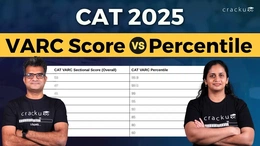
Also Read: CAT VARC Score vs Percentile 2025, Check Ideal VARC Score
How to Analyze Your VARC Sectional Performance
True improvement is only after providing the sectional test. In fact, the more time experienced mentors are willing to take is to analyze a mock rather than write it. A thoughtful review can turn the wrongs into the right.
- Review your performance: First, review the overall score, accuracy, number of attempts and time distribution. The four measurements give you a quick overview of your performance.
- Review unattempted questions: Go over each unattempted Reading Comprehension passage. Decide if the passage was hard to read or if you avoided it because you didn't know about its topic.
- Time Allocation: Assess how much time you spent on each passage relative to its importance, if you are spending more than 12-14 minutes on 1 RC then, you should practice more and try to bring it down to at least 10 minutes, so that you can attempt at least 3 RCs and 8 VA questions
- Pattern Recognition: Identify the types of VA questions you often get wrong. For example, if you find para jumbles are challenging, focus on practicing more of those.
How to Attempt a VARC Sectional Test Effectively: Conclusion
A strong performance in the CAT VARC section is the result of consistent practice, smart time management, and careful analysis of every sectional test. By choosing the right attempt strategy, avoiding common mistakes, and reviewing your performance after each mock, you can steadily improve both your accuracy and speed. Remember that success in VARC is not about attempting every question but about making the right decisions under time pressure. With regular practice and a well-tested strategy, you can maximize your VARC score and build a strong foundation for an excellent overall CAT 2026 percentile.