91- 6303239042


 Preferred Source

 Google Discover
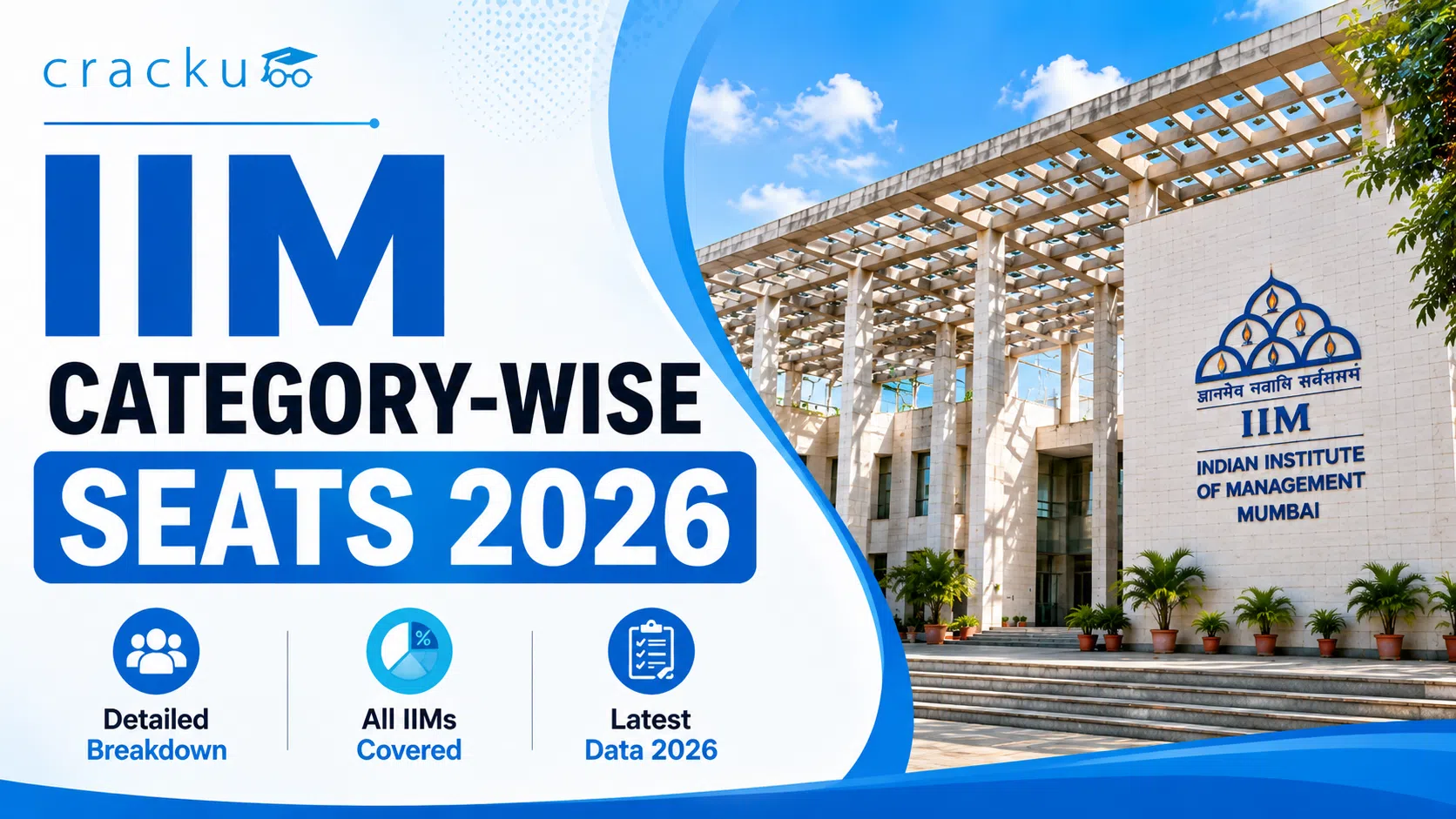
The IIM category-wise seats 2026 are distributed according to the Government of India reservation framework followed by Central Educational Institutions. The 2026 admission cycle refers to the MBA or PGP batch of 2026-28, for which candidates appeared in CAT 2025. Students appearing for CAT 2026 will compete for admission to the 2027-29 batch.
India currently has 22 Indian Institutes of Management. However, there is no single centralized document publishing the final institute-wise and category-wise seat matrix for every IIM. Batch sizes can also change because of programme expansion, supernumerary seats, withdrawals and reservation-roster rounding.
IIM Category-Wise Seats 2026
The reservation percentages applicable to regular IIM MBA admissions are 27% for NC-OBC, 15% for SC, 7.5% for ST, up to 10% for EWS and 5% for Persons with Benchmark Disabilities. The remaining seats are available through open merit.
Category | Share of Seats | Important Meaning |
Open or Unreserved | Approximately 40.5% | Open to candidates from every category based on merit |
NC-OBC | 27% | Valid non-creamy layer certificate required |
SC | 15% | Valid Central Government SC certificate required |
ST | 7.5% | Valid Central Government ST certificate required |
EWS | Up to 10% | Valid EWS certificate for the prescribed financial year |
PwD | 5% horizontal | Adjusted within General, EWS, OBC, SC or ST categories |
PwD reservation is horizontal. Therefore, it is adjusted within the vertical categories instead of being added separately to create a total reservation of 105%.
Open seats must not be interpreted as General-category-only seats. Candidates belonging to SC, ST, NC-OBC, EWS or PwD categories can secure an open seat when their merit score is high enough.
IIM Category-Wise Seat Matrix 2026
The following matrix shows how reservation percentages may translate into seats at different batch sizes. Actual numbers can differ by one or two seats because institutes follow reservation rosters and must account for fractional allocations.
Total Intake | Open | EWS | NC-OBC | SC | ST | PwD Within Total |
300 | About 122 | 30 | 81 | 45 | 22-23 | 15 |
400 | 162 | 40 | 108 | 60 | 30 | 20 |
500 | About 203 | 50 | 135 | 75 | 37-38 | 25 |
600 | 243 | 60 | 162 | 90 | 45 | 30 |
These numbers are calculated estimates and should not be treated as the official matrix of a particular IIM. The final category distribution depends on the institute’s approved intake, reservation roster, specialised programmes and supernumerary seats.
Reservation Policy for IIM Admissions 2026
IIM admission policies follow the reservation rules applicable to Central Educational Institutions. Candidates claiming reservation must produce certificates in the format and validity period prescribed by the institute.
Common document-related problems include:
- An expired or outdated EWS certificate
- An NC-OBC certificate without non-creamy layer confirmation
- A caste included in a state list but not the Central list
- Differences in the candidate’s name across CAT and category certificates
- Failure to submit the latest certificate during document verification
IIM Calcutta specifically states that the Central NC-OBC list available on the last date of CAT 2025 registration is used for the 2026-28 MBA admission process. Subsequent changes to the list may not be considered for that cycle.
Reservation provides access to a separate category-wise merit list, but it does not guarantee admission. Each IIM may consider CAT score, Personal Interview, academics, work experience and diversity while preparing its final merit list.
Also Read: IIM Reservation Policy 2026: Category-wise Admission Criteria
IIM-wise MBA Intake and Seat Distribution
The number of MBA seats varies significantly across IIMs. Official 2026 batch announcements provide the following confirmed examples:
IIM | GEN | EWS | NC-OBC | SC | ST | PwD / DAP | Total |
IIM Ahmedabad (PGP) | 189 | 20 | 103 | 57 | 30 | 18 | ~415 |
IIM Bangalore (PGP) | 201 | 50 | 138 | 77 | 39 | 20 | 525 |
IIM Calcutta (MBA) | 233 | 9 | 130 | 72 | 35 | included above | 479 |
IIM Lucknow (PGP) | Not published category-wise | – | – | – | – | – | 583 |
IIM Kozhikode (PGP) | 219 | 30 | 129 | 67 | 41 | 9 | 495 |
IIM Indore (PGP) | Not published category-wise | – | – | – | – | – | 487 |
IIM Mumbai (MBA) | 122 | 32 | 86 | 44 | 23 | 2 | 309 |
IIM Shillong (PGP) | 264 (Others) | 42 | included in Others | 63 | 22 | 12 (DA) | 403 |
IIM Rohtak (PGP) | Not published category-wise | – | – | – | – | – | ~350 |
IIM Ranchi (PGP) | Not published category-wise | – | – | – | – | – | ~170 |
IIM Raipur (PGP) | 135 | 36 | 93 | 47 | 19 | 10 | 340 |
IIM Tiruchirappalli (PGP) | 192 | 53 | 132 | 75 | 37 | 13 | 502 |
IIM Udaipur (PGP) | 141 | 36 | 111 | 44 | 23 | 7 | 366* |
IIM Kashipur (MBA) | 144 | 29 | 76 | 40 | 20 | 2 | 311 |
IIM Nagpur (MBA) | Not published category-wise | – | – | – | – | – | ~240 |
IIM Visakhapatnam (MBA) | 140 | 37 | 93 | 51 | 26 | not stated | 347 |
IIM Bodh Gaya (MBA) | Not published category-wise | – | – | – | – | – | 120-180 |
IIM Amritsar (MBA) | 93 | 27 | 71 | 55 | 14 | not stated | 260 |
IIM Sambalpur (MBA) | 116 | 37 | 84 | 46 | 25 | in GEN/EWS | 308 |
IIM Sirmaur (MBA) | 108 | 26 | 68 | 45 | 13 | not stated | 260 |
IIM Jammu (MBA) | 123 | 30 | 77 | 40 | 20 | 0 | 290 |
IIM Guwahati (MBA) | Not published category-wise | – | – | – | – | – | 70 intake, 52 admitted |
*IIM Udaipur's total includes 4 international seats outside the domestic category matrix.
Programme-level notes worth knowing before you use these numbers:
- IIM Bangalore runs a separate PGP-BA with its own smaller matrix: 27 GEN, 20 NC-OBC, 8 EWS, 9 SC, 11 ST, 3 PwD.
- IIM Mumbai figures above are the flagship MBA only. MBA-OSCM adds 72 GEN, 50 OBC, 26 SC, 17 EWS, 14 ST, and MBA-SM adds a much smaller cohort of about 27.
- IIM Amritsar and IIM Sirmaur run multiple MBA variants. The numbers above are the flagship. Amritsar's MBA-BA and MBA-HR add roughly 90 and 18 seats respectively, and one published SC figure in the MBA-BA table looks anomalous, so verify it against the institute before relying on it.
- IIM Shillong reports "Others" rather than a separate GEN and NC-OBC split, so its unreserved figure is not directly comparable to the rest of the table.
- IIM Guwahati opened in 2026 under IIM Ahmedabad's mentorship with a planned intake of 70 and 52 students actually admitted, and has not released a category matrix.
Category-wise Expected CAT Cutoffs for IIM Admissions
The published qualifying cutoff is not the same as the percentile at which candidates actually receive interview calls.
IIM Bangalore’s published reference cutoffs include 85 overall for General, 75 for EWS and NC-OBC, 70 for SC, 65 for ST and 60 for PwD candidates. IIM Trichy’s 2026 admission policy lists overall shortlisting thresholds of 95.25 for General, 89 for EWS, 88.5 for NC-OBC, 75 for SC, 44 for ST and 30 for PwD.
Category | Broad Published Cutoff Range | Safer Target for Competitive Calls |
General | 85-95+ | 98-99.7+ |
EWS | 70-89 | 93-98+ |
NC-OBC | 75-89 | 92-97+ |
SC | 65-75 | 80-94+ |
ST | 42-65 | 65-85+ |
PwD | 30-60 | Depends on institute and candidate profile |
The safer targets are indicative rather than official cutoffs. Interview calls from older IIMs remain heavily dependent on Class 10, Class 12, graduation marks, academic discipline, gender diversity and work experience.
Also Read: CAT Cutoff 2025, IIM Colleges Category & Sectional Cut offs
IIMs with the Highest MBA Seats in India
IIM Bangalore and IIM Indore are generally among the IIMs with the largest flagship management cohorts. IIM Ahmedabad, IIM Calcutta, IIM Lucknow, IIM Kozhikode and IIM Mumbai also have comparatively large intakes.
A larger batch naturally creates more seats under every reservation category. For example, a programme with 600 seats may have approximately 162 NC-OBC seats, compared with nearly 81 NC-OBC seats in a programme with 300 students.
However, a larger batch does not automatically make admission easier. Large IIMs may shortlist more candidates and attract a significantly stronger applicant pool.
How Category-wise Seats Affect IIM Admission Chances
Category-wise seats improve representation by creating separate merit lists. The actual probability of converting an IIM call depends on four major factors:
- Number of seats available in the category
- Number and quality of applicants in that category
- Institute-specific CAT and sectional cutoffs
- Candidate’s final composite score
Candidates should not prepare only to clear the published minimum cutoff. A better strategy is to target a percentile comfortably above the category requirement, maintain balanced sectional scores and apply across old, new and baby IIMs.
IIM Category-Wise Seats 2026: Conclusion
Once interview calls are released, PI performance can become more important than a small difference in CAT percentile. Reservation percentages determine the approximate number of seats, but the institute’s composite-score formula ultimately determines who receives the admission offer.
The IIM Category-Wise Seats 2026 provide candidates with a clear understanding of how MBA seats are distributed across Open, EWS, NC-OBC, SC, ST, and PwD categories under the Government of India's reservation policy. Since each IIM has a different intake and may follow institute-specific reservation rosters, candidates should always verify the latest admission policy and official seat matrix before applying.
While reservation influences the number of available seats, final admission depends on a combination of CAT performance, academic profile, work experience, diversity factors, and personal interview scores. A strong overall profile and a CAT percentile comfortably above the qualifying cutoff remain the best strategy for securing admission to top IIMs.