91- 6303239042




 Preferred Source

 Google Discover
CAT Quant Cheat Sheet 2026
The CAT Quantitative Aptitude section tests much more than your ability to remember formulas. You need to identify the right concept, choose an efficient approach and complete the calculation within limited time. A well-organised CAT Quant Cheat Sheet can therefore become an important revision resource, especially during the final weeks before CAT 2026.
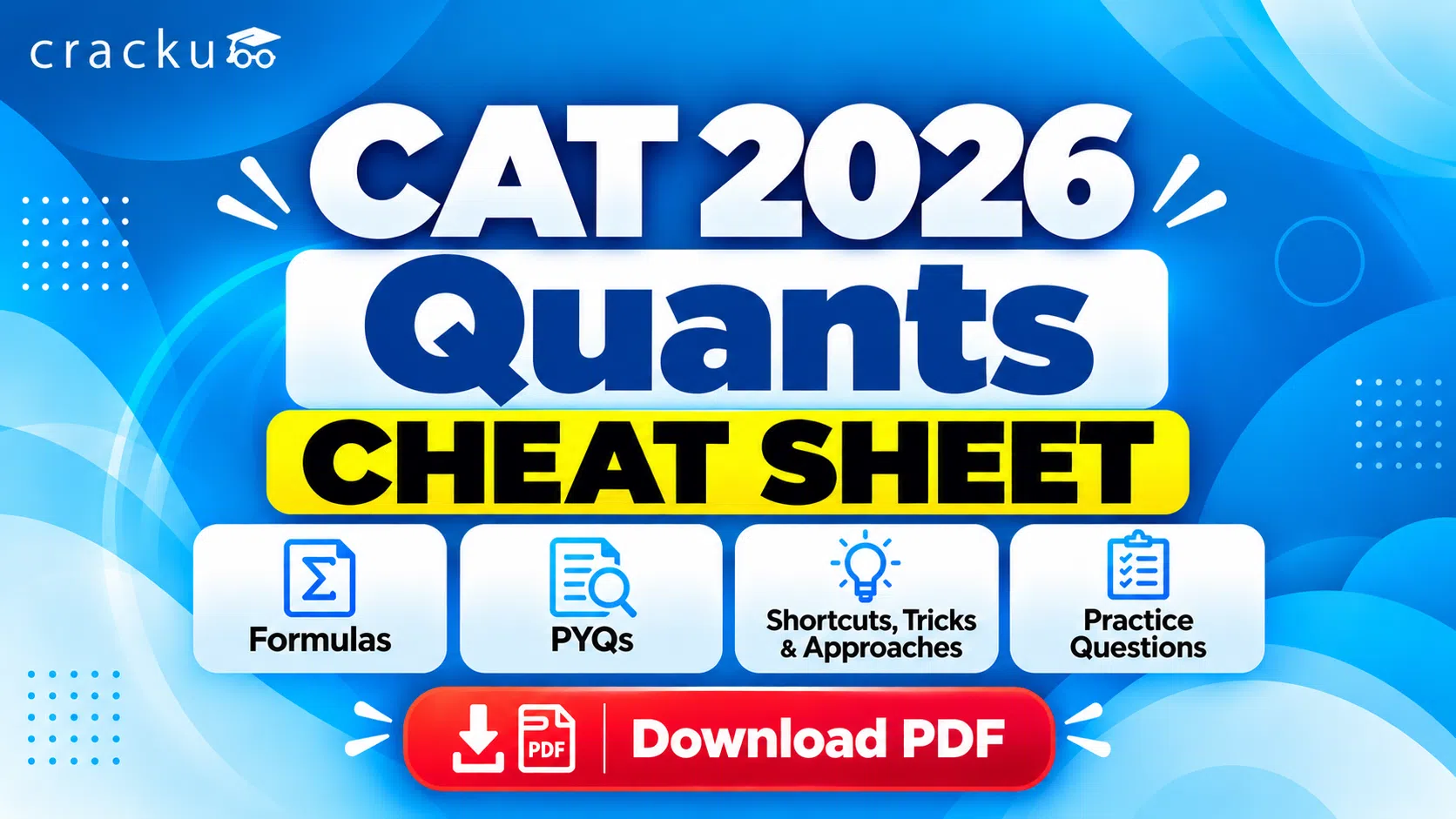
Instead of revisiting lengthy notes every time you revise, the cheat sheet brings together important formulas, concepts, shortcuts and problem-solving approaches from major areas of the CAT syllabus. It can be used alongside regular practice to quickly recall concepts before solving questions, sectional tests or full-length mocks.
CAT Quant Cheat Sheet PDF Download
The CAT Quant Cheat Sheet PDF is designed as a quick-reference resource rather than a replacement for detailed concept learning. Students can use it to revise formulas before practice sessions and identify concepts they repeatedly forget.
Keep the PDF accessible during the early stages of revision. Whenever you get a question wrong because you forgot a formula or property, return to the relevant section of the cheat sheet. Over time, this creates a useful connection between formulas and their actual application.
Students who still need to strengthen their fundamentals should first work through concepts systematically using a CAT Quant Course and then use the cheat sheet for revision.
Important Topics Covered in CAT Quant Cheat Sheet
CAT Quant preparation becomes easier when topics are organised into broader conceptual groups. The cheat sheet covers the major areas that students need to revise for the Quantitative Aptitude section.
Area | Important Topics to Revise |
Arithmetic | Percentages, Profit & Loss, Ratio & Proportion, Averages, Mixtures, Time & Work, Time-Speed-Distance, Simple & Compound Interest |
Algebra | Linear & Quadratic Equations, Inequalities, Functions, Logarithms, Progressions, Polynomials |
Geometry | Triangles, Circles, Quadrilaterals, Polygons, Coordinate Geometry |
Mensuration | Area, Perimeter, Surface Area and Volume |
Number System | Divisibility, Factors, Remainders, HCF & LCM, Units Digits |
Modern Maths | Permutations & Combinations, Probability and Set-Based Concepts |
Students should not assign equal revision time to every topic. Use your performance in CAT Mock Tests to identify the areas where formula recall, concept selection or calculation is slowing you down. Those topics should receive greater attention during revision.
Also Read: CAT 2026 Quant Important Topics: Check Topic-Wise Weightage
CAT Quant Important Formulas for Quick Revision
CAT Formula revision is useful only when you understand the conditions under which a formula can be applied. For example, memorising percentage change formulas is less valuable than recognising when successive percentage changes can replace a longer calculation.
Some of the formula groups worth repeatedly revising include:
- Percentage increase and decrease
- Profit, loss and discount relationships
- Simple and compound interest
- Average and weighted average
- Ratio and proportion
- Time, speed and distance
- Work and efficiency
- Algebraic identities
- Quadratic equations
- Arithmetic and geometric progressions
- Logarithmic properties
- Triangle properties
- Circle theorems
- Area and volume formulas
- Permutations, combinations and probability
An effective revision method is to attempt CAT Previous Year Papers after reviewing a formula group. PYQs reveal whether you can actually recognise where the formula applies when it is hidden inside a CAT-level problem.
Do not aim to memorise the entire sheet in one sitting. Divide formulas into topic clusters and revise them repeatedly through active recall.
Also read: CAT Formula PDF 2026, Topic-wise Quant Formula Sheet
CAT Quant Shortcuts and Approaches to Solve Questions Faster
Shortcuts in CAT Quant should reduce unnecessary work, not replace conceptual understanding. A shortcut is valuable only when you know why it works and when it can be safely applied.
One useful approach is option-based solving. If the answer choices allow you to substitute values or eliminate impossible options quickly, solving the entire equation may be unnecessary.
Another approach is assuming convenient values. Questions involving ratios, percentages and proportions can sometimes be simplified by choosing a suitable base value such as 100.
Approximation can also save time when answer options are sufficiently far apart. Similarly, identifying symmetry, factorisation patterns or standard algebraic identities can reduce lengthy calculations.
The most important shortcut, however, is question selection. A question that takes four minutes despite correct solving may still be a poor choice during the actual exam. While practising with CAT Sectional Tests, track not only accuracy but also the time spent on individual questions.
Build a personal shortcut list from your own practice. A method that saves you 30 seconds consistently is more useful than memorising dozens of tricks that you struggle to recall under pressure.
Also Read: CAT Quant Study Material 2026, Important PYQs, Formula PDF
How to Use CAT Quant Cheat Sheet for CAT 2026?
The CAT Quant Cheat Sheet works best when it becomes part of a revision cycle rather than something you read passively.
Start by revising one topic from the sheet for around 10 to 15 minutes. Immediately follow it with a small set of CAT Quant Questions from the same topic. This tests whether you can convert formula recall into actual problem-solving.
When analysing practice, classify your mistakes into three broad categories: concept errors, approach errors and calculation errors. If the issue is conceptual, revisit the topic in detail. If you knew the concept but selected a lengthy approach, study alternative methods. If calculation errors are frequent, focus on accuracy and mental calculation.
During the final phase of preparation, the cheat sheet can be paired with a CAT Crash Course or structured revision schedule. At this stage, avoid repeatedly studying topics you already know well. Spend more time on weak but improvable areas.
A simple revision cycle can look like this:
In the final week before CAT 2026, use the cheat sheet primarily for rapid recall. Avoid trying to learn several completely new concepts from it. Your objective should be to keep familiar formulas and approaches readily accessible.
Students following a structured CAT 2026 Course can also use the cheat sheet as a bridge between concept classes, practice sessions and mocks rather than treating it as an independent preparation resource.
Also Read: CAT Probability Cheat Sheet 2026 Formula, PYQ Download PDF
CAT Quant Cheat Sheet 2026: Conclusion
The CAT Quant Cheat Sheet 2026 can make revision faster by bringing important formulas, concepts, shortcuts and approaches into one compact resource. Its real value, however, depends on how you use it. Simply reading formulas repeatedly will not automatically improve your Quant score.
Combine the cheat sheet with topic-wise practice, CAT study material, previous year questions and timed mocks. Every time you make a mistake, identify whether the problem came from concept recall, approach selection, calculation or time management. Use that information to decide what you should revise next.
As CAT approaches, your notes should ideally become shorter rather than longer. A compact cheat sheet containing concepts you can quickly recall and apply is far more useful during final revision than hundreds of pages of notes you no longer have time to revisit.

























































![Top CAT Quant Logarithms Questions [Download PDF]](/media/cache/e7/2a/e72ae927072fbaa76b2febbd50c0f61c.webp "Top CAT Quant Logarithms Questions [Download PDF]")