91- 6303239042
 CAT WhatsApp Group


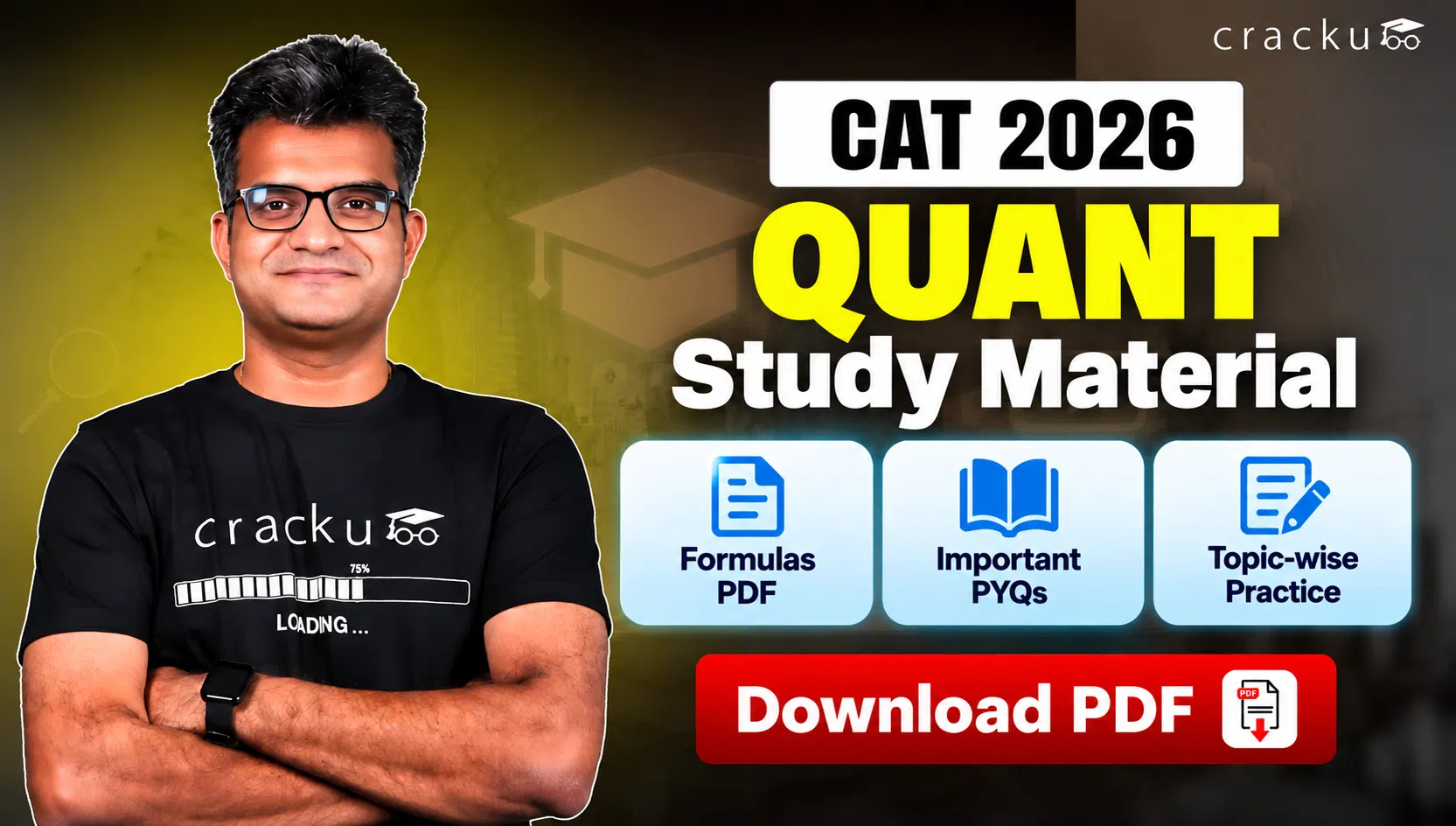
CAT Quant Study Material 2026
Too many formulas to remember, plus the pressure of attempting 16 to 18 quant questions in 40 min in the CAT exam. Feels like topper things. The first and foremost approach is to build one reliable resource set and use it repeatedly. CAT quant study material should help you understand concepts, practise different question types, revise formulas, and identify weak areas before the exam.
For CAT 2026, your preparation should gradually move from learning concepts to solving questions under time pressure. A combination of topic-wise questions, previous year questions, formula sheets, and sectional tests can make that transition smoother. The right material can also help you maintain a CAT daily target without spending hours deciding what to study next.
CAT Quant Formulas and Shortcuts for Quick Revision
Formulas become useful when they help you solve questions faster. Memorising a long list without knowing where to apply each formula will not add much value to your CAT preparation.
Your revision material should cover the important areas included in the CAT quant syllabus PDF, such as Arithmetic, Algebra, Geometry, Number System, and Modern Mathematics. Keep the CAT Formulas organised topic-wise so you can revise them without opening several different resources.
Quant topic | Important areas to revise | What to keep handy |
Percentages, Profit & Loss, Ratios, Averages, Time & Work | Core formulas and shortcuts | |
Equations, Inequalities, Functions, Progressions | Identities and standard results | |
Triangles, Circles, Quadrilaterals, Mensuration | Theorems and area formulas | |
Divisibility, Remainders, Factors, HCF-LCM | Rules and properties | |
Modern Maths | Set Theory, Probability, Permutation & Combination | Standard formulas |
Do not treat formulas as a separate task from practice. After revising a formula, solve two or three questions where you need to apply it. That small habit makes formula revision more useful and easier to remember.
CAT Quant Topic-Wise Practice Questions and Solutions
Concepts become reliable only after you use them across different question types. This is where topic-wise practice becomes important in your CAT study material.
Start with questions that test basic application. Gradually move towards questions that combine multiple concepts or require a shortcut.
A simple practice cycle can look like this:
- Revise one concept before starting the questions.
- Solve a small set without checking the solution.
- Mark questions where you needed excessive time.
- Check the solution only after completing your attempt.
- Write down the reason behind every incorrect answer.
- Reattempt difficult questions after a gap of two or three days.
Your error log should not only contain the correct answer. Write whether the mistake happened because of a concept gap, calculation error, incorrect interpretation, or poor question selection.
For example, if you repeatedly spend four minutes on a particular Arithmetic question, the problem may not be the formula. You may need to improve your approach to identifying the right starting point.
That distinction can save valuable preparation time before CAT 2026.
CAT Quant Cheat Sheet PDF for Last-Minute Revision
A CAT quant cheat sheet works best when it is short enough to revise regularly. It should not become another 50-page document that you keep postponing.
Create a compact revision sheet with:
- Important Arithmetic formulas
- Algebraic identities
- Geometry properties
- Number System rules
- Common fraction-to-percentage conversions
- Frequently used calculation shortcuts
- Important approximation methods
- Mistakes repeatedly made during practice
Keep separate notes for formulas or concepts that you personally forget.
You can also use a CAT quant formula sheet PDF for quick revision before sectional tests. However, avoid downloading several versions and switching between them every few days. If a formula does not help you solve questions, remove it from the final revision sheet.
CAT Quant Sectional Tests for Exam Practice
Once you have covered the basic concepts, sectional tests should become a regular part of preparation. CAT quant sectional tests help you understand how well you can convert your knowledge into marks under a time limit.
A useful sectional test routine can include:
Stage | Focus | What to check |
Before test | Formula revision | Important concepts and shortcuts |
During test | Question selection | Time spent on each question |
After test | Analysis | Correct, incorrect and unattempted questions |
Next practice | Weak areas | Questions based on recurring mistakes |
- Do not judge a section only by the score. A lower score can still reveal where the growth has to happen, as you do the analysis is detailed.
- Check which questions consumed the most time. Then identify whether you should have solved them differently or skipped them earlier.
- You can also include CAT quant sectional mock tests after completing individual topics. This creates a gradual shift from chapter-level practice to exam-level thinking.
- If you are attending CAT live classes, then make separate time for problem practice
- Revise the concept taught in class, solve related questions, and then test yourself.
CAT Quant PYQs: Previous Year Questions with Solutions
Previous year questions show how concepts have actually appeared in CAT. They should therefore have a fixed place in your preparation rather than being saved for the final week.
CAT quant previous year questions can help you identify recurring concepts, understand the difficulty level, and improve your approach to question selection.
While solving CAT PYQs, do not immediately look at the solution when a question appears unfamiliar.
Follow this process:
- Read the question carefully.
- Identify the topic and information provided.
- Decide whether you know a workable approach.
- Attempt the question within a reasonable time.
- Compare your method with the official or reliable solution.
- Note a shorter approach if one exists.
- Reattempt the question later without looking at the solution.
PYQs are particularly useful during the final phase because they combine concept knowledge with CAT-style wording.
However, avoid memorising solutions. The objective is to recognise the underlying concept when a different question tests it.
How to Use CAT Quant Study Material for CAT 2026 Preparation?
The biggest mistake is collecting resources without creating a system around them. Your preparation material should answer three questions: What should I study? What should I practise? What should I revise?
A simple weekly structure can keep the process manageable.
Build a topic-wise preparation cycle
Choose one or two related topics and complete the cycle of concept learning, practice, analysis, and revision. Do not move ahead simply because you have finished watching a lecture.
You should be able to solve basic and moderate questions before considering the topic ready for mixed practice.
Set a realistic CAT daily target
Your CAT daily target should include more than a question count. Add a specific combination of concept revision, practice questions, and analysis.
For example:
- Concept revision
- Topic-wise practice
- Error-log revision
- Timed question set
- Previous year questions
- Short formula revision
On a busy day, reduce the volume instead of abandoning the routine completely. Consistency matters more than creating an unrealistic schedule for two days.
Keep one formula handbook
A CAT quant formula handbook can become your single revision source. Add formulas gradually instead of trying to memorise everything at once.
Mark formulas that you repeatedly forget. Those deserve more revision than formulas you already use comfortably.
Use tests to change your strategy
Your mock and sectional performance should influence what you study next. If Arithmetic accuracy is strong but Algebra takes excessive time, your preparation should reflect that difference.
Do not spend equal time on every topic simply because the syllabus contains them all.
Revise before increasing difficulty
If your accuracy remains low, jumping directly to difficult questions may create frustration without solving the underlying problem.
Return to the concept, solve a few standard questions, and then increase the difficulty.
CAT preparation is not a race to finish the maximum number of resources. It is a process of making your solving approach more accurate, faster, and more dependable.
Build your final revision stack
By the final weeks, your resources should become smaller, not larger. Keep your formula sheet, error log, selected PYQs, and sectional-test analysis easily accessible.
Your final preparation should feel like sharpening a tool rather than collecting another one.
CAT Quant Study Material 2026: Conclusion
The right CAT quant study material can support every stage of preparation, from learning a new concept to making the final revision before CAT 2026. Use topic-wise questions to build accuracy, PYQs to understand the exam's question style, formulas for quick revision, and sectional tests to develop time management.
Most importantly, keep checking whether your material is improving your performance. If a resource is taking time without helping you solve questions better, replace the resource rather than simply adding another one. Your preparation becomes stronger when every hour has a clear purpose.