91- 6303239042
 CAT WhatsApp Group


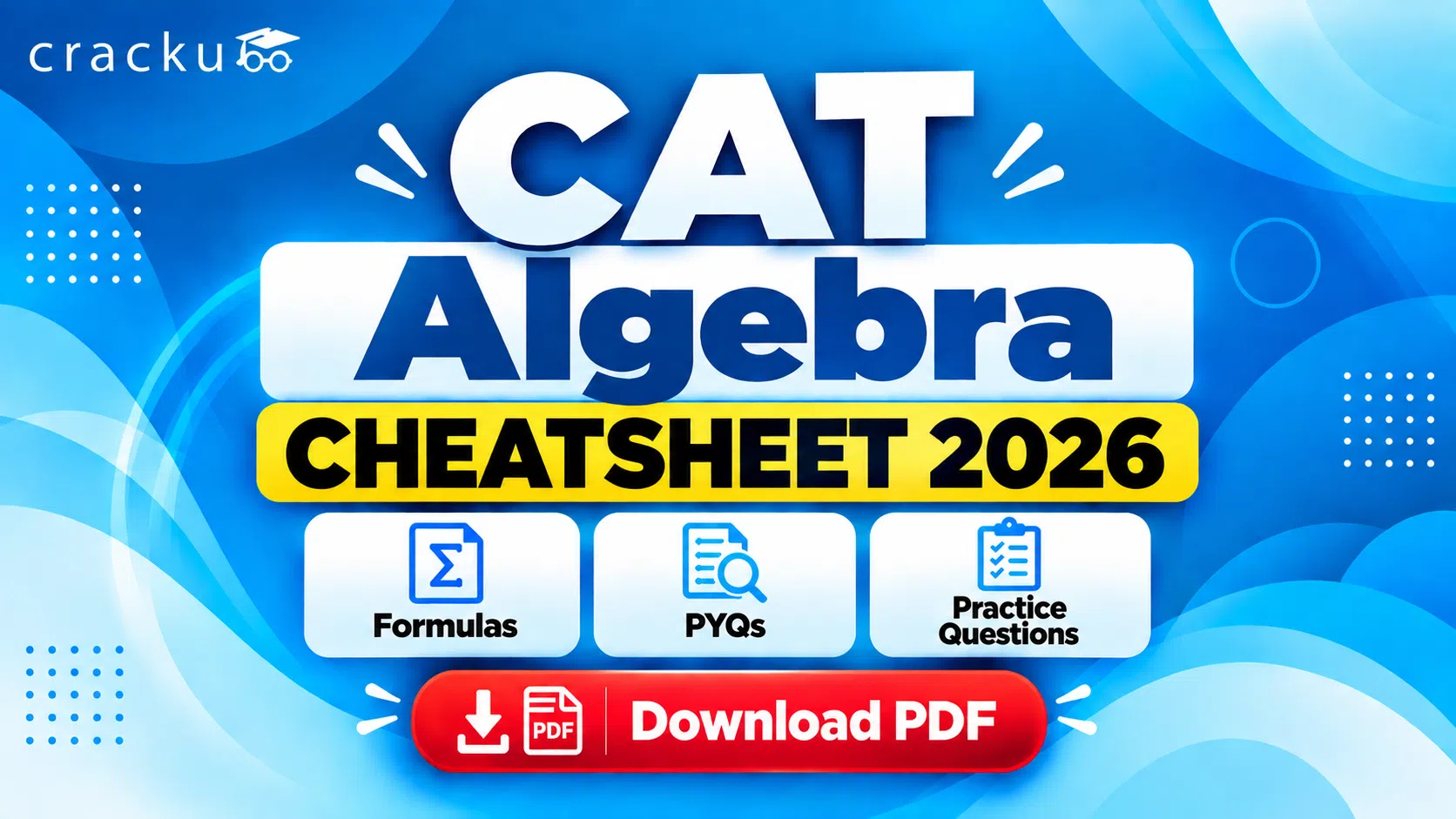
CAT Algebra Cheat Sheet 2026
Algebra is one of the core areas of CAT Quantitative Aptitude, but preparing for it is not simply about memorising dozens of identities. CAT questions often disguise standard algebraic concepts inside equations, constraints, graphs and word problems. The real skill is recognising the underlying structure and choosing the shortest valid approach.
The CAT Algebra Cheat Sheet 2026 brings together formulas, identities, concepts and CAT-focused shortcuts across equations, inequalities, functions, logarithms, sequences, polynomials and optimisation.
Use this sheet as a revision companion after learning the concepts and while practising CAT-level questions.
Download CAT Algebra Cheat Sheet PDF
A CAT Algebra Cheat Sheet PDF gives you a compact revision resource instead of requiring you to revisit complete notes before every practice session or mock.
The provided cheat sheet covers a broad Algebra revision map including algebraic identities, linear and quadratic equations, inequalities, modulus, polynomials, functions, logarithms, exponents, surds, AP-GP, standard summations, optimisation, floor functions and number of roots.
Keep the PDF handy while solving CAT Algebra Questions. When you get a question wrong, return to the corresponding concept on the sheet and identify whether the error came from the formula, its conditions or the approach used.
CAT Algebra Important Topics for CAT 2026
The CAT syllabus does not require aspirants to treat every Algebra concept independently. Many CAT questions combine two or more concepts, such as quadratics with inequalities or functions with graphs.
Based on the coverage of this cheat sheet, your Algebra revision should include:
Area | Important Topics to Revise |
Equations | Linear equations, quadratics, transformed roots |
Inequalities | Linear, polynomial and rational inequalities |
Modulus | Absolute-value equations and inequalities |
Polynomials | Remainder theorem, factor theorem, roots |
Functions | Domain, range, inverse and composition |
Graphs | Standard graphs and graph transformations |
Logarithms | Log laws, equations and inequalities |
Exponents & Surds | Exponent laws, rationalisation |
Sequences | AP, GP, HP and means |
Series | Standard sums and telescoping series |
Optimisation | AM-GM, maximum-minimum problems |
Special Concepts | Floor function, fractional part, number of roots |
The final revision checklist in the cheat sheet similarly groups preparation around equations, inequalities, polynomials, functions, logs, sequences, optimisation and special functions.
Also Read, CAT Algebra PYQs with Video Solutions & Formulas PDF
Important CAT Algebra Formulas for Quick Revision
Some formulas deserve especially frequent revision because they can reduce multi-step calculations to a few substitutions.
For a quadratic equation of the form ax² + bx + c = 0:
x=-bb2-4ac2a
If its roots are α and β:
+=-ba
=ca
The discriminant D=b2-4ac also immediately indicates whether there are two distinct real roots, equal real roots or no real roots.
For sequences:
Tn=a+(n-1)d
Sn=n2[2a+(n-1)d]
For a GP:
Tn=arn-1
S=a1-r,|r|<1
The condition on the infinite GP is important. Applying a familiar formula without checking its validity is exactly the type of mistake a cheat sheet should help prevent.
Students taking CAT Mock Tests should mark formulas they repeatedly fail to recall and revise those more frequently instead of rereading the entire formula sheet every time.
Also Read, CAT Algebra Marathon Questions 2026 PDF with Video Solutions
Best Shortcuts and Approaches for CAT Algebra
The best Algebra shortcuts are usually transformations that prevent unnecessary calculation.
Suppose a question gives:
x+y=S,xy=P
Instead of individually calculating x and y, use:
x2+y2=S2-2P
x3+y3=S3-3PS
(x-y)2=S2-4P
The cheat sheet specifically recommends rewriting the required expression in terms of S and P rather than solving separately for x and y unless required.
Another useful pattern is recognising equations that are actually quadratics in disguise.
For example,
x4-5x2+4=0
can be simplified by taking t=x2.
A good CAT Quant Course should help you develop this recognition ability rather than treating Algebra as a collection of isolated formulas.
Common CAT Algebra Mistakes to Avoid
Knowing a formula is only half the job. CAT Algebra frequently rewards students who pay attention to restrictions.
Common mistakes include:
- accepting extraneous roots after squaring;
- including values that make a denominator zero;
- forgetting that the argument of a logarithm must be positive;
- ignoring domain restrictions involving square roots;
- failing to reverse an inequality after multiplying or dividing by a negative number;
- using the infinite GP formula when |r|1;
- dividing by a variable and accidentally losing the zero solution.
These are also highlighted as common CAT Algebra traps in the supplied cheat sheet.
Use CAT Sectional Tests to identify which of these mistakes occurs repeatedly in timed conditions.
How to Use the CAT Algebra Cheat Sheet for Preparation
Do not try to memorise the entire sheet in one sitting.
First, learn the underlying concepts through your regular preparation. Next, solve topic-wise questions without referring to the sheet. Use the cheat sheet only when reviewing errors or revising previously studied chapters.
A useful revision cycle is:
Learn concept → Solve questions → Analyse errors → Revise formula/approach → Reattempt
As CAT approaches, reduce the interval between revisions. You can also annotate your personal copy with formulas or conditions that you repeatedly forget.
Students following a CAT 2026 Course can use the cheat sheet after completing each corresponding Algebra chapter. During the final preparation phase, combine it with PYQs and timed mixed-Quant practice rather than repeatedly solving only chapter-wise exercises.
CAT Algebra Cheat Sheet 2026: Conclusion
The CAT Algebra Cheat Sheet 2026 is most effective as a quick-revision and problem-recognition tool. Its purpose is not to replace conceptual learning, but to help you recall identities, formulas, restrictions and high-value approaches quickly.
If you are preparing through a CAT Crash Course, prioritise the concepts you already understand and use the sheet to strengthen recall before mocks. More importantly, maintain a record of formulas you forget and traps you repeatedly fall into. Algebra becomes significantly easier when you stop viewing every question as new and begin recognising the familiar structure underneath it.