91- 6303239042
 CAT WhatsApp Group


 Preferred Source

 Google Discover
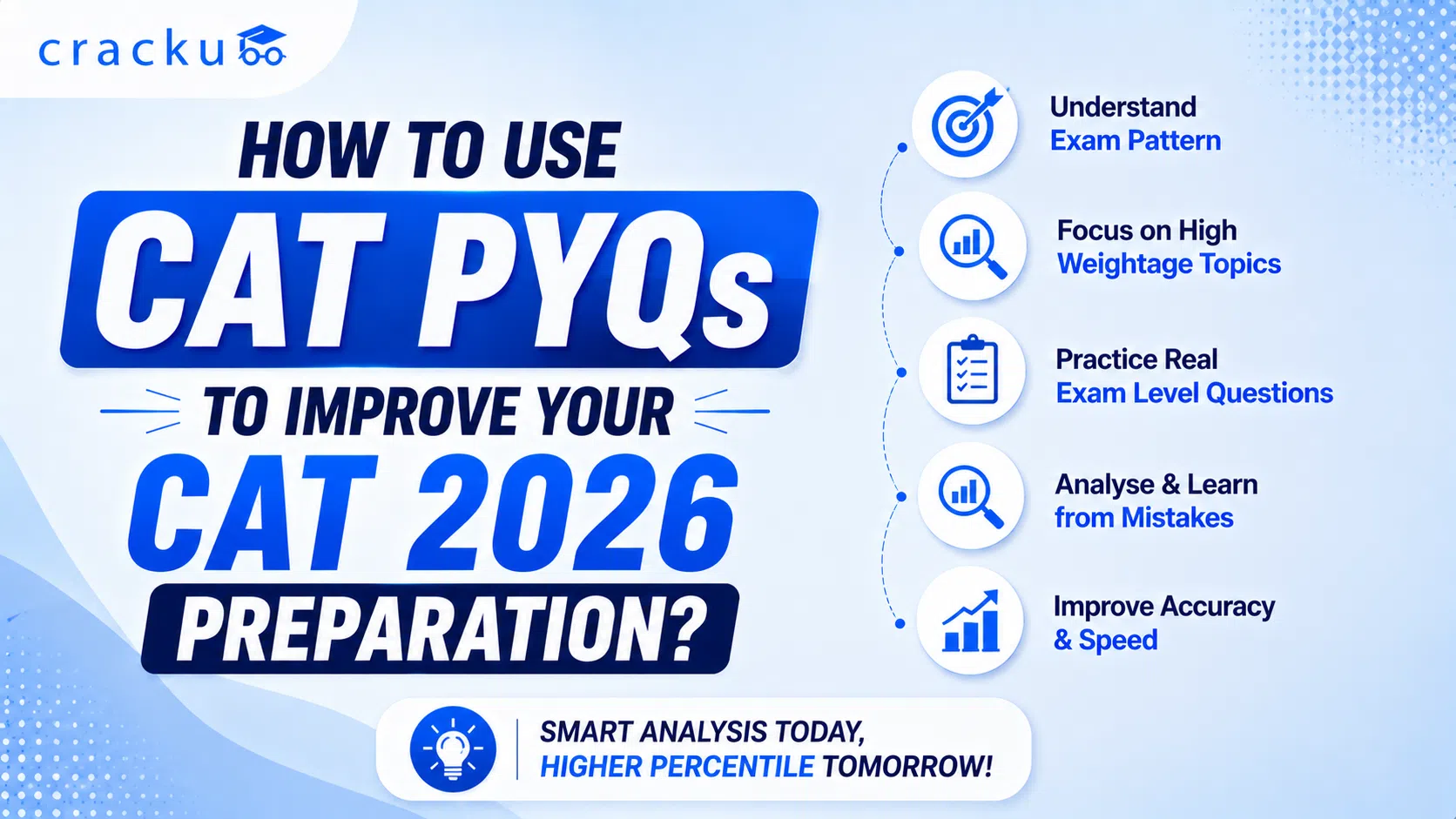
How to use CAT PYQs for CAT 2026 Preparation
CAT previous year question papers, or PYQs, are a major source of help for those who are preparing for the forthcoming CAT Examination, i.e., CAT 2026. Apart from enabling the candidates to learn about the types of questions to identify important topics, the previous year papers also help an applicant to figure out whether they have got a firm grip over all the concepts as per the examination level of difficulty. They also help a candidate to test the preparation and get a hang of time, accuracy, and choosing the right questions. But merely solving the previous CAT question papers will not be the right method; a candidate must figure out where s/he went wrong and should work on it to strengthen weak areas. The CAT PYQ article is aimed at explaining to candidates how effectively they can make use of the CAT PYQs for preparing for CAT 2026 and how they can make it a part of their study plan to give the maximum results.
Why CAT PYQs Are Important for CAT 2026 Preparation
CAT previous year question papers are very resourceful as they give candidates a realistic idea of the kinds of questions one can expect in the real exam. The points mentioned below are justifiable reasons for integrating CAT PYQs in preparation for CAT 2026:
Benefit of Solving CAT PYQs | How It Helps |
Understand the CAT Exam Pattern | Familiarizes candidates with the section-wise structure, question types, and distribution across VARC, DILR, and QA. |
Identify Important Topics | Helps recognize frequently tested topics and recurring question patterns by analysing multiple years' papers. |
Improve Time Management | Develops the ability to allocate time efficiently across sections and complete the paper within the exam duration. |
Practice Actual CAT Questions | Provides exposure to authentic CAT questions, helping candidates understand the exam's style and expectations. |
Identify Strengths and Weaknesses | Evaluating performance after each paper helps pinpoint strong areas and topics that require additional practice. |
Enhance Speed and Accuracy | Regular PYQ practice improves calculation speed, problem-solving efficiency, and answer accuracy. |
Understand the Difficulty Level | Gives a realistic understanding of the CAT exam's difficulty level and prepares candidates for varying question complexities. |
Build Exam Readiness | Solving full-length CAT papers in exam-like conditions improves concentration, decision-making, confidence, and overall test-taking ability. |
How to Solve CAT PYQs Effectively?
To benefit from solving CAT previous years' question papers (PYQ) the best way is to solve the papers and then analyse them as well. Here is one example of how this can be done:
Step | What to Do | Benefit |
Start Topic-Wise | Begin by solving PYQs from topics you are already comfortable with before moving to weaker areas. | Strengthens concepts and builds confidence. |
Attempt Complete CAT Papers | Once most of the syllabus is covered, solve full CAT previous year papers in a timed, exam-like environment. | Improves exam temperament, time management, and stamina. |
Analyse Every Attempt | Review every incorrect and skipped question to identify conceptual gaps and recurring mistakes. | Helps improve accuracy and prevents repeated errors. |
Track Speed and Accuracy | Monitor the time taken and accuracy after each paper to measure your progress. | Enables you to optimize your solving strategy and boost performance. |
Revise Weak Topics Regularly | Revisit topics where you struggled before attempting similar questions again. | Strengthens weak areas and improves overall preparation. |
Practice PYQs from Different Years | Solve CAT question papers from multiple years to experience different question patterns and difficulty levels. | Increases adaptability to changing exam trends. |
Combine PYQs with Mock Tests | Use PYQs along with regular mock tests and daily practice instead of relying on them alone. | Ensures comprehensive preparation and better exam readiness. |
Best Time to Start Solving CAT Previous-Year Papers
There is no fixed and definitive time to begin doing CAT question banks from previous years. The timing mainly depends on the level of preparedness of a candidate. Candidates can work on PYQs topic-wise after finishing the individual related concepts at the initial stages. Once they have covered the bulk of the syllabus, their focus should switch to attempting all past year CAT questions with a watch to check how much time they are taking. During the last few months before CAT 2026, the PYQs can accompany the mocks to not only assess the results, but also perfect the management of the time and the consolidation of the areas that are weak.
How to Analyse CAT PYQs After Solving Them
Analysis of CAT PYQs is just as important as solving them. Once a candidate completes his/her paper, he/she must analyse their performance rather than getting preoccupied with their score alone.
Analysis Step | What to Do | Why It Matters |
Review Incorrect Answers | Identify why each answer was incorrect and revise the related concept if needed. | Helps eliminate conceptual gaps and prevents repeating the same mistakes. |
Check Unattempted Questions | Revisit skipped questions to determine whether they were genuinely difficult or simply overlooked. | Improves question selection and builds confidence in attempting more questions. |
Identify Weak Areas | Note the topics and question types where mistakes occur frequently. | Enables focused preparation on weaker sections before the next mock or PYQ. |
Analyse Time Spent | Review the time taken for each question and look for faster solving approaches. | Improves speed, efficiency, and overall time management during the CAT exam. |
Track Accuracy | Compare the number of correct and incorrect attempts across sections. | Helps assess whether your question selection strategy is effective. |
Maintain an Error Log | Record recurring mistakes, difficult concepts, and key learnings after every PYQ session. | Creates a personalized revision resource and reduces repeated errors over time. |
Also Read: How to Analyse CAT Mock Test, Check Complete Guide
CAT PYQs vs Mock Tests: What Should You Prioritize?
It is true that both CAT PYQ papers and mock tests are very essential for CAT 2026 aspirants. But they should not be so biased towards one that they ignore the other. Through past question papers, applicants could find out real CAT questions and also learn about the history of the examination. Meanwhile, mock tests could be another way of revision and could also be used by learners as a tool to identify themselves with different ways of testing.
Parameter | CAT PYQs | CAT Mock Tests |
Questions | Actual questions asked in previous CAT exams | Newly designed questions based on the CAT pattern |
Main Purpose | Understanding actual exam trends and question types | Testing preparation and building exam strategy |
Difficulty Level | Reflects the difficulty of past CAT exams | Can vary across different mock test series |
Best Used For | Concept application and understanding past papers | Speed, time management, and question selection |
Analysis | Helps identify performance on actual CAT questions | Helps track progress across multiple tests |
When to Use | Throughout preparation, initially topic-wise and later as full papers | Regularly after covering a significant part of the syllabus |
Common Mistakes While Practicing CAT PYQs
Below are few common mistakes that candidates need to avoid during their preparation for CAT:
- Not Attempting the Full Papers in Time: Solving full papers before developing a foundation will not reflect reality.
- Converted Approach: Remember the way of solving rather than the answer or solution
- Practicing Without a Target: Use PYQs with respect to use case — like topic-wise or sectional or full-length.
- Solving All PYQs Together: You can reserve a few recent papers for the end of your preparation and practice under exam-like conditions.
Also Read: 5 CAT Preparation Mistakes That Can Ruin Your Percentile
How CAT Toppers Use Previous Year Questions
The CAT tops often make use of past year papers more strategically than just attempting as many papers without thinking. They mainly try to work out the concepts behind each question, analyse various methods of solving, and determine which questions to go for or leave for the exam. Some also go back after certain intervals to a selection of PYQs, just to find out whether they can now solve them in less time and higher speed.
How to use CAT PYQs for CAT 2026 Preparation: Conclusion
CAT PYQs for CAT 2026 Preparation are one of the most valuable resources for understanding the real exam pattern and improving performance. They help candidates identify important topics, analyse question trends, improve accuracy, and develop better time management skills across VARC, DILR, and QA sections. However, simply solving CAT previous year question papers is not enough. Candidates should focus on detailed analysis, mistake tracking, and continuous improvement after every attempt. Combining CAT PYQs with mock tests, revision, and concept practice can help aspirants build a strong preparation strategy and move closer to achieving their desired CAT percentile.